Aircraft Galley Equipment Guide
How an aircraft galley is built around standard trolleys and inserts, 115 V 400 Hz power, weight and airworthiness certification, and how that differs from a marine galley.
Read guideAviation
Aircraft galley accessories are the trolleys, standard containers, drawers, trays and waste equipment that carry food, drink and waste between caterer, galley and cabin, built to the ATLAS or KSSU standard and TSO-C175.
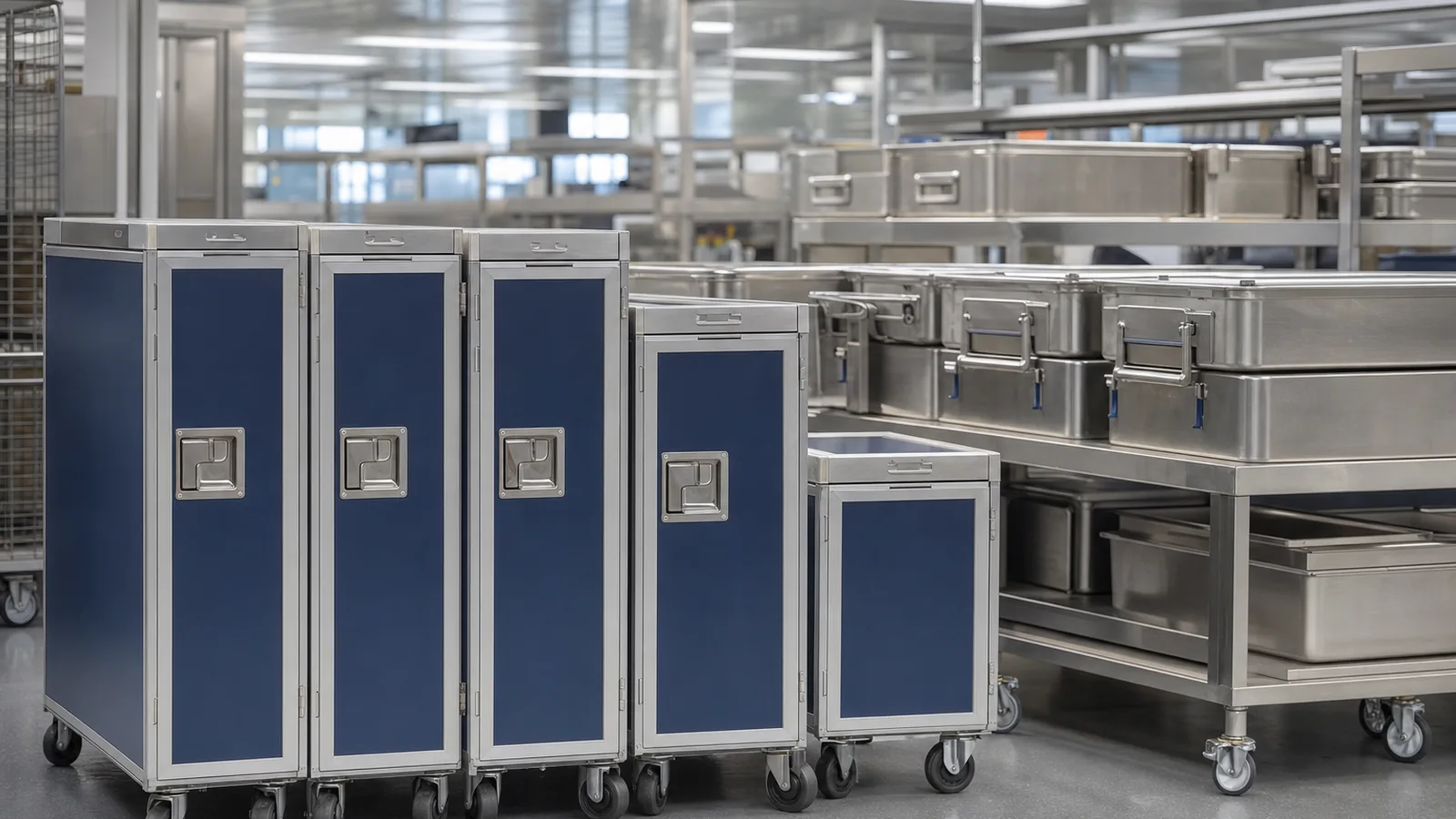
Galley inserts stay in the aircraft. Accessories do not. Trolleys, standard containers, drawers and trays are loaded at the caterer, delivered to the aircraft, emptied in the cabin, returned to the galley with waste and sent back to be washed and loaded again. They are handled more often, by more people and in more places than anything else in the galley, and they have to fit the galley of every aircraft they are loaded into.
Trolleys, also called carts, carry meals, drinks, items for sale and waste. They are built to one of two standards.
ATLAS is the most common standard, used by about 80 % of airlines. It is named after the carriers that originated it: Alitalia, TAP, Lufthansa, Air France and Sabena. A full-size ATLAS trolley is about 0.3 m wide, 1.03 m tall and 0.81 m long and weighs about 15 kg empty. A half-size ATLAS trolley is about 0.405 m long.
KSSU is named after KLM, Swissair, SAS and UTA. KSSU trolleys share the height of about 103 cm and the width of about 30.5 cm, but are deeper: about 42.5 cm for a half size and about 85 cm for a full size.
The dimensions look close, but the difference is decisive. Galley bays are built to one standard, and accessories for ATLAS trolleys do not fit KSSU trolleys and vice versa. Before ordering, the standard of the trolleys already in service, of the galleys they go into and of the caterers who load them has to be confirmed.
Trolleys come in several working configurations: full-size and half-size meal trolleys, trolleys fitted with drawers, trolleys for bar and drink service, and waste trolleys that collect used trays and packaging during service.
Above the trolley bays, galleys have compartments for standard containers, sometimes called standard units. They carry cutlery, cups, dry stores, snacks, bar items and equipment that does not travel in a trolley. Containers are built to the same ATLAS or KSSU standard as the trolleys, so that they fit the galley compartments of aircraft on that standard. Drawers and inserts divide trolleys and containers into smaller compartments for particular items.
Meal trays, tray inserts and the items served on them are sized to the trolley standard, so that a full load of trays fits a trolley without wasted space. Because every tray, cup and container is carried on every sector, weight is part of the specification for each of them, not only for the trolley.
Waste is collected in waste trolleys and standard containers and, in some galleys, compressed by a trash compactor fitted as a galley insert. Waste stowage is part of the certified galley: on aeroplanes with 20 or more passenger seats, 14 CFR 25.853 requires galley structure, including the exposed surfaces of stowed carts and standard containers, to meet heat release and smoke emission tests.
Carts and containers are aviation parts. FAA technical standard order TSO-C175 covers galley carts, containers and associated components and adopts SAE AS8056, Minimum Design and Performance of Airplane Galley In-Flight Carts, Containers, and Associated Components, as its minimum performance standard, with FAA modifications. SAE ARP4171 sets out safety considerations for food and beverage service carts.
Accessories also have to stay put. Under 14 CFR 25.561, items of mass in the cabin must be restrained against emergency landing loads, including 9.0 g forward, which is why trolleys and containers are locked into their stowage by latches and retention devices whenever they are not in use. The wider regulatory picture is on the commercial aircraft galley equipment page.
Accessories are usually ordered as replacement stock, for a fleet change or when a caterer takes over a new airline contract. Include in an enquiry:
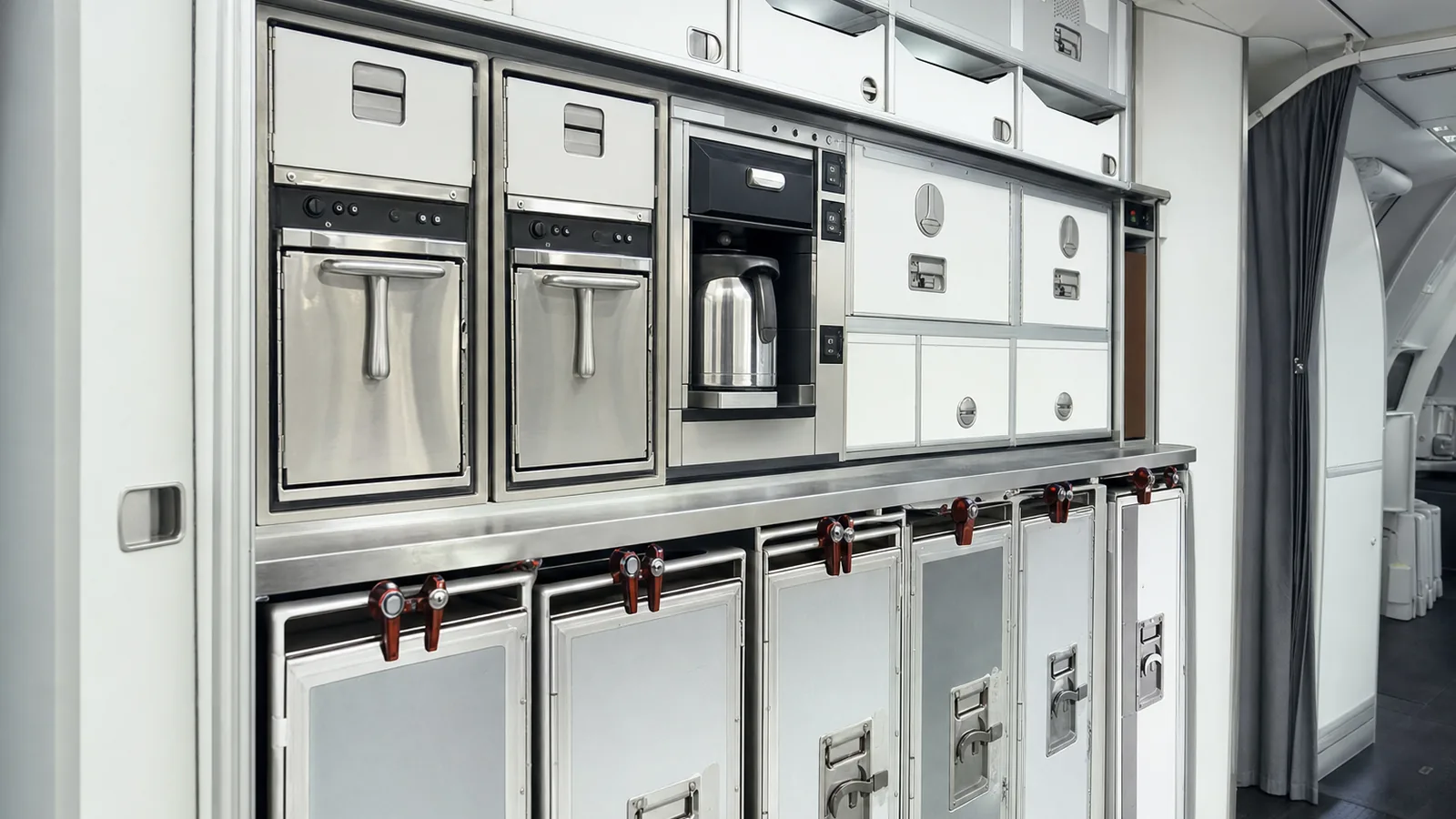
For the powered units in the galley, see aircraft galley components. For the operational picture of loading and service, see airline galley equipment. The aircraft galley equipment list sets out the whole inventory, and the aircraft galley equipment guide explains the standards.
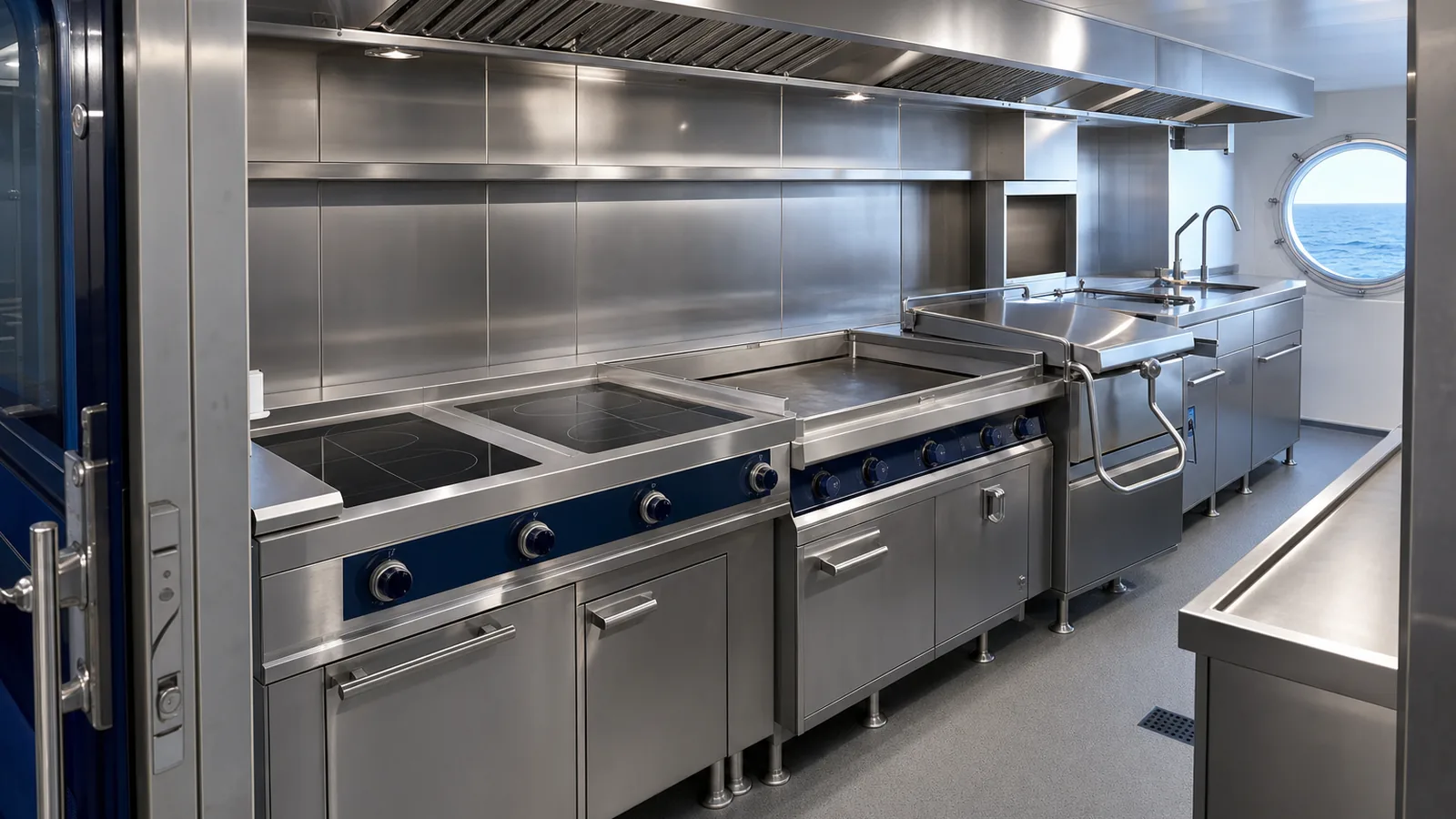
The products in our catalogue are marine galley equipment and are not certified for aircraft use. For ship and yacht galleys, see marine galley equipment.
A full-size ATLAS trolley is about 0.3 m wide, 1.03 m tall and 0.81 m long and weighs about 15 kg empty. A half-size ATLAS trolley is about 0.405 m long.
No. KSSU trolleys have the same height and a similar width but are deeper, about 85 cm full size and 42.5 cm half size, and accessories for one standard do not fit the other.
A standard container, or standard unit, is a box built to the ATLAS or KSSU standard that is stowed in the compartments above the trolley bays and carries cutlery, cups, dry stores, snacks and bar items.
FAA TSO-C175 covers galley carts, containers and associated components and adopts SAE AS8056 as the minimum performance standard. SAE ARP4171 sets out safety considerations for food and beverage service carts.
How an aircraft galley is built around standard trolleys and inserts, 115 V 400 Hz power, weight and airworthiness certification, and how that differs from a marine galley.
Read guideWhat the term covers, how a ship or aircraft galley differs from a shore kitchen, and the equipment groups that make up a working galley.
Read guideThe constraints that actually decide a galley specification — service, power, space, water, heat, motion, materials and compliance — worked through in the order they bite.
Read guideSend us your equipment list, drawing or specification and our team will come back with pricing and lead times.