
Guide
Marine Galley Equipment Guide: What Makes Equipment Marine-Grade
What actually changes when a commercial appliance is built for a ship — supply, fixing, water protection, materials, hygiene construction, refrigerant and certification — and why shore equipment fails at sea.
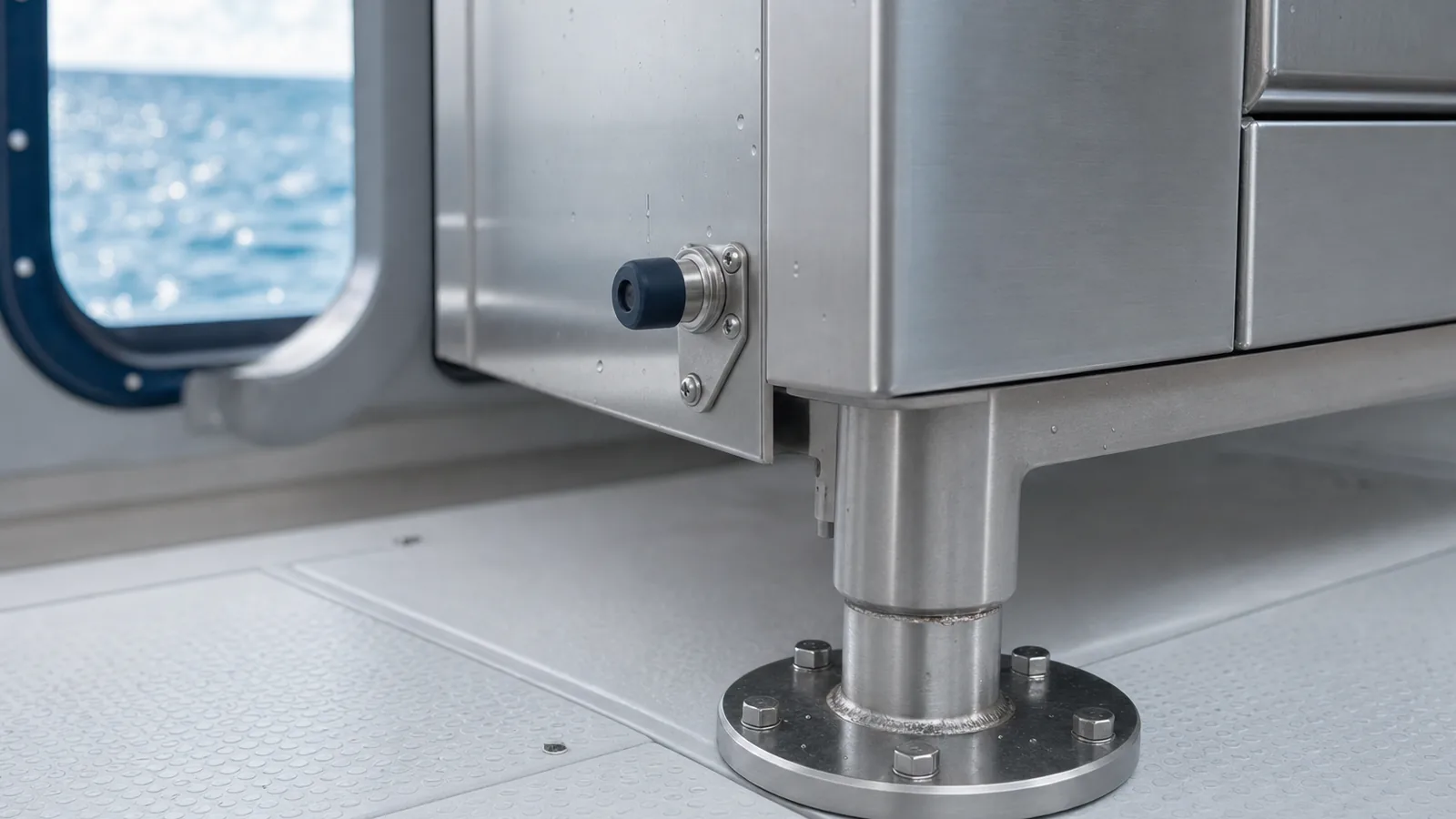
"Marine" on a galley appliance is not a single feature. It is a set of changes to a commercial design, each answering a condition that a shore kitchen never meets: a supply generated on board, a floor that moves, cleaning with water jets, salt in the air, sanitation inspections that look at how the unit meets the deck, and a service engineer who may be several days away.
Some of those changes are visible, such as flanged feet or a stainless plinth. Most are not. They sit on the data plate, in the grade of steel used for the parts that stay wet, and in the construction details a sanitation inspector looks for. This guide goes through them one by one, and ends with what happens when a shore appliance is installed instead.
Supply configuration: built for the ship's switchboard
The most important marine change is the one least visible. A ship generates its own electricity, and its low-voltage system is designed to marine standards rather than to the grid of the country where the equipment was made. IEC 60092-201, the system-design standard for electrical installations in ships, specifies 440 V where the shore standard IEC 60038 specifies 480 V, and 440 V systems are typically rated at 60 Hz. Many vessels run 400 V at 50 Hz instead.
A marine appliance is therefore ordered in the vessel's own voltage and frequency. The alternative, running a 50 Hz appliance on a 60 Hz ship, is not a matter of efficiency. Synchronous speed is proportional to frequency, so the motor turns roughly 20 % faster; with the voltage unchanged the ratio of voltage to frequency falls by about 16.7 %, which under-fluxes the motor, and iron losses rise. Combi oven fans, dishwasher and washer pumps, mixer drives and refrigeration compressors are all motor loads.
That is why a single marine appliance often appears in a catalogue several times: the same machine in 400 V, 440 V and 230 V builds, at 50 Hz, 60 Hz or both. In this catalogue, 107 products are listed at 440 V, and 50 Hz and 60 Hz appear in almost equal numbers.
Fixing against motion
On a ship the appliance has to stay in place, and so do its doors, trays, shelves and pans. The changes are mechanical:
- Flanged feet, bolted to the deck or welded to a stainless plinth, so the appliance becomes part of the structure. MKN describes stable flange connections that make appliances slip-proof and tilt-resistant.
- Door stops, so an oven or cabinet door cannot swing in a roll.
- Secured pull-out rails and insert racks that lock trays in place.
- Cooker guards, storm rails and pan clamps that keep pots on the hob.
MKN lists flanged feet, door stops, secured pull-out rails and cooker guards as its standard marine devices. Other manufacturers describe equivalent features, such as marine feet for stability and shelf safety bars.
Two different requirements drive how a unit is fixed. Stability is about the ship's motion. Sanitation, on vessels inspected under the US Vessel Sanitation Program, is about cleanability: non-portable equipment must be continuously welded to stainless steel pads or plates on the deck, or raised on legs. A good installation satisfies both at once, and a specification should say which the vessel needs.
Water protection: IP ratings for hose-down galleys
Ship galleys are often cleaned with pressure spray guns rather than wiped. The ingress protection rating defined in IEC 60529 tells you what a unit withstands:
- IPX4: splashing water from any direction.
- IPX5: low-pressure jets, 12.5 litres per minute at 30 kPa from a 6.3 mm nozzle.
- IPX6: powerful jets, 100 litres per minute at 100 kPa, for 3 minutes.
- IP25: protection against solid objects of 12.5 mm and above, plus the IPX5 jet test.
Ratings vary by appliance type within the same marine line. Electrolux Professional states IPX6 for pressure-washable thermaline braising and boiling pans, while the thermaline 90 induction top carries IPX5 certification. Across the Electrolux Professional products in this catalogue, 52 are rated IPX6, 109 IPX5 and 17 IP25. The practical rule is to check the rating of each unit against the cleaning method, and not to assume a whole range shares the highest one.
Corrosion: choosing the stainless grade by location
Stainless steel resists corrosion because of a thin passive chromium-oxide film. Chlorides from salt air, seawater, food and cleaning chemicals attack that film, and grade matters.
- Grade 304 (1.4301) contains no molybdenum. Its pitting resistance equivalent number (PREN) is typically 18 to 20.
- Grade 316 contains about 2 to 2.5 % molybdenum, which stabilises the passive film against chloride attack. Its PREN is approximately 24 to 26; 316L (1.4404) is quoted at 23.1 to 28.5.
On marine hardware exposed directly to saltwater, 304 typically pits within one to three seasons, concentrating at crevices, under bolt heads and in splash zones where evaporation concentrates chloride. That is why manufacturers put 316L where water dwells. Electrolux Professional uses 1.4435 (AISI 316L) for cooking wells and 20 mm AISI 316 fry tops, while keeping general worktop sheet in 1.4301 (AISI 304); MKN specifies 1.4404 chrome-nickel steel for marine appliance surfaces.
316L is not immune. Permanent immersion in seawater generally calls for a PREN above 40, which means duplex or superaustenitic grades, not galley stainless.
Hygiene construction: what a sanitation inspector looks for
On passenger vessels calling at US ports, the Vessel Sanitation Program reviews plans, inspects construction and inspects the finished vessel. Its construction guidelines describe details that are designed into marine equipment and its installation:
- Seams: an open juncture between 0.8 mm and 3 mm is a seam; gaps over 3 mm must be closed with profile strips, not sealant.
- Coving: the junction of deck and bulkhead is coved with a radius of at least 9.5 mm; food-contact surfaces form a seamless coved corner with adjacent splash zones.
- Fasteners: on food-contact surfaces and splash zones, low-profile, non-slotted and non-corroding; exposed slotted screws, Phillips screws and pop rivets are prohibited there.
- Sealants: food-grade, certified to ANSI/NSF Standard 51 or equivalent.
- Surfaces: food-contact surfaces at least as cleanable as 100-grit or No. 3 stainless finish.
- Legs and foundations: at least 150 mm of clearance under equipment on legs, or a sealed foundation or coaming at least 100 mm high.
The programme itself does not test, certify or approve equipment. Manufacturers describe marine equipment as engineered to meet USPH standards, which means built so that, installed correctly, it helps the vessel pass. It is not a certificate the machine holds.
Refrigeration: the refrigerant question
Much current self-contained commercial refrigeration, including most of the cabinets in this catalogue, uses R290 (propane). It has a very low global warming potential and has displaced HFCs under F-gas and HFC phase-down policy, but it is classified A3, higher flammability.
Charge limits changed recently. EN IEC 60335-2-89:2022 raised the permitted R290 charge in self-contained commercial refrigerating appliances with a built-in compressor from 150 g to 500 g per circuit, harmonised with the EU Machinery Directive in August 2023. For split systems, more than 150 g is not permitted. Any marine-specific requirement on charge, ventilation or gas detection comes from the class society or flag state, so it is checked for the specific vessel rather than assumed either way.
Laundry at sea
Laundry equipment faces the same conditions as the galley and a few of its own. Marine washer-extractors and dryers are built in the vessel's supply configuration and, in the Miele range, specified and approved for shipboard and offshore use.
The dryer choice is also an installation choice. A vented dryer needs an exhaust duct, which on a ship means a hull or superstructure penetration, a duct run through fire zones and a make-up air path. A heat-pump dryer recirculates its air in a closed loop, condenses the moisture and sends it to a drain, so it needs no exhaust at all. Miele states that its heat-pump dryers use about 50 to 60 % less energy depending on the model.
Certification: what the paperwork does and does not say
Three kinds of documentation come up in marine galley specifications, and they are frequently confused.
- USPH or VSP wording: describes construction intended to let the vessel pass Vessel Sanitation Program inspection. Not a certificate.
- Classification-society type approval: a product-level certification by a society such as Lloyd's Register or DNV, with periodic renewal. DNV states that a type-approved product is accepted for installation on all vessels it classes. It is common for marine electronics, propulsion, navigation and safety systems; some laundry machines carry it, but galley appliances generally do not, and it should never be assumed without the certificate for the specific model.
- EU Marine Equipment Directive (MED): covers listed safety equipment. Galley appliances are generally not MED-listed.
Fire protection for deep-fat cooking equipment is a SOLAS requirement for the installation, under regulation II-2/10.6.4: an extinguishing system, a primary and backup thermostat with an alarm, automatic power shut-off when the system operates, a galley alarm and labelled manual controls.
Why shore equipment fails at sea
Put the pieces together and the common failures of shore equipment installed on a vessel are predictable:
- Motors run at the wrong speed on the ship's frequency, fans and pumps wear early and heating performance drifts.
- Doors swing, trays slide and appliances creep without flanged feet, stops and secured rails.
- Water reaches electrics that were only protected for wiping, not jets.
- 304 stainless pits where salt and cleaning chemicals dwell.
- Construction details fail a sanitation inspection because seams, fasteners or clearances were designed for a shore kitchen.
- Spare parts and service for a model built for another market are not available where the vessel operates.
None of these are visible on the day of installation. They show up months later, at sea.
Where to look next
The marine galley equipment catalogue lists equipment built to these requirements, with separate pages for ships, yachts and offshore units. The manufacturer pages for MKN, Electrolux Professional and Miele describe each range, and the guide to choosing galley equipment turns these requirements into a specification.
Frequently asked questions
What makes galley equipment marine-grade?
A set of changes to a commercial design: a supply configuration matched to the ship, fixing against motion such as flanged feet and door stops, water protection for hose-down cleaning, 316L stainless where water dwells, and construction details that help the vessel pass sanitation inspection.
Can a 50 Hz galley appliance run on a 60 Hz ship?
It will run, but not as designed. The motor turns roughly 20 % faster and, with the voltage unchanged, is under-fluxed while iron losses rise, so fans, pumps and compressors are affected. Marine equipment is ordered in the ship's own frequency.
What IP rating does galley equipment need on a ship?
It depends on how the galley is cleaned. IPX5 withstands low-pressure jets and IPX6 powerful jets of 100 litres per minute. Ratings differ between appliances in the same marine line, so each unit is checked against the cleaning method.
Is 316L stainless steel resistant to seawater?
It resists chloride pitting much better than 304 thanks to about 2 to 2.5 % molybdenum, but it is not immune. Permanent seawater immersion generally calls for a PREN above 40, meaning duplex or superaustenitic grades.
Is marine galley equipment type approved by Lloyd's Register or DNV?
Generally not as a class. Type approval is common for marine electronics and safety systems; some laundry models carry it, but it should only be relied on with the certificate for the specific model.