
Guide
What Equipment Can Be Found in a Galley?
A walk through a working galley, station by station, and the equipment found at each: stores, preparation, the hot line, holding, warewashing and the laundry beside it.
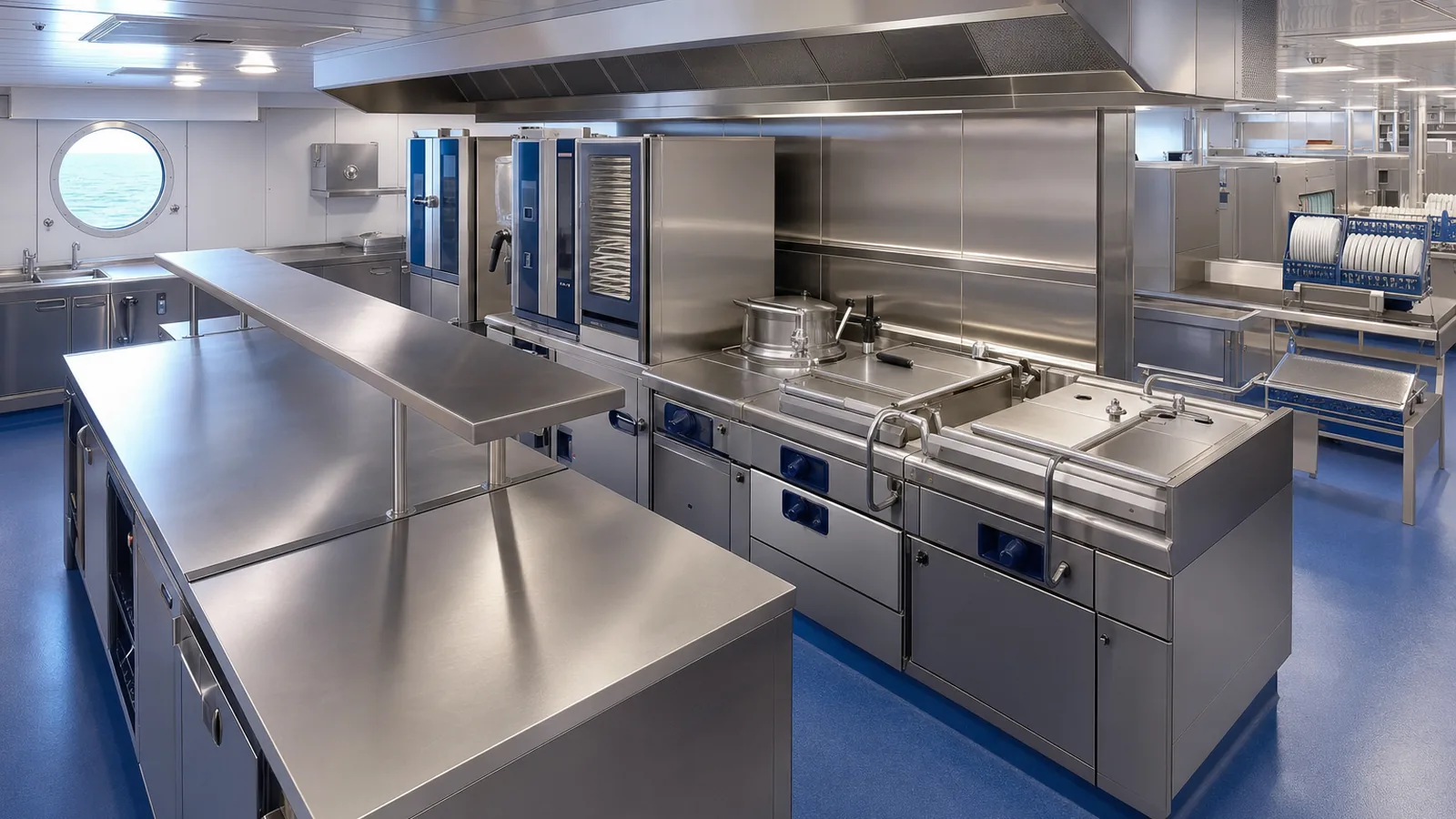
A galley is easiest to understand by following the food through it. Provisions come aboard and go into stores; they are prepared, cooked, held and served; plates, pans and utensils come back to be washed; waste leaves. Each stage has its own station and its own equipment, and on a vessel each station also has to deal with motion, limited water and the ship's electrical supply.
This guide walks through those stations in the order food moves through them. It describes a ship galley, where the full sequence is usually present; a yacht or a small workboat will compress several stations into one, and an aircraft galley works on a different principle altogether, built around trolleys and standard inserts.
Stores and cold storage
Everything starts with storage. Dry stores hold ambient provisions; refrigerated and frozen stores hold everything else. On larger vessels, provisions for a long rotation go into walk-in cold rooms, and the galley itself works from upright refrigerators and freezers close to the preparation area.
Upright marine cabinets differ from shore models in the details. The Electrolux Professional ecostore and Prostore ranges, for example, are listed in one- and two-door builds from 470 to 1430 litres, with refrigerators holding between roughly 0 and +10 °C and freezers between -15 and -22 °C, and with tropicalised construction for high ambient temperatures. Thawing cabinets sit in the same family and take frozen stock back to chill temperature under control rather than on a bench.
Refrigerant is part of the specification. Many current self-contained cabinets, including most in this catalogue, use R290, a natural refrigerant with very low global warming potential but classified A3, higher flammability. Under EN IEC 60335-2-89:2022 the permitted charge in a self-contained commercial appliance with a built-in compressor rose from 150 g to 500 g per circuit; split systems remain limited to 150 g.
See refrigerators, freezers and refrigeration equipment.
Preparation
Preparation is the quiet station and the one most often undersized. It needs flat stainless surface at the right height, somewhere to put what has been prepared, and machines for the repetitive bulk work.
Work tables
Work tables in a modular galley are built to the same series and depth as the cooking line they stand beside, so that pans and containers move across one plane. The German standard DIN 18860 covers commercial kitchen working tables; manufacturers cite part 2 for base and worktop geometry. Electrolux Professional specification sheets, for example, describe units built to DIN 18860-2 with a 20 mm drop-nose top, a 70 mm recessed plinth and a 2 mm worktop in 1.4301 (AISI 304) stainless.
Preparation machines
Planetary mixers, vegetable peelers and dough rollers take bulk work off the galley team. A vegetable peeler listed at up to 160 kg per hour, for instance, turns a sack of potatoes into a short batch job. These are motor-driven machines, so their rated supply frequency has to match the ship.
See work tables and food preparation equipment.
The hot line
The hot line is where most of the connected load and most of the heat in the galley sit. In a modular galley it is built as a run of modules of the same depth, typically 700 mm or 850 mm in the MKN Optima lines, standing on neutral bases or plinths.
Surface cooking
Induction tables and tops, solid-top and boiling-top ranges, griddle plates and fry tops do the à la minute work. Induction puts the heat into the pan rather than the surrounding air; griddles and fry tops come in smooth and ribbed plates for different products. See induction cookers and grills and griddles.
Deep fat fryers
Fryers are the one galley appliance with their own fire rules on ships. SOLAS chapter II-2, regulation 10.6.4, requires deep-fat cooking equipment to be fitted with an automatic or manual extinguishing system, a primary and a backup thermostat with an alarm, automatic shut-off of electrical power when the extinguishing system operates, an alarm in the galley indicating that it has operated, and clearly labelled controls for manual operation. The regulation refers to ISO 15371 for these systems. See deep fat fryers.
Volume cooking
Soups, stocks, sauces and braised dishes for a crew or a passenger service are made in bulk. Boiling kettles, electric or steam-heated and often tilting, run from tens of litres to 500 litres in the MKN Optima 850 range. Bratt pans sear, braise and shallow-fry in a large open pan, and multifunctional appliances such as the MKN FlexiChef combine several of those functions in one body. See boiling kettles and bratt pans.
Combi ovens
Combi ovens and combi steamers roast, bake and steam in the same cavity and are the most flexible single appliance in most galleys. They are sized in gastronorm levels, typically from 6 to 20 levels, and some are built with a steam generator while others inject steam directly without a boiler. A manufacturer's meals-per-day figure, where given, is the most useful starting point for sizing: MKN, for example, quotes 30 to 160 meals per day on GN 1/1 for one twin FlexiCombi. See combi ovens.
Holding and service
Food that is cooked ahead has to be kept hot or cold until it is served. Bain-maries hold prepared food in gastronorm containers at service temperature, and heated holding positions sit between the hot line and the servery or mess.
Temperatures are not a matter of taste. The US Public Health Vessel Sanitation Program operations manual requires potentially hazardous food to be held at 57 °C or above, or at 5 °C or below. See bain-maries.
Warewashing
Everything that leaves the galley comes back to the scullery. The equipment scales with the service:
- Undercounter dishwashers and glasswashers for pantries, bars and small galleys.
- Hood-type dishwashers for medium loads, where a loaded rack goes in and a hood is lowered over it for the cycle.
- Rack-conveyor dishwashers for high volumes, sometimes extended with pre-wash and drying zone modules; the Electrolux Professional green&clean rack machines are listed at 150 to 200 racks per hour.
Two things decide the scullery on a ship. The first is water: typical rack-conveyor machines use up to about 1.2 US gallons per rack and the most water-saving designs as little as 0.54, and across thousands of racks a day that difference shows up in tank capacity and watermaker running time. The second, on passenger ships, is sanitation: under the VSP, hot-water sanitising rinse entering the manifold must not exceed 90 °C and must reach at least 82 °C for most machine types, and warewashers need an audible or visual alarm when the sanitising temperature or chemical concentration falls below the values on the data plate. See dishwashing equipment.
Extraction and ventilation
Every appliance on the hot line releases heat and moisture into the galley, and fryers and griddles add grease. Extraction canopies, grease filters and supply air remove it. On a vessel this is part of the ship's HVAC design, and it depends on the figures the equipment manufacturer publishes. MKN, for instance, lists latent and sensible heat emission in watts for many appliances: one 92-litre tilting bratt pan is listed at 4200 W latent and 6000 W sensible heat.
Extraction and ventilation are normally designed and supplied with the ship's HVAC package rather than with the appliances, but the appliance data has to reach the HVAC designer early.
Drainage and waste
Galley drainage is easy to overlook and hard to change later. Under VSP construction guidelines, equipment drains connect to the waste system through an air gap or air-break that can be inspected and cleaned, and food service and warewash areas need deck drainage so that water does not pool.
Wastewater leaving the galley is greywater. It is not directly regulated by MARPOL Annex IV, which covers sewage, although coastal states increasingly legislate beyond MARPOL, so the volume the galley and scullery produce matters for holding capacity.
The laundry beside the galley
On ships, offshore units and larger yachts, the laundry is often specified and ordered with the galley. It follows the same logic of stations:
- Washer-extractors, sized by load in kilograms; marine Miele machines run from 6 kg to 35 kg.
- Tumble dryers, either air-vented or heat-pump. A heat-pump dryer recirculates its air and needs no exhaust duct, which on a vessel removes a hull or superstructure penetration and a duct run through fire zones, in exchange for a condensate drain.
- Rotary ironers for bed and table linen.
- Washer-dryer stacks where floor space is the limit.
See laundry equipment.
How the stations change by vessel type
The same stations appear on every vessel, but their size and emphasis change. A cargo ship's galley feeds a fixed crew over a long rotation, so stores and volume cooking dominate. A passenger ship adds service peaks and sanitation inspections. An offshore accommodation unit runs around the clock with a large laundry. A yacht compresses everything into a small space with very little water, while guests expect restaurant service.
The ship galley equipment guide and the yacht galley equipment guide look at those differences in detail, and the guide to choosing galley equipment sets out how to turn the stations into a specification.
Frequently asked questions
What equipment is found in a ship's galley?
A working ship galley has cold stores and upright refrigerators and freezers, preparation tables and machines, a hot line of induction, griddles, fryers, kettles, bratt pans and combi ovens, holding equipment such as bain-maries, and a scullery with dishwashers. Many ships also order the laundry with the galley.
What fire protection does a deep fat fryer on a ship need?
SOLAS II-2 regulation 10.6.4 requires an automatic or manual extinguishing system, a primary and backup thermostat with an alarm, automatic power shut-off when the system operates, an alarm in the galley and clearly labelled manual controls, with reference to ISO 15371.
At what temperature must food be held on a passenger ship?
The Vessel Sanitation Program requires potentially hazardous food to be held at 57 °C or above, or at 5 °C or below.
How much water does a rack dishwasher use per rack?
Typical rack-conveyor machines use up to about 1.2 US gallons per rack, and the most water-saving designs as little as 0.54. On a vessel that difference compounds across thousands of racks into tank capacity and watermaker running time.
Why do heat-pump tumble dryers suit ships?
A heat-pump dryer recirculates its air, so it needs no exhaust duct. That removes a hull or superstructure penetration and a duct run through fire zones, in exchange for a condensate drain.