Aircraft Galley Equipment Guide
How an aircraft galley is built around standard trolleys and inserts, 115 V 400 Hz power, weight and airworthiness certification, and how that differs from a marine galley.
Read guideAviation
Aircraft galley components are the galley inserts and fittings that make a galley monument work: ovens, beverage makers, water boilers, chillers and trash compactors, built to ARINC 810 interfaces and 115 V 400 Hz power.
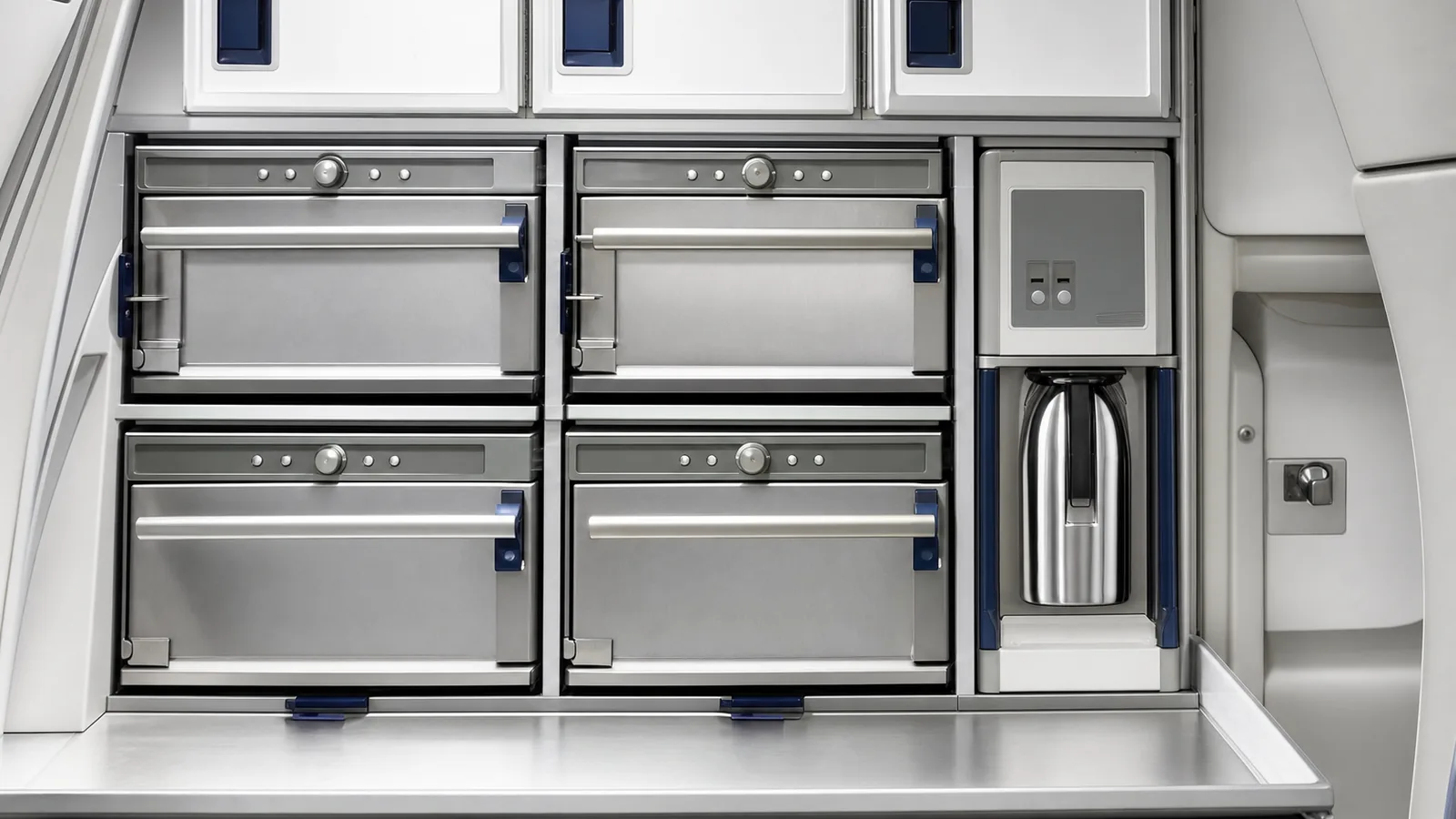
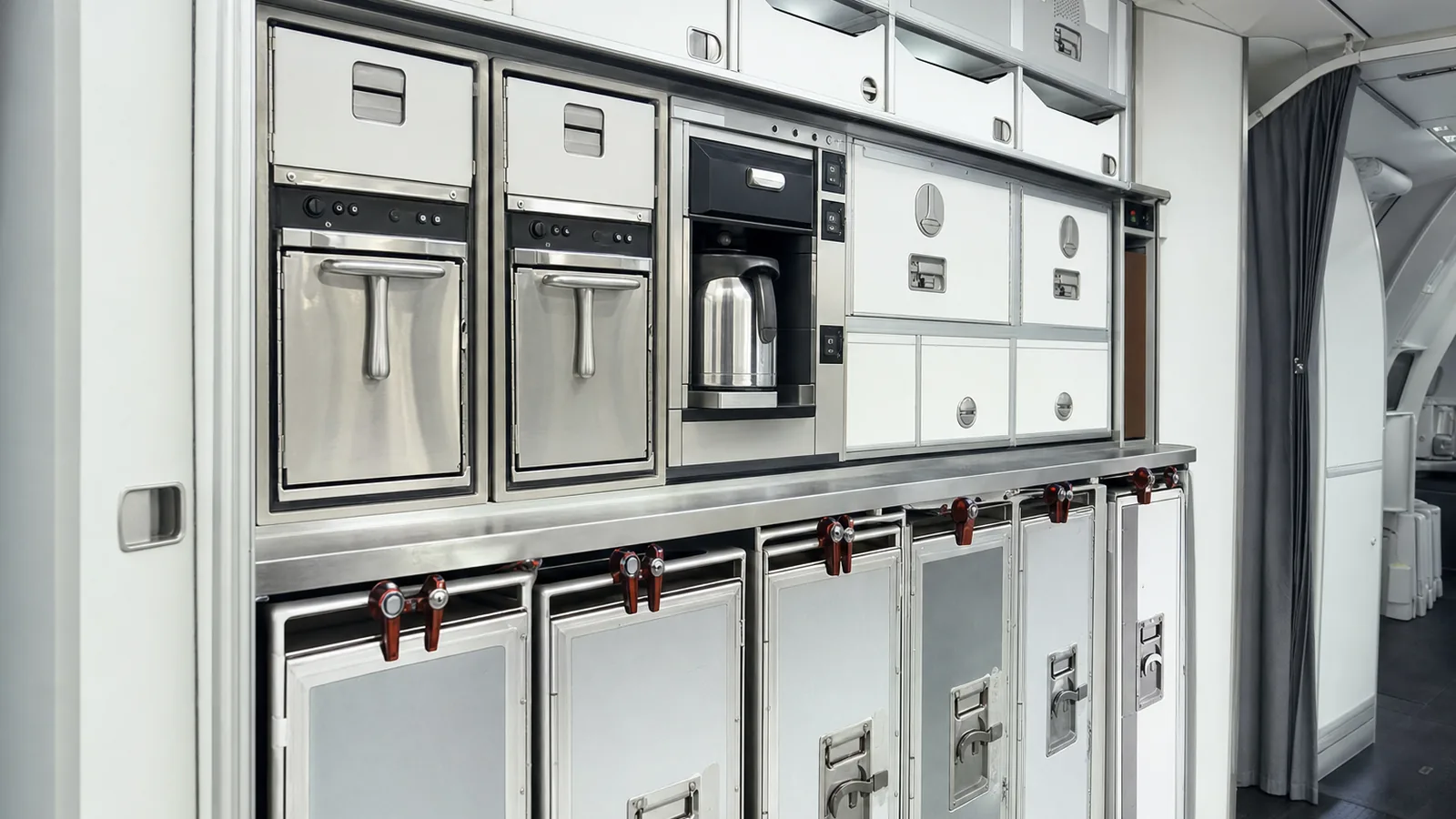
A galley monument on its own is a structure of bays, compartments and services. What turns it into a working galley are the powered units fitted into it, known as galley inserts or GAIN (galley insert) equipment. An insert can be any power consumer installed in the galley: an oven, a coffee maker, a water boiler, a refrigeration unit, a trash compactor or another electrical appliance.
Inserts are designed to be removable. They slide into a compartment of defined size, connect to the galley's electrical supply and, where needed, to its potable water and waste water services, and are locked in place. That makes it possible to replace a faulty unit during a short ground stop, or to change the equipment in a galley without rebuilding it.
Ovens heat meals that were prepared and chilled on the ground. Aircraft ovens are built in convection and steam versions: convection ovens circulate hot air to heat trays of meals evenly, while steam ovens add moisture so that food does not dry out during reheating. Some manufacturers also offer multifunctional units and induction cooking for premium cabins.
Hot drinks are served throughout a flight, so galleys carry coffee makers, espresso makers and water boilers. They are plumbed to the aircraft's potable water system and built to fit standard insert compartments.
Food prepared on the ground has to be kept cold until it is served, especially on long sectors. Chillers and refrigeration units keep trolleys, compartments or dedicated cabinets at chilled temperatures in flight.
Waste returns to the galley after every service. Trash compactors reduce its volume so that more fits into the available waste stowage before landing.
Because airlines and galley manufacturers source inserts from different suppliers, their interfaces are standardised. ARINC 810 defines the physical interfaces of galley insert equipment:
An insert built to ARINC 810 can be fitted to a compartment built to the same standard, whoever made the galley. Inserts are also offered in ATLAS-sized configurations, matching the trolley and container standard used by most airlines.
Modern galleys connect their inserts to a data bus. ARINC 812 defines communication between galley equipment over a Controller Area Network bus, including the data content exchanged. A common data interface means that inserts from different suppliers can exchange information within the same galley, in the same way that ARINC 810 lets them share the same compartments.
Galley inserts run on the aircraft's 115 V AC, 400 Hz supply. The high frequency allows alternators and transformers to be much smaller and lighter than 50 or 60 Hz equipment, which matters on an aircraft; the price is larger voltage drops, with reactive drops as much as seven times larger than at 60 Hz, which short cable runs on an aircraft make acceptable. The consequence for components is simple: an aircraft oven or boiler cannot be replaced by a ground or marine appliance, and a marine appliance cannot be installed in an aircraft galley.
Components also include the fittings that hold equipment in place. Under 14 CFR 25.561, items of mass in the cabin must be restrained against emergency landing loads, which include 9.0 g forward and 6.0 g downward, unless their position means that breaking loose could not injure occupants or block escape routes. Inserts, trolleys and containers are therefore secured by latches and retention devices designed for those loads. The certification background is covered on the commercial aircraft galley equipment page.
A galley insert is identified by its fit and its interfaces as much as by its function. An enquiry for components is quoted most quickly with:
For trolleys, standard containers and service items, see aircraft galley accessories. The complete galley inventory is set out in the aircraft galley equipment list, and the aircraft galley equipment guide explains trolley, insert and certification standards together.
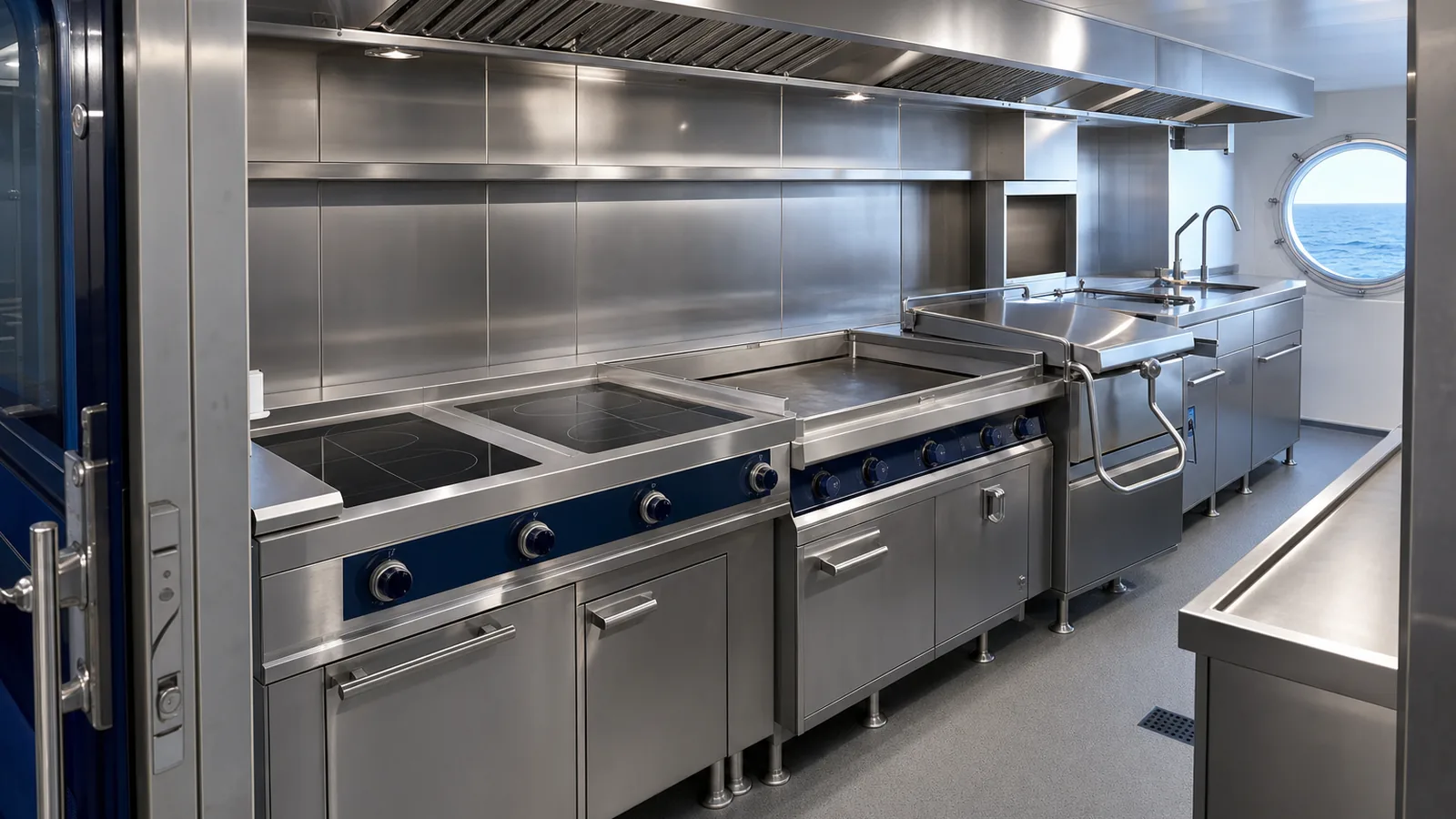
The products in our catalogue are marine galley equipment and are not certified for installation in aircraft. For marine ovens, kettles and refrigeration, see marine galley equipment.
A galley insert, or GAIN, is a powered unit fitted into an aircraft galley compartment, such as an oven, coffee maker, espresso maker, water boiler, refrigeration unit or trash compactor. Inserts are removable and connect to the galley's electrical, water and waste services.
ARINC 810 defines the physical interfaces of galley insert equipment: dimensions, installation requirements, the electrical connector and cable, the potable water coupling, the waste water interface, and qualification and test guidance.
ARINC 812 defines the data interface of galley insert equipment: communication between galley units over a Controller Area Network bus, including the data content exchanged.
Aircraft galleys use convection ovens, which heat meals with circulating hot air, and steam ovens, which add moisture so that reheated food does not dry out. Both run on the aircraft's 115 V AC, 400 Hz supply.
How an aircraft galley is built around standard trolleys and inserts, 115 V 400 Hz power, weight and airworthiness certification, and how that differs from a marine galley.
Read guideWhat the term covers, how a ship or aircraft galley differs from a shore kitchen, and the equipment groups that make up a working galley.
Read guideThe constraints that actually decide a galley specification — service, power, space, water, heat, motion, materials and compliance — worked through in the order they bite.
Read guideSend us your equipment list, drawing or specification and our team will come back with pricing and lead times.