Aircraft Galley Equipment Guide
How an aircraft galley is built around standard trolleys and inserts, 115 V 400 Hz power, weight and airworthiness certification, and how that differs from a marine galley.
Read guideAviation
The galley of a commercial transport aircraft is certified structure: its monuments, carts, containers and inserts are designed to aviation standards for flammability, emergency landing loads and 115 V 400 Hz power.

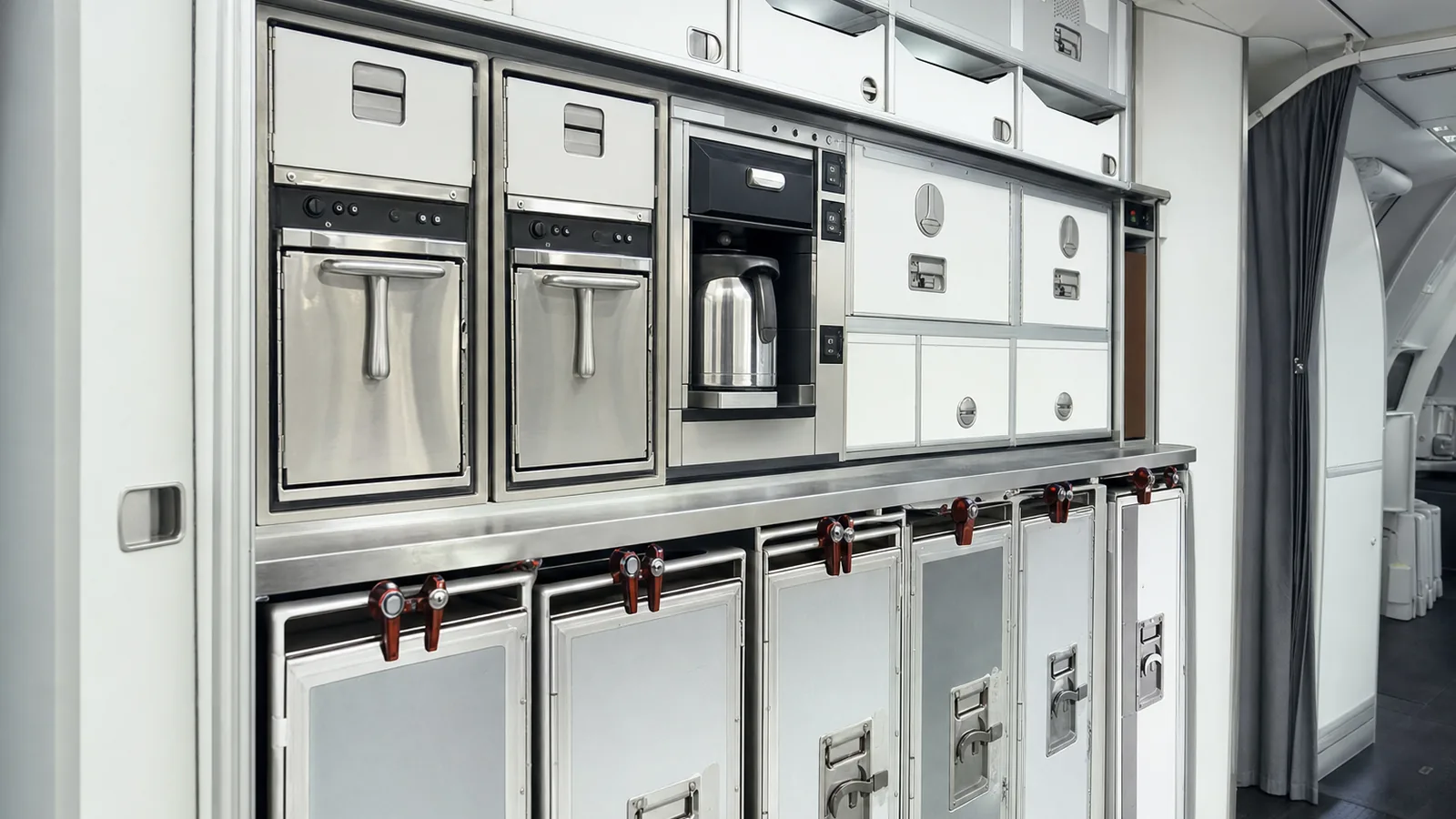
On a commercial transport aircraft the galley is not furniture added to the cabin. It is a certified installation, designed with the cabin layout and approved as part of the aircraft. The structure bolted to the floor is usually called a galley monument: a shell that carries the trolley bays, stowage compartments, worktops and the electrical, potable water and waste water services. Functional units such as ovens, beverage makers and chillers are then fitted into it as galley inserts.
Galleys are typically placed at the forward, mid and aft positions of the cabin, next to the doors where catering is loaded. How many there are, and how large, depends on the aircraft type and on the airline's cabin configuration, so the same aircraft model can leave the factory with very different galley layouts.
For equipment, this has one important consequence: every item in the galley has to be compatible with the certified monument it goes into. A trolley has to match the bay, an insert has to match its compartment and connectors, and any change to the installation is a change to the aircraft.
Three sets of requirements have the most direct effect on what can be installed. The references below are to the US Federal Aviation Regulations for transport-category aeroplanes (14 CFR Part 25); the European certification specifications for large aeroplanes, CS-25, contain corresponding paragraphs.
14 CFR 25.853 governs compartment interiors. On aeroplanes with a passenger capacity of 20 or more, galley structure must meet the heat release and smoke emission tests in parts IV and V of appendix F, in addition to the general flammability requirements for cabin materials. Galley structure explicitly includes the exposed surfaces of stowed carts and standard containers, and the cavity walls that are exposed when a full complement of carts or containers is not carried. In other words, a trolley bay has to meet the requirement whether or not the trolley is in it.
14 CFR 25.561 sets the ultimate inertia forces the structure must withstand in an emergency landing: 3.0 g upward, 9.0 g forward, 3.0 g sideward on the airframe and 4.0 g on the seats, 6.0 g downward and 1.5 g rearward. Items of mass in the cabin must be positioned so that, if they break loose, they cannot injure occupants, damage fuel systems or block escape routes, or they must be restrained against those loads. A loaded meal trolley or an oven is exactly that kind of item, which is why carts and inserts are held in their stowage by latches and retention devices.
FAA technical standard order TSO-C175 covers galley carts, containers and associated components. It adopts SAE AS8056, Minimum Design and Performance of Airplane Galley In-Flight Carts, Containers, and Associated Components, as its minimum performance standard, with FAA modifications. SAE ARP4171 sets out safety considerations for food and beverage service carts. A cart or container sourced for a commercial aircraft is therefore expected to come with the approval and documentation that show it meets that standard.
A commercial aircraft supplies its galley with 115 V AC at 400 Hz. The high frequency keeps alternators and transformers small and light, and galley inserts are built for it. Galley inserts are also connected to the aircraft's potable water system and to its waste water system, and ARINC 810 standardises those couplings along with the electrical connector, dimensions and installation of each insert. ARINC 812 adds a standard data interface over a Controller Area Network bus, so that inserts from different suppliers can communicate within one galley. The inserts themselves are described on the aircraft galley components page.
Every kilogram in a commercial galley is flown on every sector for the life of the aircraft. That is why galley structures are built as integrated, lightweight designs by specialist manufacturers; why trolleys and containers are standardised and filled on the ground; and why most in-flight food service heats and chills prepared food rather than cooking from raw. When a galley is changed during a cabin retrofit, the weight, power demand and certification of every new item are assessed together.
Commercial aircraft galley items are identified by their certification and their fit, not by a general description. An enquiry is quoted most quickly when it includes:
For the operational side of the same galley, see airline galley equipment. For trolleys and containers, see aircraft galley accessories. The aircraft galley equipment guide sets out the standards in one place.
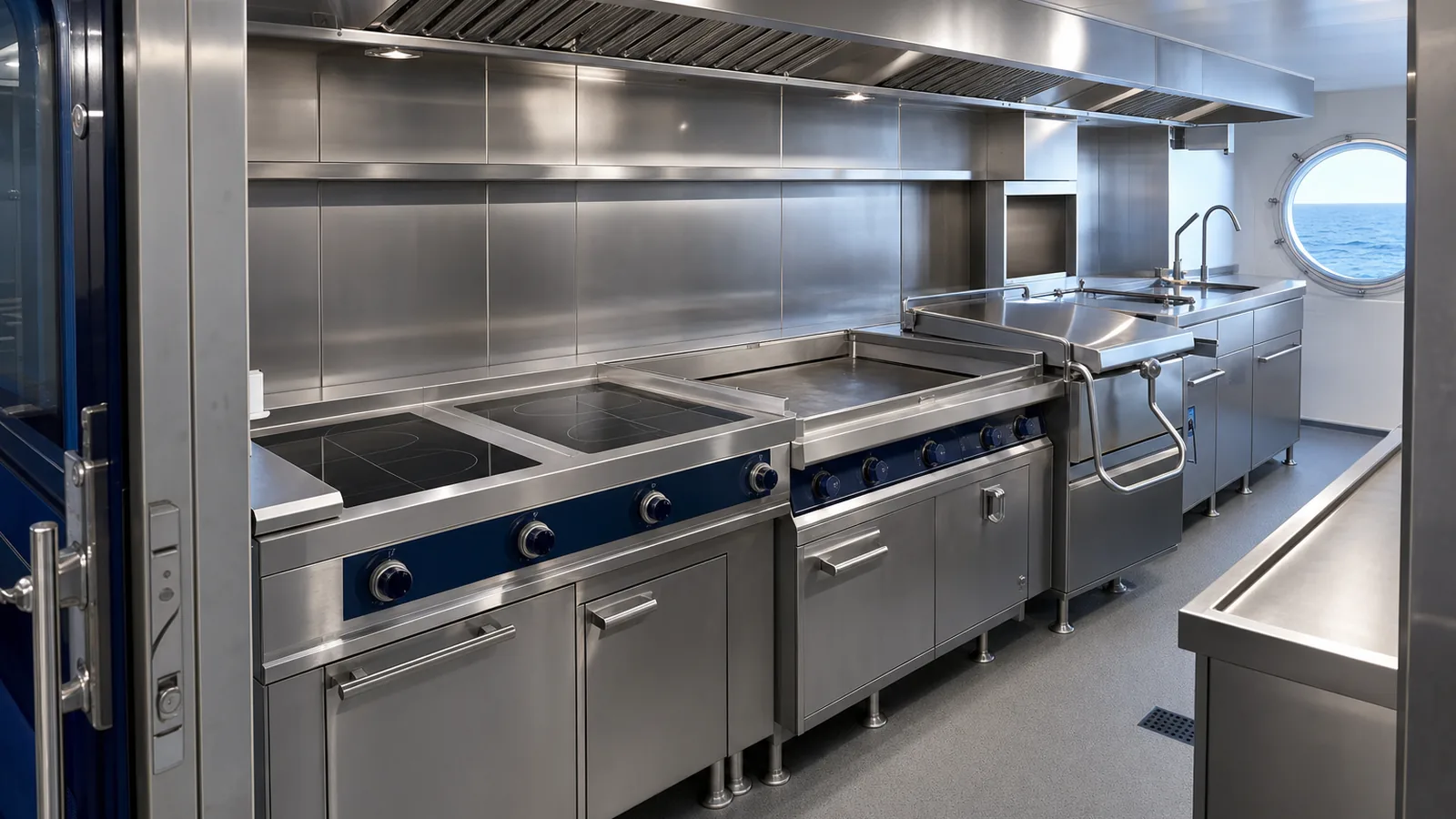
The products in our catalogue are marine galley equipment: combi ovens, kettles, dishwashers and laundry machines built for a ship's 400 V 50 Hz or 440 V 60 Hz supply. They are not certified for installation in an aircraft, and aircraft galley inserts are not built for a ship. For the marine side of galley equipment, see marine galley equipment.
A galley monument is the structure bolted to the aircraft cabin floor that forms the galley. It carries the trolley bays, stowages and worktops and the electrical, potable water and waste water services, and galley inserts such as ovens and beverage makers are fitted into it.
On transport-category aeroplanes with 20 or more passenger seats, 14 CFR 25.853 requires galley structure, including the exposed surfaces of stowed carts and standard containers, to meet heat release and smoke emission tests. CS-25 contains the corresponding European requirement.
14 CFR 25.561 requires items of mass in the cabin to be restrained against emergency landing loads, including 9.0 g forward, unless they are positioned so that breaking loose could not injure occupants or block escape routes. Latches and retention devices hold carts and inserts in place.
FAA TSO-C175 covers galley carts, containers and associated components and adopts SAE AS8056 as its minimum performance standard. SAE ARP4171 sets out safety considerations for food and beverage service carts.
How an aircraft galley is built around standard trolleys and inserts, 115 V 400 Hz power, weight and airworthiness certification, and how that differs from a marine galley.
Read guideWhat the term covers, how a ship or aircraft galley differs from a shore kitchen, and the equipment groups that make up a working galley.
Read guideThe constraints that actually decide a galley specification — service, power, space, water, heat, motion, materials and compliance — worked through in the order they bite.
Read guideSend us your equipment list, drawing or specification and our team will come back with pricing and lead times.