
Guide
Ship Galley Equipment Guide: Planning Around Crew, Rotation and Provisioning
How a ship galley is planned from the people it feeds: crew size and service pattern, rotation and provisioning, volume cooking, the scullery, power and steam, fire rules and the laundry.
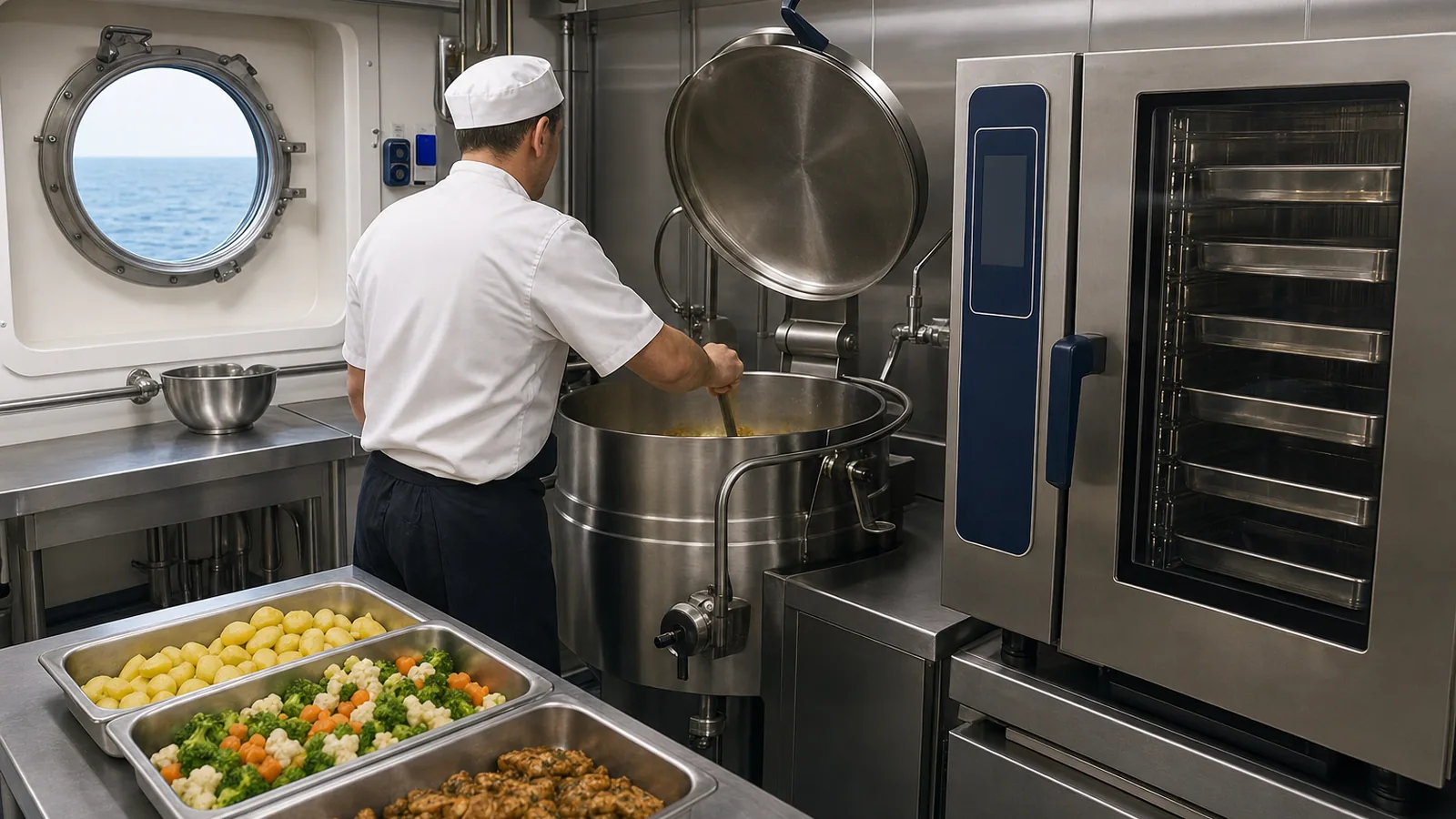
A ship's galley is planned backwards from the people it feeds. The crew does not change from day to day, the ship cannot pop out for supplies, and the galley has to produce every meal of a rotation on the ship's own power, water and stores. That makes a ship galley different from a restaurant kitchen of the same size: less about menu range, more about volume, endurance and keeping going when something fails.
This guide follows the planning in that order. It applies most directly to cargo ships, tankers, bulk carriers, offshore support and service vessels; passenger ships add service peaks and sanitation inspections, which are covered where they change the equipment.
The crew sets the requirement
The Maritime Labour Convention, 2006 sets the baseline for what the galley has to deliver. Under Regulation 3.2 and Standard A3.2:
- Food and drinking water must be of appropriate quality, nutritional value and quantity, and take into account the differing cultural and religious backgrounds of the crew.
- Ships' cooks with responsibility for food preparation must be trained, qualified and found competent, and must not be under 18 years of age.
- On ships with a prescribed manning of less than ten, a fully qualified cook may not be required; anyone processing food must then be trained or instructed in food and personal hygiene and in handling and storing food on board.
- Frequent, documented inspections of food, water and catering are carried out on board, by or under the authority of the master.
The Convention does not itself require cooks to be certified; its guidelines suggest certification as the expected approach, and flag states set the rule. For equipment, the practical consequence is simple: the galley has to support cooking from raw, for a crew of mixed backgrounds, to a standard that survives documented inspection, with equipment the cook can keep clean.
Service pattern
Write down how the crew eats: fixed mealtimes for the whole crew, watch-based sittings, night meals for the engine room, packed meals for shore work. A crew on watches spreads the load across the day; a day-working crew concentrates it. That difference, more than the crew number, decides whether the galley needs one large appliance of each type or two smaller ones.
Rotation and provisioning decide the stores
The length of a rotation and the interval between provisioning ports decide how much food is carried and in what state.
- Long rotations push towards frozen and dry stores, with walk-in cold rooms for bulk provisions and upright cabinets in the galley for the working stock.
- Thawing becomes a daily process rather than an occasional one. A thawing cabinet takes frozen stock back to chill temperature under control, which matters when inspections are documented.
- Short rotations with frequent provisioning allow more chilled stock and less freezer space.
Upright cabinets in the Electrolux Professional ecostore and Prostore ranges, for example, run from 470 to 1430 litres in one- and two-door builds, with tropicalised construction for high ambient temperatures. Most use R290, which is classified A3, higher flammability; self-contained appliances with a built-in compressor may now carry up to 500 g per circuit under EN IEC 60335-2-89:2022, while split systems remain limited to 150 g. See refrigeration equipment.
Volume cooking carries the load
A crew galley cooks in bulk: soups, stocks, sauces, stews, rice, pasta and braised dishes. The equipment that carries that work is the volume cooking, and it is where most of the galley's capacity, weight and connected load sit.
Boiling kettles
Kettles cook liquid dishes at volume. They come electric or steam-heated, fixed or tilting; in the MKN Optima 850 range they run up to 500 litres. Tilting kettles decant directly into containers, which reduces manual handling on a moving deck. See boiling kettles.
Bratt pans and multifunctional appliances
Bratt pans sear, braise and shallow-fry in a large open pan. Multifunctional appliances such as the MKN FlexiChef combine boiling, braising and frying in one body; a FlexiChef Team holds two pans of up to 150 litres each. They replace several separate appliances, but they concentrate the load: the largest FlexiChef Team draws up to 34 kW and weighs 770 kg. See bratt pans.
Combi ovens
Combi ovens roast, bake and steam in one cavity and do more different jobs than any other single appliance. They are sized in gastronorm levels, from 6 to 20 in marine ranges, and where manufacturers publish output figures those are the best sizing tool. MKN, for example, quotes 30 to 160 meals per day on GN 1/1 for one twin FlexiCombi combi steamer. See combi ovens.
One large or two smaller?
On a ship, redundancy has a value it does not have ashore. Two smaller combi ovens or kettles keep half the capacity working when one is out of service; one large unit uses less space and one connection. For a small crew on a long rotation, the second position is often worth more than the space it takes.
The hot line and its fire rules
The rest of the cooking is à la minute: induction tables and tops, griddles and fry tops, and deep fat fryers. In a modular galley these form one line of the same depth, typically 700 mm or 850 mm in the MKN Optima lines.
Deep fat fryers carry specific requirements on ships. SOLAS regulation II-2/10.6.4 requires deep-fat cooking equipment to have an automatic or manual extinguishing system, a primary and backup thermostat with an alarm, automatic shut-off of electrical power when the extinguishing system operates, an alarm in the galley indicating operation, and clearly labelled manual controls. The regulation refers to ISO 15371 for the extinguishing systems. The fryer, its thermostats and the extinguishing system therefore have to be specified together. See deep fat fryers and induction cookers.
The scullery and fresh water
Every meal returns to the scullery, and on a ship the scullery is where the galley's water budget is decided. Crew consumption on commercial vessels runs at roughly 100 litres per person per day for drinking, cooking, washing and sanitation, and fresh water is either bunkered, taking tank space and deadweight, or made on board by evaporators or reverse-osmosis plant that run continuously.
Dishwasher choice follows the load:
- Undercounter machines for small crews and pantries, using between about 1.8 and 5 litres per cycle depending on their tier.
- Hood-type machines for medium loads.
- Rack-conveyor machines for large crews and passenger service; typical conveyor machines use up to about 1.2 US gallons per rack, and the most water-saving designs as little as 0.54. The Electrolux Professional green&clean rack machines are listed at 150 to 200 racks per hour.
On passenger ships inspected under the Vessel Sanitation Program, the dishwasher's data plate has to state wash, rinse and sanitising temperatures and related values, the hot-water sanitising rinse must reach at least 82 °C for most machine types without exceeding 90 °C at the manifold, and an alarm must warn when temperature or chemical concentration falls below the data plate. See dishwashing equipment.
Power and steam
Supply
Every appliance is ordered in the ship's supply. IEC 60092-201 specifies 440 V for ship low-voltage systems, typically at 60 Hz; many vessels run 400 V at 50 Hz. A motor run off its rated frequency does not run at its rated speed, so fans, pumps and compressors suffer if the build is wrong. In this catalogue, 107 products are listed at 440 V.
Connected load
Add the hot line, scullery and laundry together early. Volume cooking dominates: kettles, bratt pans and combi ovens each run to tens of kilowatts, and the largest combi oven listed here draws 70.2 kW. Energy management readiness, listed on many marine cooking and laundry products, lets the ship's system stagger heavy loads where generating capacity is tight.
Steam
Where the ship has steam available at the galley, steam-heated kettles move a large load off the electrical system. Most of the steam-heated products in this catalogue are boiling kettles.
Weight, space and the route in
Ship galleys are rarely generous, and refits are constrained by the steel around them.
- Weight: galley appliances are structural loads, from a few kilograms up to 770 kg for the largest multifunctional appliance. Give the naval architect net weights before the layout is fixed.
- Line depth: choose one depth for a modular line and keep to it; mixing depths makes cleaning and pan handling harder.
- Access: on a refit, every appliance has to travel through existing doors, hatches and passageways. External dimensions belong in the specification.
- Fixing: flanged feet bolted or welded to the deck, door stops, secured pull-out rails and cooker guards keep equipment and its contents in place.
The laundry
On many ships the laundry is specified and ordered with the galley. Marine washer-extractors from Miele run from 6 kg to 35 kg, with tumble dryers and rotary ironers alongside. Two choices matter most:
- Size and number: a crew laundry used by individuals favours several smaller machines; a hotel or accommodation laundry favours fewer large ones.
- Dryer type: a vented dryer needs an exhaust duct through the ship's structure and fire zones; a heat-pump dryer needs only a condensate drain, and Miele states its heat-pump models use about 50 to 60 % less energy depending on the model.
See laundry equipment.
A ship galley planning checklist
- Crew number, nationalities and service pattern; whether passengers are carried.
- Rotation length and provisioning interval.
- Supply voltage, phase and frequency; steam availability at the galley.
- Deck loading limits and access routes.
- Fresh water production and storage; greywater capacity.
- Whether the vessel is inspected under the Vessel Sanitation Program.
- Fryer fire protection to SOLAS II-2/10.6.4.
- Existing equipment and the series it belongs to, for spares.
The ship galley equipment catalogue lists the equipment mapped to ships, and the commercial vessel and offshore pages cover the narrower selections for those vessel types. For the general method, see the guide to choosing galley equipment.
Frequently asked questions
What galley equipment does a cargo ship need?
Cold stores and upright refrigerators and freezers for a long rotation, volume cooking such as boiling kettles, bratt pans and combi ovens, a hot line with induction, griddles and a SOLAS-compliant fryer installation, and a dishwasher sized to the crew. Many ships order the laundry with the galley.
Does a ship with fewer than ten crew need a qualified cook?
Under MLC 2006, ships with a prescribed manning of less than ten may not be required to carry a fully qualified cook, but anyone processing food must be trained or instructed in food and personal hygiene and in handling and storing food.
What are the SOLAS requirements for a deep fat fryer on a ship?
Regulation II-2/10.6.4 requires an automatic or manual extinguishing system, a primary and backup thermostat with an alarm, automatic power shut-off when the system operates, an alarm in the galley and clearly labelled manual controls, with reference to ISO 15371.
How much fresh water does a ship crew use?
Crew consumption on commercial vessels runs at roughly 100 litres per person per day for drinking, cooking, washing and sanitation, which is why the water drawn by dishwashers and washer-extractors is treated as a design figure.
Is it better to fit one large combi oven or two smaller ones on a ship?
Two smaller units keep half the capacity working when one is out of service, which matters on a long rotation far from service; one large unit saves space and needs one connection. The choice depends on crew size and how far the vessel operates from support.