
Guide
What Is Galley Equipment?
What the term covers, how a ship or aircraft galley differs from a shore kitchen, and the equipment groups that make up a working galley.
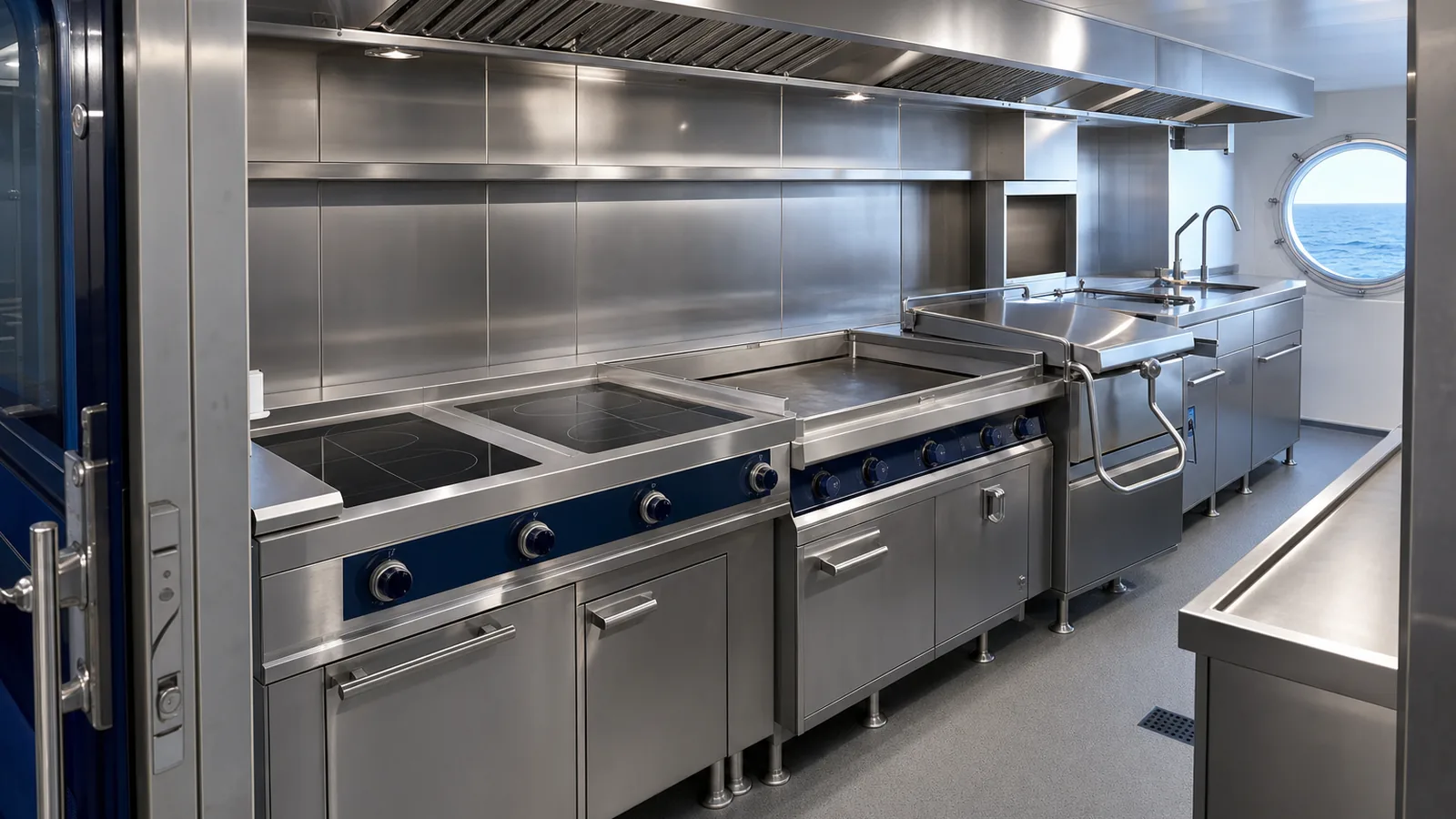
A galley is a kitchen that travels. On a ship, a yacht, an offshore platform or an aircraft it does the same work as any commercial kitchen: it stores food, prepares it, cooks it, holds it at temperature and cleans up afterwards. What makes it a galley rather than a kitchen is everything around that work. It runs on the vessel's own electrical supply, it uses water that has been carried or made on board, it moves, it is inspected as part of the vessel, and when something breaks the nearest service engineer may be a port or a continent away.
Galley equipment is the equipment built, configured and installed to do that work under those conditions. Much of it looks like the equipment in a hotel kitchen, and some of it is the same product in a different build. The differences are rarely visible on a photograph; they sit on the data plate, under the base and in the materials of the parts that touch water.
What counts as galley equipment
In practice the term covers the fixed and semi-fixed equipment of the galley and, on many ships, of the laundry that is ordered with it. It falls into a handful of groups:
- Cooking equipment: ranges and induction tops, griddles and fry tops, deep fat fryers, boiling kettles, bratt pans and multifunctional pans, combi ovens and combi steamers. See cooking equipment.
- Refrigeration: upright refrigerators and freezers, thawing cabinets and, on larger vessels, provision cold rooms. See refrigeration equipment.
- Preparation: work tables, mixers, vegetable peelers and similar machines. See work tables and food preparation equipment.
- Holding and service: bain-maries and heated holding positions. See bain-maries.
- Warewashing: undercounter, hood-type and rack-conveyor dishwashers and glasswashers. See dishwashing equipment.
- Laundry: washer-extractors, tumble dryers, rotary ironers and washer-dryer stacks. See laundry equipment.
- Structure and services around the equipment: extraction and ventilation, sinks, shelving and storage, drainage.
A galley specification usually covers the first six groups as equipment and treats the last as part of the vessel's outfitting.
How a marine galley differs from a shore kitchen
The differences are practical, and each one changes what can be ordered.
It runs on the ship's electrical system
A shore kitchen is connected to a national grid. A ship generates its own power, and its low-voltage system follows ship design standards rather than the local grid. IEC 60092-201, the system-design standard for electrical installations in ships, specifies 440 V where the shore standard IEC 60038 specifies 480 V, and 440 V systems typically run at 60 Hz. Many vessels still run 400 V at 50 Hz.
Frequency matters as much as voltage. A 50 Hz motor run on 60 Hz turns roughly 20 % faster, and with the voltage unchanged the ratio of voltage to frequency falls by about 16.7 %, which under-fluxes the motor. Combi oven fans, dishwasher pumps and mixer drives all sit on motors. That is why marine equipment is ordered in the vessel's own supply configuration rather than adapted afterwards, and why the same appliance often exists in several electrical builds.
It moves
A kitchen ashore does not roll. Marine builds add the hardware that keeps equipment and its contents in place: MKN, for example, lists flanged feet, door stops, secured pull-out rails and cooker guards as standard marine devices. In practice, flanged feet are bolted to the deck or welded to a stainless plinth so the appliance becomes part of the structure, and storm rails and pan clamps keep pots on a hob.
It is cleaned with a spray gun
Ship galleys are commonly cleaned with pressure spray guns rather than wiped down, so the resistance of equipment to water jets is a specification item. IEC 60529 defines the ratings: IPX5 is tested with low-pressure jets of 12.5 litres per minute at 30 kPa, IPX6 with powerful jets of 100 litres per minute at 100 kPa for 3 minutes. Both ratings exist within the same marine product lines, depending on the appliance, so the rating is checked unit by unit rather than assumed for a whole range.
It is inspected as part of the vessel
On passenger ships calling at US ports, the US Public Health Vessel Sanitation Program reviews galley plans, inspects construction and inspects the finished vessel. The programme states that it does not test, certify or approve equipment. "Built to USPH requirements" therefore describes equipment designed so that the vessel can pass those inspections once it is installed correctly, not a certificate the machine carries. Installation is part of the result: non-portable equipment must be sealed to the deck or raised on legs that give at least 150 mm of clearance.
Water is carried or made
Fresh water on a ship is either bunkered, taking up tank space and deadweight, or produced on board by evaporators or reverse-osmosis plant that consume energy continuously. Crew consumption on commercial vessels runs at roughly 100 litres per person per day; cruising yachts often work to between 4 and 20 litres. Every litre used also becomes a litre to store or discharge, so the water drawn by a dishwasher or washer-extractor is a design figure rather than a running cost.
Materials: why the stainless grade matters
Most galley equipment is stainless steel, but not all stainless steel behaves the same in a salt atmosphere. Grade 304 (1.4301) contains no molybdenum. Grade 316 contains about 2 to 2.5 % molybdenum, which stabilises the passive film against chlorides and raises the threshold for pitting; its pitting resistance equivalent number is roughly 24 to 26 against 18 to 20 for 304.
Manufacturers split the grades accordingly. Electrolux Professional uses 1.4435 (AISI 316L) for cooking wells, while its general worktop sheet stays 1.4301 (AISI 304). The pattern across the industry is 316L where water, salt, food acids and cleaning chemicals sit and dwell, and 304 for dry structure. Even 316L is not immune to seawater: permanent immersion calls for duplex or superaustenitic grades.
How an aircraft galley differs again
Aircraft galleys share the name and the purpose but are built to a different logic, dominated by weight, standard interfaces and airworthiness certification.
- Power: aircraft electrical systems supply 115 V AC at 400 Hz. The higher frequency allows smaller, lighter alternators and transformers, at the cost of larger voltage drops, which the short distances on an aircraft make acceptable.
- Trolleys: service is organised around standard trolleys. The ATLAS standard is used by around 80 % of airlines; a full-size ATLAS trolley is about 0.3 m wide, 1.03 m tall and 0.81 m long. The KSSU standard has the same height and width but a greater depth, and accessories for one do not fit the other.
- Inserts: ovens, beverage makers and refrigerators installed in an aircraft galley follow ARINC 810 for their physical interfaces and ARINC 812 for data communication.
- Certification: galley carts and containers are covered by FAA TSO-C175, which adopts SAE AS8056; galley structure on aircraft with 20 or more passenger seats must meet the flammability tests in 14 CFR 25.853.
Marine galley equipment is not certified for installation in an aircraft, and aircraft galley inserts are not built for a ship's supply. The two share a word, not a product range. The aircraft galley equipment guide covers that side in more detail.
Marine versions of shore equipment
The major galley equipment manufacturers build marine versions of their commercial ranges rather than separate products. The typical changes are a supply configuration matched to the vessel, fixing hardware for motion, water protection suited to hose-down cleaning, 316L wetted parts where water dwells, and construction details that help the vessel meet sanitation inspections. Laundry manufacturers add marine and offshore specifications of their washers and dryers, and some models carry classification-society type approval.
Type approval is worth reading carefully. A type-approved product has been certified by a classification society such as Lloyd's Register or DNV against defined requirements, with periodic renewal. It is common for marine electronics, propulsion and safety systems; galley appliances are generally not listed under the EU Marine Equipment Directive, and approval should not be assumed without the manufacturer's certificate for the specific model.
Where to go next
For the practical side of a specification, the guide to choosing galley equipment works through power, space, water, motion and compliance in order. The station-by-station guide walks through what sits where in a working galley, and the marine galley equipment guide looks at what makes a unit marine-grade. To see the equipment itself, the marine galley equipment catalogue lists what is mapped to each vessel type.
Frequently asked questions
Is galley equipment the same as commercial kitchen equipment?
Often it is the same product in a different build. Marine versions are ordered in the vessel's supply voltage and frequency, fixed against motion, protected for hose-down cleaning and built with 316L stainless where water dwells, so a shore unit is not a drop-in replacement.
What voltage does ship galley equipment use?
It follows the ship's system rather than a national grid. IEC 60092-201 specifies 440 V, typically at 60 Hz, and many vessels run 400 V at 50 Hz, so equipment is ordered in the build that matches the switchboard.
Why is 316L stainless steel used in marine galleys?
316L contains about 2 to 2.5 % molybdenum, which raises its resistance to chloride pitting compared with 304. Manufacturers use it where water, salt and cleaning chemicals sit, such as cooking wells and pans, and keep 304 for dry structure.
Does USPH-compliant galley equipment have a certificate?
No. The Vessel Sanitation Program states that it does not test, certify or approve equipment. The wording means the equipment is built so that the vessel can pass VSP plan review and inspection once it is installed correctly.
What is the difference between ATLAS and KSSU aircraft trolleys?
Both are about 1.03 m tall and 0.3 m wide, but a full-size KSSU trolley is deeper, at about 85 cm against about 81 cm for ATLAS. ATLAS is used by around 80 % of airlines, and accessories for one standard do not fit the other.