827 of 869 products, and what is left out
Almost the whole catalogue is mapped to ship galleys. The exceptions are MKN's CounterSL counter line and the three compact Junior combi steamers, both made for serveries and short counters rather than a ship's main galley. Everything else is on the list: the Optima 850 and Optima 700 lines, FlexiChef, the thermaline 90 and 900XP blocks, SkyLine and FlexiCombi combi ovens, every green&clean dishwasher and the whole Miele laundry range.
That makes this the widest vessel view in the catalogue, and the one where filtering matters most, because a cargo ship, a passenger ship and a service vessel each use a very different slice of it.
Volume cooking for a fixed crew
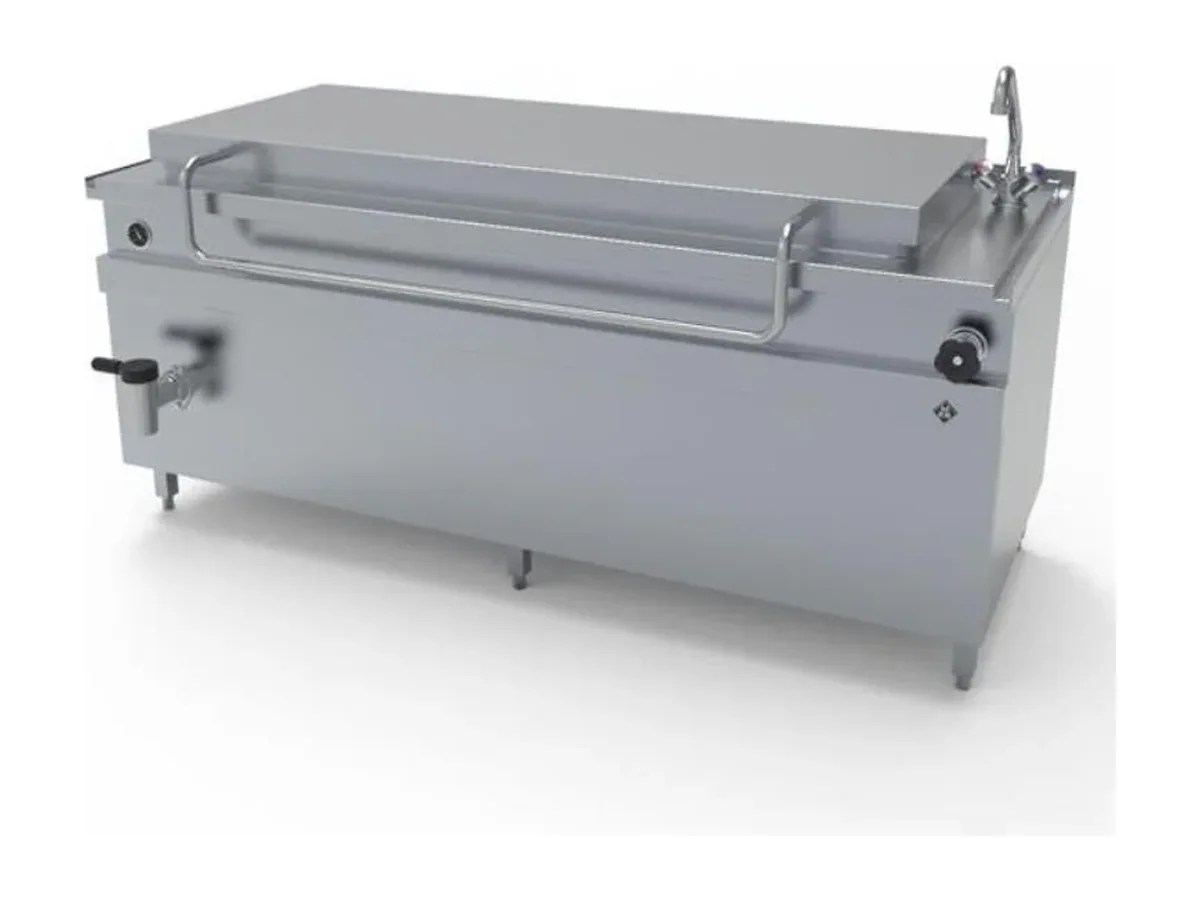
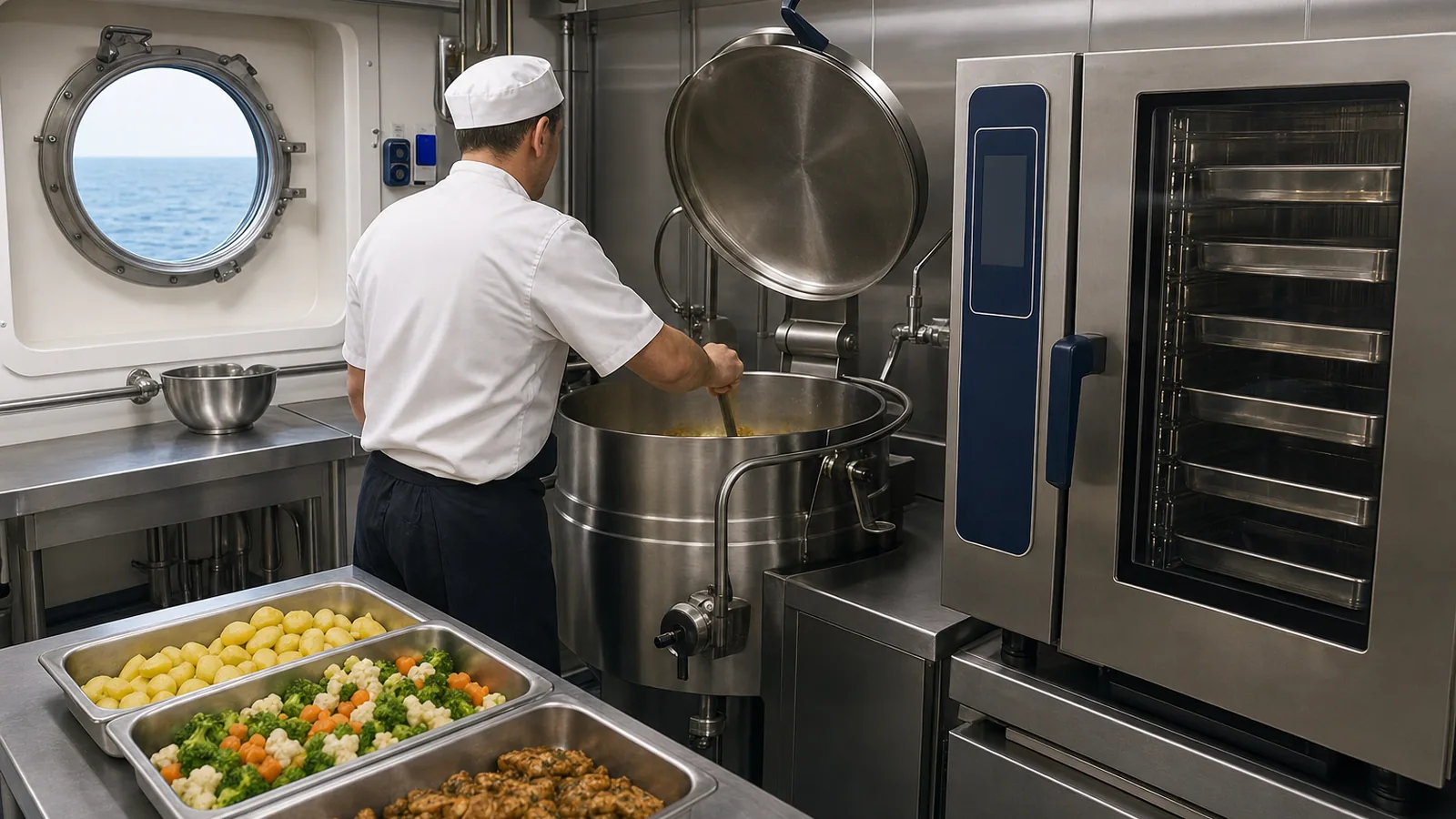
A ship's galley feeds the same crew every day for the length of a rotation, on the ship's own power and water. The equipment that carries that load is the volume cooking: every boiling kettle and every bratt pan in the catalogue is mapped to ships, with kettles up to 500 litres and FlexiChef Team appliances holding two pans of up to 150 litres each. Combi ovens from 6 to 20 GN levels cover roasting and steaming in the same space.
Choosing between kettles, bratt pans and a FlexiChef is less a menu decision than a question of how many appliances the galley can connect and carry. A FlexiChef Team replaces several separate bodies but concentrates up to 770 kg and 34 kW in one position.
Fresh water at the dishwasher
On a commercial ship, fresh water is either bunkered or made on board, and crew consumption runs at roughly 100 litres per person per day for drinking, cooking, washing and sanitation. Dishwashing is one of the places that figure is decided. Rack-conveyor machines range from about 1.2 US gallons per rack down to 0.54 on high-efficiency designs, and across thousands of racks the difference shows up in tank capacity and watermaker running time.
The green&clean rack-type machines here are listed at 150 to 200 racks per hour. Seven green&clean units are built to USPH construction requirements, which matters on a passenger ship calling at US ports under the Vessel Sanitation Program.
The supply comes before the size
All 107 products that name 440 V are mapped to ships, alongside 400 V, the most common voltage on this page, and a large 380–415 V group. 50 Hz and 60 Hz are named in almost equal numbers. On a vessel built to IEC 60092-201, where the low-voltage system is typically 440 V at 60 Hz, that rules out a large part of the list before size or series is considered.
Steam is the other supply to check. 28 products are steam heated, most of them boiling kettles, and they only make sense where the ship has steam available at the galley.
The laundry belongs in the same order
Every Miele laundry product is mapped to ships: washer-extractors from 6 to 35 kg, tumble dryers, rotary ironers up to 2759 mm wide and washer-dryer stacks. Of the dryers, 36 are air vented and 6 are heat-pump models. A heat-pump dryer needs no exhaust, which removes a hull or superstructure penetration and a duct run through fire zones in exchange for a condensate drain.
Where the Boat and Yacht pages fit better
The CounterSL counter line and the Junior combi steamers are not mapped to ships; for servery counters and compact positions, the Boat and Yacht pages are the place to look instead. Cold rooms, galley extraction, ice machines, sinks and storage furniture are outside the catalogue for now and need a separate package.