
Guide
How to Choose Galley Equipment
The constraints that actually decide a galley specification — service, power, space, water, heat, motion, materials and compliance — worked through in the order they bite.
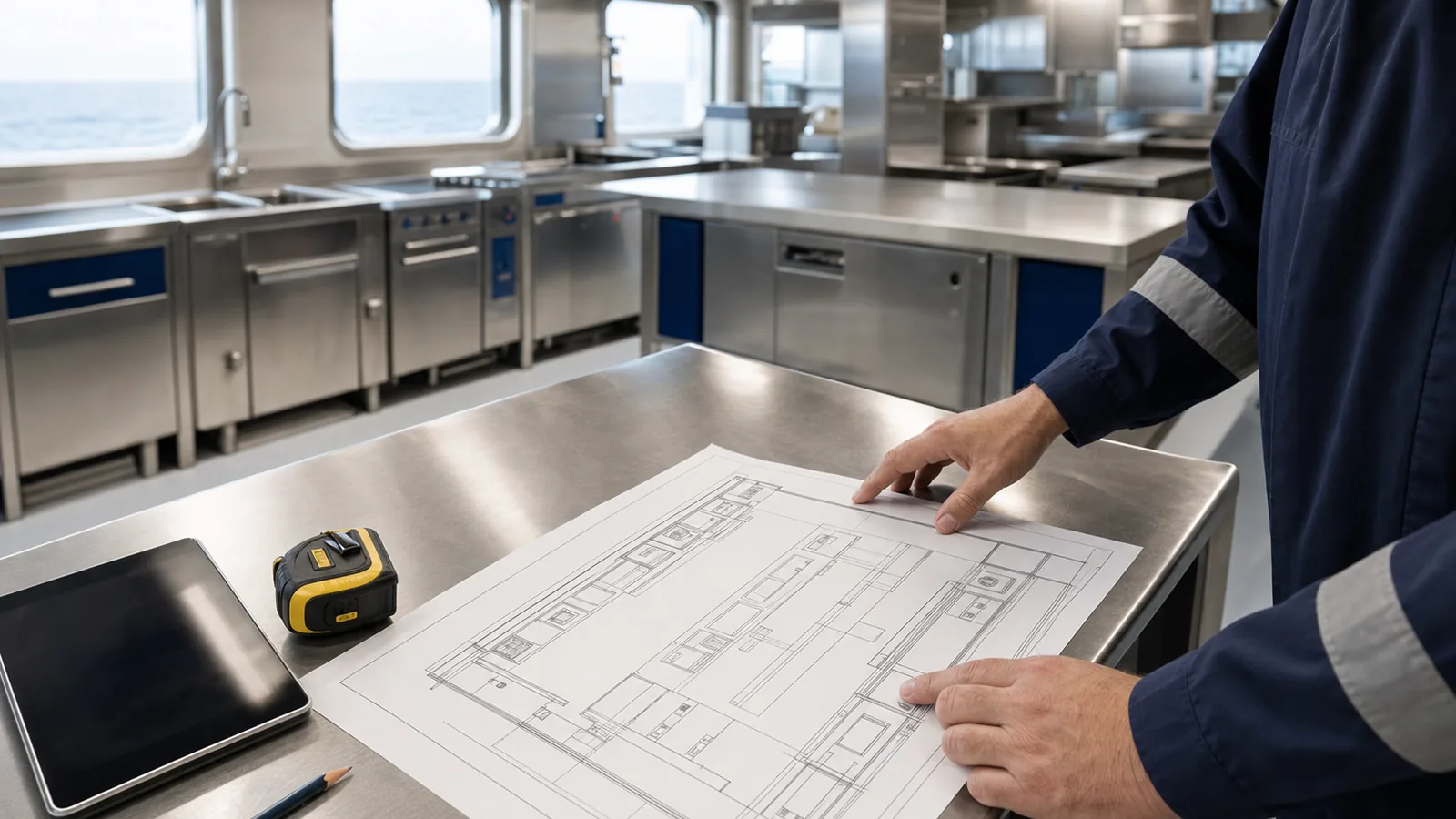
Choosing galley equipment for a vessel is mostly a process of elimination. A catalogue offers far more than any galley can take, and most of it is ruled out before anyone compares features: by the supply on the switchboard, by the space and deck strength available, by the water the vessel can make or carry, by the heat the ventilation can remove, and by the inspections the vessel has to pass.
This guide sets out those constraints in the order they usually rule things out. Working through them in sequence produces a short list that fits the vessel, and a specification that a supplier can quote without a round of clarifications.
1. Start with the service, not the catalogue
Before any equipment is named, write down what the galley has to do:
- How many people it feeds, crew and passengers or guests separately, and at how many sittings.
- The service pattern: steady mess service, peaks around sailings and watch changes, around-the-clock shifts, or restaurant-style guest service.
- The length of a rotation or voyage, which decides how much is stored and how much is cooked from raw.
- Special requirements: the Maritime Labour Convention asks for food of appropriate quality, nutritional value and quantity, taking into account the differing cultural and religious backgrounds of the crew.
- Whether the laundry is part of the same order.
From that list, derive functions rather than products: bulk boiling, searing and braising, frying, roasting and steaming, holding, cold storage, dishwashing. Only then choose the appliance type that performs each function best in the space available.
Where a manufacturer publishes a capacity figure tied to output, use it. MKN, for instance, quotes 30 to 160 meals per day on GN 1/1 for one twin FlexiCombi combi steamer. Figures like that are more useful for sizing than litres or levels alone.
2. Power: voltage, frequency and connected load
Match the supply first
A ship's electrical system follows ship design standards, not a national grid. IEC 60092-201 specifies 440 V where the shore standard specifies 480 V, and 440 V systems typically run at 60 Hz; many vessels run 400 V at 50 Hz, and some have separate hotel-services boards at other voltages. The same appliance is often built in several electrical versions for exactly this reason.
Frequency is not a detail to adapt later. A 50 Hz motor run on 60 Hz turns roughly 20 % faster, and with the voltage unchanged it is under-fluxed. Fans in combi ovens, pumps in dishwashers and drives in mixers are all affected. Filter by voltage and frequency before comparing anything else.
Add up the connected load
Individual appliances in a marine galley range from about 1 kW to over 70 kW; the largest combi oven in this catalogue is listed at 70.2 kW, and a FlexiChef Team multifunctional appliance draws up to 34 kW. The sum of the hot line, scullery and laundry has to fit within what the generators and the galley feeder can supply, with the usual diversity allowances applied by the electrical engineer.
Energy management readiness, listed on many marine cooking and laundry products, lets the vessel's system control when heavy loads run. Where the galley and laundry share limited generating capacity, it can decide between two otherwise similar models.
Consider steam
Where the vessel has steam available at the galley, steam-heated boiling kettles move a large load off the electrical system. Where it does not, they are not an option.
3. Space, depth and weight
Choose a line depth
Modular cooking equipment is built to a fixed depth for each series, and mixing depths in one line makes cleaning and pan movement harder. The MKN Optima lines, for example, come in 700 mm and 850 mm depths. The shallower line leaves more floor for passage in a narrow galley; the deeper one gives more working surface per appliance.
Check the weight early
Galley appliances are structural loads. Net weights in this catalogue run from a few kilograms to 770 kg for the largest FlexiChef Team, and the heaviest laundry machines approach 700 kg. The naval architect needs these figures before the galley layout is fixed, not after the equipment is ordered.
Check the route in
On a refit, every appliance has to reach the galley through existing doors, hatches, passageways and stairs. The external dimensions on the data sheet, and whether the unit can be split or delivered without its base, belong in the specification.
4. Water and drainage
Fresh water on a vessel is carried or made, and both cost space, weight or energy. Commercial vessels typically work to roughly 100 litres per person per day for all uses; cruising yachts to between 4 and 20 litres. That makes the water drawn by equipment a design figure.
The scullery is usually the largest single draw in the galley. Typical rack-conveyor dishwashers use up to about 1.2 US gallons per rack and the most water-saving designs as little as 0.54; undercounter machines use between about 1.8 and 5 litres per cycle depending on their tier. Laundry manufacturers publish water consumption per programme, which should be compared in the same way.
Every litre used is also a litre of greywater to hold or discharge. Under VSP construction guidelines, equipment drains connect to waste through an accessible air gap or air-break, and warewash areas need deck drainage.
5. Heat and ventilation
Almost all of the energy a cooking appliance draws ends up in the galley as heat and moisture, and the ventilation has to remove it. Ask for the manufacturer's heat emission data and pass it to the HVAC designer: MKN, for example, lists latent and sensible heat in watts for many appliances, with one 92-litre tilting bratt pan at 4200 W latent and 6000 W sensible.
The same logic applies in the laundry. A vented tumble dryer needs an exhaust duct and a make-up air path; a heat-pump dryer recirculates its air, needs only a condensate drain, and Miele states its heat-pump models use about 50 to 60 % less energy depending on the model.
6. Motion and fixing
Equipment on a vessel has to stay where it is put, and so do its doors, trays and pans. Marine builds add the hardware: MKN lists flanged feet, door stops, secured pull-out rails and cooker guards as standard marine devices, with insert racks that secure trays. Flanged feet are bolted to the deck or welded to a stainless plinth; storm rails and pan clamps keep pots on a hob.
Fixing also has to satisfy sanitation rules where they apply. On passenger vessels inspected under the Vessel Sanitation Program:
- Non-portable equipment is sealed to the deck or raised on legs giving at least 150 mm of clearance, or 100 mm where no part is more than 150 mm from the cleaning access point.
- Equipment not on legs stands on a sealed foundation or coaming at least 100 mm above the finished deck.
- There is at least 150 mm between equipment and the deckhead, or the equipment extends to the deckhead and is sealed.
- Cleaning space behind equipment grows with the distance to be cleaned, from 150 mm up to 460 mm.
7. Materials and cleaning
Specify the stainless grade by where the part sits. Grade 316L contains about 2 to 2.5 % molybdenum and resists chloride pitting much better than 304, so it belongs where water, salt, acids and cleaning chemicals dwell: wells, pans, kettles and wetted parts. Grade 304 is normal for dry structure. Neither is immune to permanent seawater immersion.
Specify water protection by how the galley is cleaned. IPX5 withstands low-pressure jets, IPX6 powerful jets; where the crew cleans with pressure spray guns, the IP rating of each unit is checked individually, because both ratings occur within the same marine product lines.
8. Compliance: what can and cannot be claimed
Several regimes touch the galley, and each is often misunderstood.
- Vessel Sanitation Program: it reviews plans and inspects the vessel, but does not certify or approve equipment. "Built to USPH requirements" describes construction that helps the vessel pass.
- SOLAS: regulation II-2/10.6.4 sets fire protection requirements for deep-fat cooking equipment on ships, including an extinguishing system, backup thermostat with alarm and automatic power shut-off.
- Maritime Labour Convention: Regulation 3.2 requires cooks responsible for food preparation to be trained, qualified and competent and at least 18 years old, and frequent documented inspections of food, water and catering by or under the authority of the master. On ships with a prescribed manning of less than ten, a fully qualified cook may not be required, but anyone processing food must be trained in hygiene and food storage.
- Type approval: classification-society type approval is common for marine electronics and safety systems. Galley appliances generally are not type approved as a class, so ask for the certificate of the specific model where a class or owner requires it.
9. Maintenance far from port
A galley that works on paper but cannot be kept running at sea has been specified badly. Standardising on a small number of series across a vessel, or a fleet, reduces the range of spare parts to carry and the number of systems the crew has to learn. Network connectivity and HACCP logging, listed on many combi ovens, dishwashers and refrigeration cabinets, move temperature records and fault information off paper and into a system that the shore office can see.
A specification checklist
Before asking for a quotation, have these ready:
- Vessel type, flag and trading area, and whether the vessel is inspected under the Vessel Sanitation Program.
- Number of people fed, service pattern and rotation length.
- Supply voltage, phase and frequency of the galley and laundry boards, and whether steam is available.
- Galley drawing with available positions, line depth, deckhead height and access route.
- Deck loading limits under the galley and laundry.
- Water production or storage, and any limits on greywater.
- Cleaning method, and the IP rating required.
- Existing equipment to be kept, and the series it belongs to.
The what is galley equipment guide explains the equipment groups, and the marine galley equipment guide looks closer at what makes a unit marine-grade. When the short list is clear, the marine galley equipment catalogue and the vessel pages for ships, yachts and offshore units show what is available for each.
Frequently asked questions
What is the first thing to check when choosing galley equipment for a ship?
The supply: voltage, phase and frequency of the galley board. A 50 Hz motor run on 60 Hz turns roughly 20 % faster, so equipment is ordered in the build that matches the switchboard before size or features are compared.
How do I size a combi oven for a galley?
Start from the number of meals and the service pattern, then use the manufacturer's output figures where they exist. MKN, for example, quotes 30 to 160 meals per day on GN 1/1 for one twin FlexiCombi combi steamer.
Should galley equipment be 304 or 316L stainless steel?
Use 316L where water, salt, food acids and cleaning chemicals dwell, such as wells, pans and wetted parts, because its molybdenum content resists chloride pitting. 304 is normal for dry structure.
What clearance does galley equipment need under VSP rules?
Non-portable equipment must be sealed to the deck or raised on legs giving at least 150 mm of clearance, or 100 mm where no part is more than 150 mm from the cleaning access point, with at least 150 mm to the deckhead or a sealed connection to it.
Does a ship's cook need a certificate under MLC 2006?
The Convention requires cooks to be trained, qualified, competent and at least 18 years old, but does not itself require certification; its guidelines suggest certification as the expected approach, and flag states set the rule. Ships with a prescribed manning of less than ten may not need a fully qualified cook.