
Guide
Aircraft Galley Equipment Guide: Trolleys, Inserts, Power and Certification
How an aircraft galley is built around standard trolleys and inserts, 115 V 400 Hz power, weight and airworthiness certification, and how that differs from a marine galley.
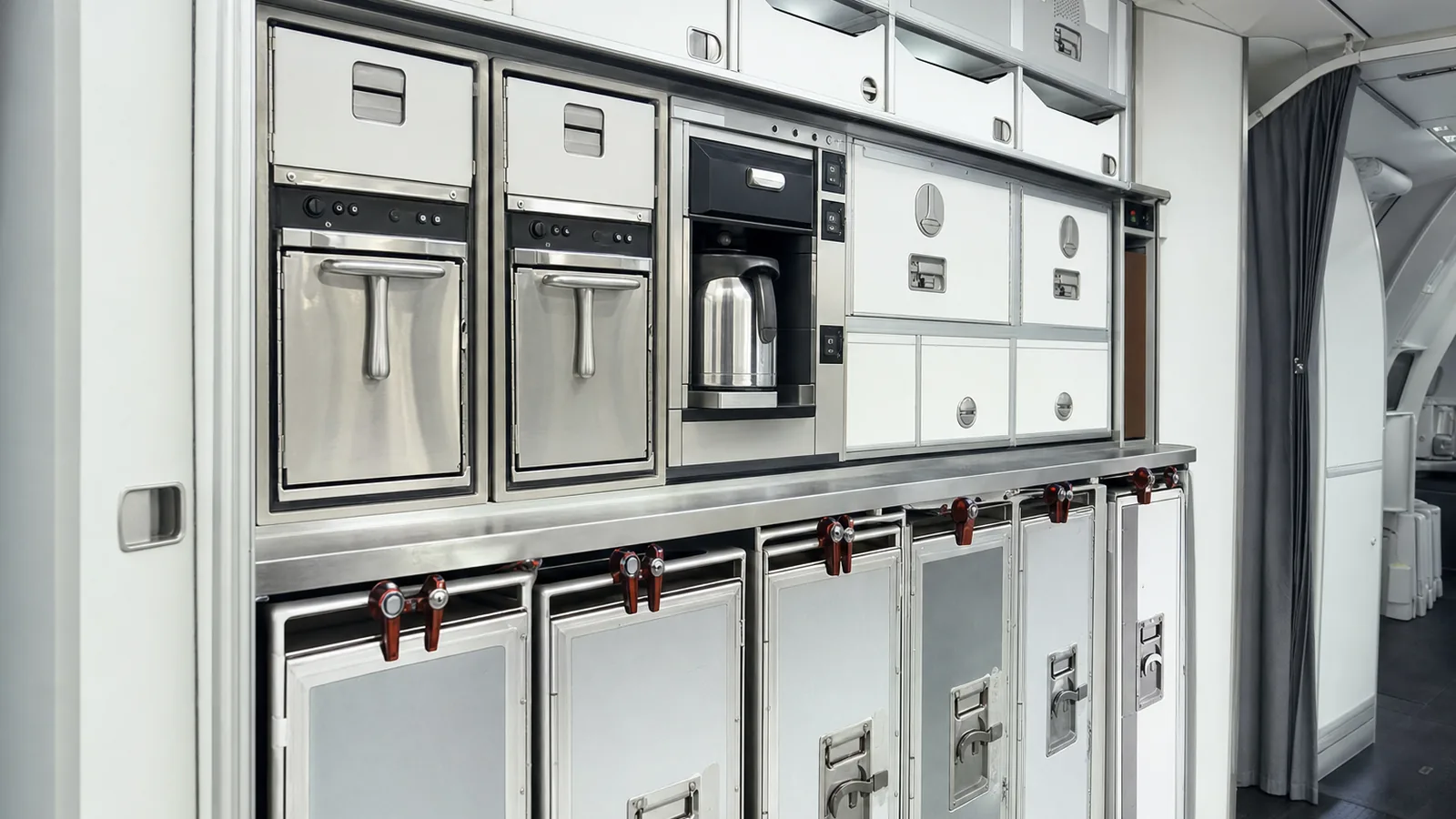
An aircraft galley has the same purpose as a ship's: store food and drink, heat it, keep it cold, serve it and bring the waste back. Almost everything else about it is different. The galley is a certified part of an aircraft; every kilogram in it is carried on every flight; it runs on the aircraft's own electrical system at a frequency no ground kitchen uses; and it is organised around standard trolleys and containers that are loaded by a caterer on the ground and rolled aboard during a short turnaround.
This guide explains how that system works: the trolley standards, the galley inserts and their interface standards, the power supply, the certification rules and the constraints that follow. It is an explanation of how aircraft galleys are built, not a buying guide for aviation parts, which are certified items sourced with their approvals.
A galley built around the trolley
Most cabin catering on an airliner is prepared on the ground. Meals, drinks, duty-free goods and waste are carried in trolleys and standard containers, loaded by the caterer, stowed in the galley and wheeled out along the aisle. The galley itself is largely a structure of trolley bays, container stowages and inserts, with worktops and electrical and water services in between.
That changes what galley equipment means. Instead of a hot line and a scullery, the working parts are:
- Trolleys, in full and half sizes, for meals, drinks and waste.
- Standard containers stowed in compartments above the trolleys.
- Inserts: ovens, beverage makers such as coffee makers and water boilers, and refrigeration or chilling units.
- The galley structure, with its worktops, stowages, electrical supply, potable water and waste water connections.
Trolley standards: ATLAS and KSSU
Two trolley standards dominate, named after the airlines that originated them.
- ATLAS is the most common size, used by about 80 % of airlines. It was named for its originating group of carriers: Alitalia, TAP, Lufthansa, Air France and Sabena.
- KSSU is named for KLM, Swissair, SAS and UTA.
Dimensions are close but not interchangeable:
- A full-size ATLAS trolley is about 0.3 m wide, 1.03 m tall and 0.81 m long, and weighs about 15 kg empty. A half-size ATLAS trolley is about 0.405 m long.
- KSSU trolleys share the height of about 103 cm and the width of about 30.5 cm, but are deeper: about 42.5 cm for a half size and about 85 cm for a full size.
The difference is small on paper and decisive in practice. Galley bays are built to one standard, and accessories for ATLAS trolleys do not fit KSSU trolleys and vice versa, so an airline's catering equipment, its caterers' equipment and its galleys have to agree.
Galley inserts and the ARINC standards
Ovens, beverage makers and refrigerators installed in a galley are called galley inserts. To let airlines and galley manufacturers use inserts from different suppliers, their interfaces are standardised:
- ARINC 810 defines the physical interfaces of galley insert (GAIN) equipment: standard dimensions, installation requirements, the electrical connector and cable, the potable water coupling, the waste water interface, and qualification and test guidance.
- ARINC 812 defines the data interfaces: communication over a Controller Area Network data bus between galley equipment, including the data content exchanged.
In practice this means an insert is specified by its envelope, connections and data interface as much as by what it cooks. A combi oven from a ship's galley and an aircraft oven do a related job, but share none of those interfaces.
Power: 115 V AC at 400 Hz
Aircraft electrical systems supply 115 V AC at 400 Hz, and galley inserts are built for it. The higher frequency is chosen for weight: high-frequency alternators need fewer copper windings, so alternators and transformers can be much smaller and lighter than their 50 or 60 Hz equivalents.
The trade-off is voltage drop. High-frequency systems suffer larger drops, and reactive drops can be as much as seven times larger than at 60 Hz. On an aircraft the distances are short, so the weight saving wins. On a ship the opposite applies: distances are longer, weight is less critical, and the low-voltage system typically runs at 440 V and 60 Hz under IEC 60092-201, or 400 V at 50 Hz.
Certification and safety rules
An aircraft galley is part of a certified aircraft, and its equipment has to meet airworthiness rules that have no marine equivalent. Three are particularly relevant.
Carts and containers
The US Federal Aviation Administration's technical standard order TSO-C175 covers galley carts, containers and associated components. It adopts SAE AS8056, Minimum Design and Performance of Airplane Galley In-Flight Carts, Containers, and Associated Components, as the minimum performance standard, with FAA modifications. SAE ARP4171 sets out safety considerations for food and beverage service carts.
Flammability
Under 14 CFR 25.853, on aeroplanes with a passenger capacity of 20 or more, galley structure, including the exposed surfaces of stowed carts and standard containers and the cavity walls exposed when not all carts are carried, must meet the tests in parts IV and V of appendix F, in addition to the general flammability requirements for compartment interiors.
Emergency landing loads
14 CFR 25.561 sets the ultimate inertia forces that an aeroplane's structure must withstand in an emergency landing: 3.0g upward, 9.0g forward, 3.0g sideward on the airframe and 4.0g on the seats, 6.0g downward and 1.5g rearward. Items of mass in the cabin must be positioned so that, if they break loose, they cannot injure occupants, damage fuel systems or block escape routes, or they must be restrained to withstand those loads. A loaded trolley or an oven is exactly such an item, so both have to be secured in their stowage.
Weight: the constraint behind everything
Every kilogram in an aircraft galley is carried on every flight, so weight shapes the galley more than any other factor. It explains the 400 Hz power system, lightweight trolleys, the standard containers that are filled on the ground rather than equipment that cooks from raw, and the preference for heating prepared food over cooking it.
It also explains why aircraft galleys are designed as integrated structures by specialist manufacturers, with the inserts, trolleys and services agreed together, rather than assembled from individual appliances as a ship galley is.
How an aircraft galley differs from a marine galley
The two share a name and a purpose, and differ in almost every specification:
- Power: aircraft 115 V AC at 400 Hz; ships typically 440 V at 60 Hz or 400 V at 50 Hz.
- Food production: aircraft mostly heat and chill food prepared on the ground; ships cook from raw for a whole voyage.
- Equipment standards: aircraft use ATLAS or KSSU trolleys and ARINC 810 and 812 inserts; ships use commercial catering equipment in marine builds, often in gastronorm sizes.
- Certification: aircraft galley equipment is part of the aircraft's airworthiness, with TSO-C175 for carts and 14 CFR 25.853 flammability rules for galley structure; marine galley equipment is chosen to meet the vessel's supply, sanitation inspections and SOLAS fire rules for fryers.
- Weight and water: an aircraft carries its water and weight on every sector; a ship makes or bunkers water and treats weight as a structural load.
Because of those differences, marine galley equipment is not certified for installation in an aircraft, and aircraft galley inserts are not built for a ship's supply. The equipment in this catalogue is marine equipment.
Related guides
The what is galley equipment guide compares ship, yacht and aircraft galleys at a general level. For marine galleys, the marine galley equipment guide explains what makes equipment marine-grade, and the guide to choosing galley equipment sets out how a vessel's galley is specified.
Frequently asked questions
What is the difference between ATLAS and KSSU trolleys?
Both are about 103 cm tall and about 30 cm wide, but KSSU trolleys are deeper: about 85 cm for a full size against about 81 cm for ATLAS. ATLAS is used by around 80 % of airlines, and accessories for one standard do not fit the other.
What power do aircraft galley ovens use?
Aircraft galley inserts run on the aircraft's 115 V AC, 400 Hz supply. The higher frequency allows smaller, lighter alternators and transformers, at the cost of larger voltage drops, which short distances on an aircraft make acceptable.
What is ARINC 810?
ARINC 810 defines the physical interfaces of galley insert equipment such as ovens, beverage makers and refrigerators: dimensions, installation, the electrical connector, potable water coupling and waste water interface. ARINC 812 covers their data communication over a CAN bus.
Which regulation covers aircraft galley carts?
FAA TSO-C175 covers galley carts, containers and associated components, adopting SAE AS8056 as the minimum performance standard. Galley structure on aeroplanes with 20 or more passenger seats must also meet the flammability tests of 14 CFR 25.853.
Can marine galley equipment be installed in an aircraft?
No. Aircraft galley equipment is part of the aircraft's certification, built to aviation interface standards and 115 V 400 Hz power; marine galley equipment is built for a ship's supply and is not certified for aircraft installation.