
Electrolux Professional Freezer 725234 – ecostore, 1 Door Digital Freezer, 670lt (-22/-15), AISI 304
670 lt vertical marine freezer, 503 lt net, −22/−15 °C on R290 with hidden evaporator and digital control. Electrolux ecostore 725234.
Upright one- and two-door digital freezers from the Electrolux Professional ecostore and Prostore ranges, from 470 to 1430 litres, holding between -15 and -22 °C.
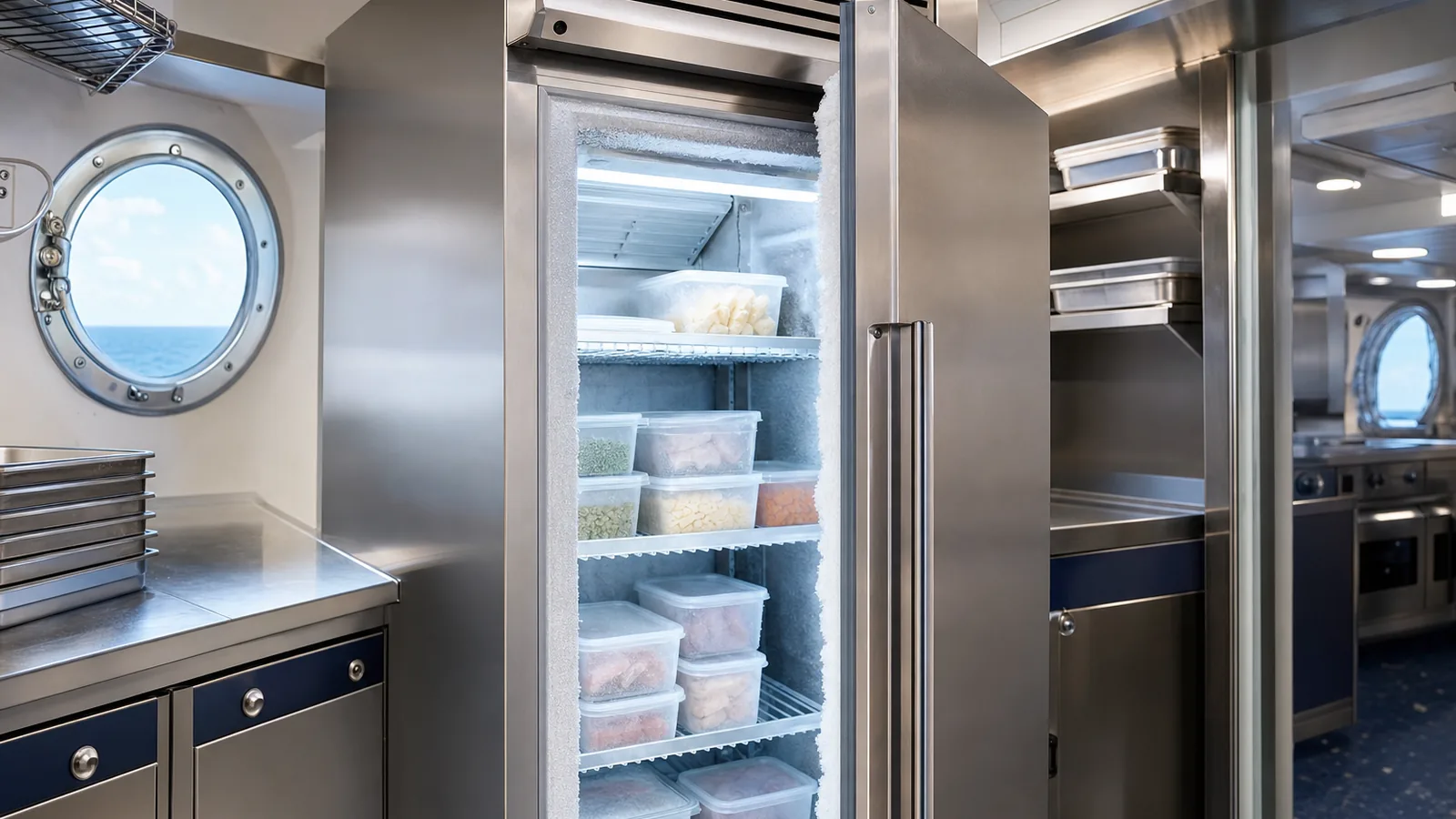
670 lt vertical marine freezer, 503 lt net, −22/−15 °C on R290 with hidden evaporator and digital control. Electrolux ecostore 725234.
Prostore 800 freezer, 720 liter gross / 501 lt net volume, 900x700x2040 mm, R290, −15/−22 °C, 220–240 V/1 ph/50 Hz. PNC 691393.
Two-door ecostore vertical freezer, 1430 liter gross, 1135 lt net, −22/−15 °C, AISI 304 with R290, digital control. PNC 725489.
Two-door ecostore marine freezer, 1430 l gross at −22/−15 °C on R290, 220–230 V/1 ph/60 Hz, full AISI 304 construction. PNC 725488.
ecostore vertical freezer, 670 liter gross and 503 lt net at −22/−15 °C, R290, AISI 304 inside and out. PNC 725458.
Prostore 500 marine freezer, 470 liter gross with 317 lt net volume, −22/−15 °C, 600 x 700 x 2040 mm, built-in R290 system. PNC 691388.
Prostore 500 marine freezer, 470 liter gross / 317 lt net at −22/−15 °C, 600×700 mm footprint, R290, 220–230 V/1 ph/60 Hz. PNC 691389.
Prostore 800 marine freezer, 720 l gross / 508 l net, 900x700 mm footprint, 220–230 V/1 ph/60 Hz, R290, digital control. PNC 691390.
A 470 litre Prostore 500 at 600 mm wide sits at one end of this range, while the 1430 litre two-door ecostore cabinet at 1441 mm wide sits at the other. That gives scope from compact stores for a single galley to central frozen rooms serving several pantries. Net volumes, where stated, show the practical difference: the 470 litre Prostore 500 holds 317 litres, while the largest ecostore carries 1135 litres.
For a technical buyer that spread is about deck space as much as storage. Prostore 500 and Prostore 800 hold 470 and 720 litres on footprints only 600 and 900 mm wide, useful in narrow servery backs or yacht galleys. ecostore freezers are wider, up to 1441 mm, and the largest of them takes GN 2/1 grids.
All eight freezers in this category are electric, with nameplates at either 220-230 V or 220-240 V, so integration on vessels with 230 V hotel services is straightforward, usually via a transformer from a 440 V main if required by the ship design. Half of the range is specified at 50 Hz and the other half at 60 Hz.
For mixed-fleet operators, the split between 50 Hz and 60 Hz makes it important to match cabinet choice to the actual board on the vessel. A 60 Hz-only freezer in a 50 Hz environment risks underperforming compressors; none of the freezers here names both frequencies, so on a fleet with both regimes the model has to be chosen per vessel.
All three series here – ecostore, Prostore 500 and Prostore 800 – are Electrolux Professional digital freezers with HACCP logging, network connectivity and tropicalised construction. ecostore carries capacities from 670 to 1430 litres on widths between 710 and 1441 mm, so the larger two-door cabinets are only available in this higher-capacity line. Prostore 500 is fixed at 470 litres and 600 mm width, and Prostore 800 at 720 litres and 900 mm width, giving two known footprints for layout work.
R290 refrigerant is used on most of the range, and every freezer in Prostore 500 and Prostore 800 carries it. In ecostore, R290 covers most but not all of the listed freezers, so where refrigerant policy is strict, the specifier should check each PNC. All units are tropicalised, so heat rejection is sized for high ambient temperature galleys and stores rather than back-of-house restaurant conditions ashore.
The largest ecostore freezer uses GN 2/1 grids, with six supplied as standard and a net volume of 1135 litres, so it ties directly into existing Gastronorm-based production and transport. The 470 litre Prostore 500 ships with four 520 x 442 grids rather than a Gastronorm size, and that difference drives how trolleys, inserts and containers are planned around the frozen store.
Across all three series, HACCP logging and network capability are standard features. On a ship that consolidates temperature records centrally, that means these cabinets can report directly into the galley monitoring system rather than relying on manual checks. For offshore and commercial vessels where audits look closely at frozen storage history, that is often as important as quoted temperature range.
This freezer category covers cabinets holding between -15 and -22 °C. For fresh-chill rooms, pastry, vegetable or general pantry work at higher temperatures, the sibling Refrigerators category is the correct place to look. Likewise, where a project needs mixed-temperature banks with both chill and freeze in matched footprints, pairing a freezer here with a matching refrigerator from that category will generally give a more coherent installation than attempting to run all storage from deep-frozen cabinets alone.
On this page the upright marine freezers run from 470 to 1430 litres. A central store can be built from the 1430 litre ecostore cabinets, with 670–720 litre units where a second, smaller position is needed.
Across the range, four products list 50 Hz and four list 60 Hz. The ecostore series splits evenly by frequency, while Prostore 500 and Prostore 800 each have one 50 Hz and one 60 Hz model, so the specific PNC must match the ship’s board.
R290 refrigerant appears on seven of the eight freezers in this category. In Prostore 500 and Prostore 800 it is present on both models; in ecostore it is present on three of the four, so individual specification should be checked for the remaining unit.
The tightest cabinets are the Prostore 500 freezers at 600 mm wide with 470 litres capacity. At the other end, the largest ecostore freezer is 1441 mm wide and holds 1430 litres, so layout planning can work within that 600–1441 mm span.
A walk through a working galley, station by station, and the equipment found at each: stores, preparation, the hot line, holding, warewashing and the laundry beside it.
Read guideWhat actually changes when a commercial appliance is built for a ship — supply, fixing, water protection, materials, hygiene construction, refrigerant and certification — and why shore equipment fails at sea.
Read guideHow a ship galley is planned from the people it feeds: crew size and service pattern, rotation and provisioning, volume cooking, the scullery, power and steam, fire rules and the laundry.
Read guide