

Miele Tumble Dryer PDR 908 [EL MAR 3N AC 400V 50-60Hz] – 8 kg, 400 V, Lotus white
8 kg Little Giants marine tumble dryer, 130 l drum, 42 min cottons at 0.5 kWh/kg, exhaust air, Lloyd’s Register approved. PDR 908 EL MAR.
8 kg · 6.4 kW
Marine laundry equipment for ships, yachts and offshore units: washing machines, tumble dryers, rotary ironers and washer dryer stacks, supplied for the vessel's own voltage and frequency.
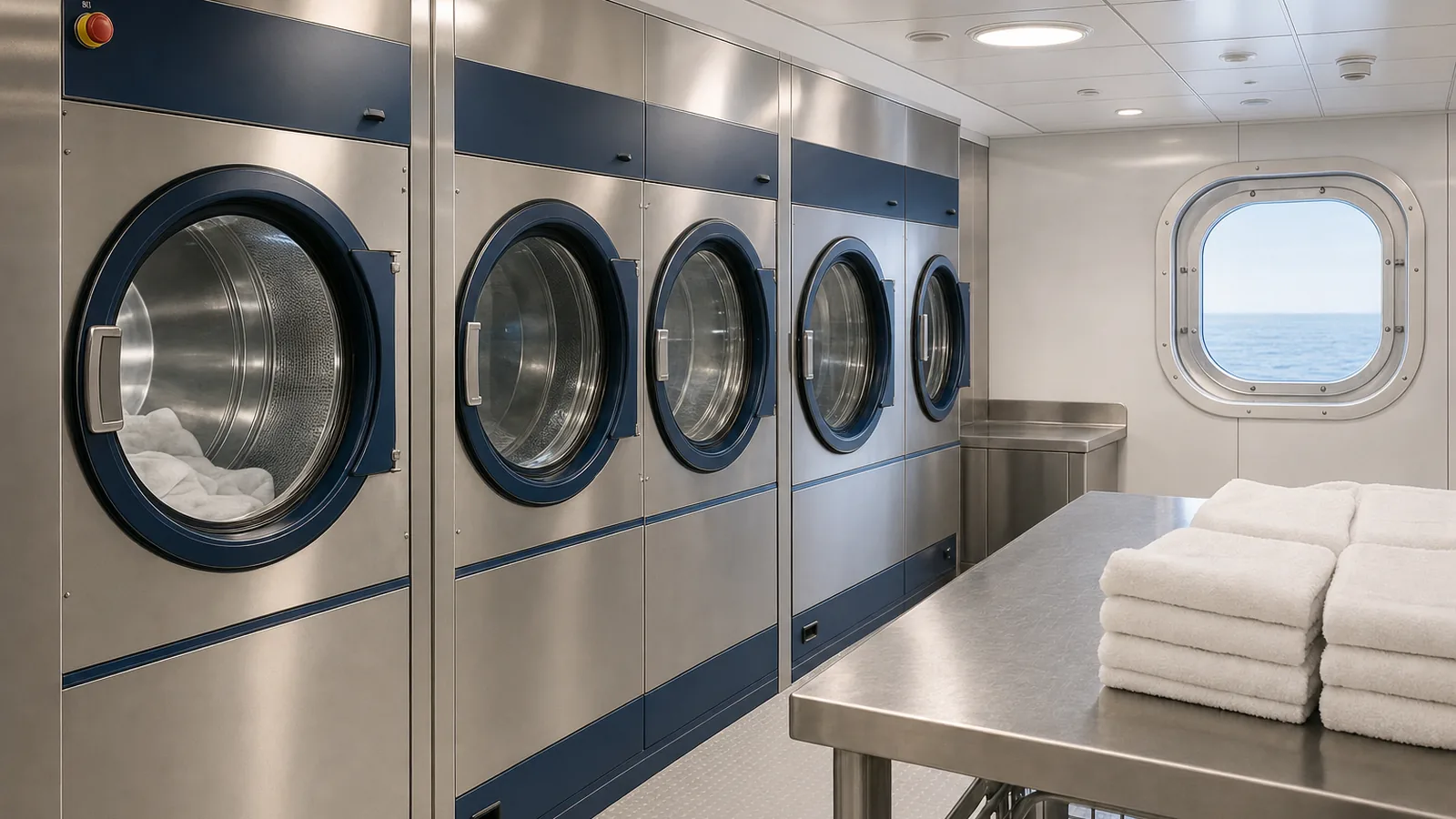
Marine laundry equipment means the commercial washers, dryers and ironers that handle crew and guest linen on board. A vessel needs them built for its own electrical supply and fixed in place against the motion of the sea, which is where they part ways with shore machines. All 113 listings below come from the Miele marine program, from a 6 kg Little Giants washer for a yacht pantry up to 44 kg Benchmark machines for a main laundry.
Miele Tumble Dryer PDR 908 [EL MAR 3N AC 400V 50-60Hz] – 8 kg, 400 V, Lotus white
8 kg Little Giants marine tumble dryer, 130 l drum, 42 min cottons at 0.5 kWh/kg, exhaust air, Lloyd’s Register approved. PDR 908 EL MAR.
Miele Tumble Dryer PDR 908 [EL MAR 3N AC 400V 50-60Hz] – 8 kg, 400 V, Stainless steel
8 kg Little Giants exhaust-air dryer, 130 l drum and 5.5 l/h evaporation, Miele PDR 908 [EL MAR 3N AC 400V 50-60Hz], Lloyd’s Register approved.
Miele Tumble Dryer PDR 908 HP [MAR 1N AC 230V 50Hz] – 8 kg, 230 V, Stainless steel
8 kg Little Giants heat‑pump dryer, 130 l drum, 1.44 kW at 230V~ 50HZ with Lloyd’s Register approval.
Miele Tumble Dryer PDR 908 HP [MAR 1N AC 230V 60Hz] – 8 kg, 230 V, Lotus white
Miele Little Giants PDR 908 HP MAR heat‑pump dryer, 8 kg with 130 l drum, 1.2 kW at 230V~ 60HZ, Lloyd’s Register approved for shipboard use.
Miele Tumble Dryer PDR 908 HP [MAR 1N AC 230V 60Hz] – 8 kg, 230 V, Stainless steel
8 kg Little Giants marine heat‑pump dryer, 1.2 kW at 230V~ 60HZ with 130 l drum and Lloyd’s Register approval. PDR 908 HP [MAR].
Miele Tumble Dryer PDR 908 HP [MAR 2 AC 208-240V 60Hz] – 8 kg, 208–240 V, Stainless steel
Miele Little Giants PDR 908 HP MAR heat‑pump dryer, 8 kg, 2~ 208–240 V 60 Hz, 1.2 kW, Lloyd’s Register approved for shipboard use.
Laundry Equipment by vessel, type and brand
A working laundry on board is usually built from four groups of machines:
Little Giants covers the small end: 6 to 8 kg loads, drums of 57 to 130 liters and widths of 596 to 606 mm, drawing 1.2 to 6.4 kW. That size suits a yacht crew area or a laundry tucked into a corridor recess. All of the series is listed as marine approved and offshore specified.
Benchmark starts at 9 kg and goes to 44 kg, with drums of 80 to 800 liters, widths of 700 to 1,206 mm and a load of 4.6 to 37.7 kW. It is the series for main laundries on ferries, cruise ships and offshore accommodation. Rotary ironers from the Professional series then turn that volume into finished linen. They run from 985 to 2,759 mm wide and draw 3.2 to 23.5 kW.
Listed supplies run from 208-240 V and 220-240 V up to 400 V, 400-480 V, 440 V and 450 V, and most machines are published for both 50 Hz and 60 Hz. Check the voltage, phase and frequency of the board first, because the model code changes with the supply. Nearly all of this equipment is electrically heated, and only two products use steam, so the laundry should be counted as an electrical load even on a vessel with steam available.
The catalog has 36 vented dryers and 6 heat pump dryers. A vented dryer needs an exhaust duct out through the structure and a path for make-up air. A heat pump dryer needs no exhaust, only a drain for the condensate, which makes it easier to place where a new duct cannot pass through a bulkhead or fire zone.
Net weights run from 39 kg to 692 kg across the range. The largest ironers are more than 2 m wide, so measure the route through doors and hatches before you measure the laundry itself, and allow for operators and service access around each machine.
Different vessels need different parts of this range. These pages narrow the list down:
Questions about marine laundry equipment
What is marine laundry equipment?
It is the commercial washing, drying and ironing machinery used on ships, yachts and offshore units. It is supplied for the vessel's own voltage and frequency and fixed in place on board.
How should I choose between Little Giants and Benchmark machines for a shipboard laundry?
Little Giants cover 6–8 kg loads with 57–130 litre drums and 1.2–6.4 kW power, in widths around 596–606 mm, making them suitable for smaller laundries and stacked columns. Benchmark runs from 9 to 44 kg with 80–800 litre drums and up to 37.7 kW, in widths from 700 to 1206 mm, better suited to main laundries on ferries, cruise ships and offshore units.
What voltages and frequencies are available for these marine laundry machines?
Across the 113 products, supply voltages include 208–240 V, 220–240 V, 230 V, 400 V, 400–480 V, 440 V and 450 V, so both low-voltage and 400+ V three-phase systems are covered. Frequencies of 50 Hz and 60 Hz are listed on most machines, meaning like-for-like models can be matched to different shipboard and shore-power standards.
When is a heat pump dryer preferable to an air-vented dryer on a vessel?
Heat pump dryers in this range are marked as "Heat pump (no vent)" and avoid the need for exhaust ducting, which is useful where cutting through bulkheads or decks for air vents is constrained. Air-vented dryers, of which there are 36 models, need an exhaust duct and a make-up air path through the vessel.
How much space and weight should I allow for a rotary ironer in a ship laundry?
Professional series rotary ironers span widths from 985 to 2759 mm and net weights from 39 to 458 kg, with electrical power between 3.2 and 23.5 kW. A large-unit main laundry needs to reserve both deck area for a machine more than 2,000 mm wide and enough structural capacity to carry several hundred kilograms plus the live load of operators.
Galley equipment besides laundry equipment


