
Electrolux Professional Vegetable Peeler 600875 – Vegetable Peeler, 25 kg - Abrasive Plate & Filter, Electrovalve
25-liter Electrolux Professional TI2536M vegetable peeler, up to 400 kg/hour, IP55, 220–277/380–480 V/3 ph/60 Hz marine-ready.
Planetary mixers, vegetable peelers and dough rollers for galleys preparing food at volume.
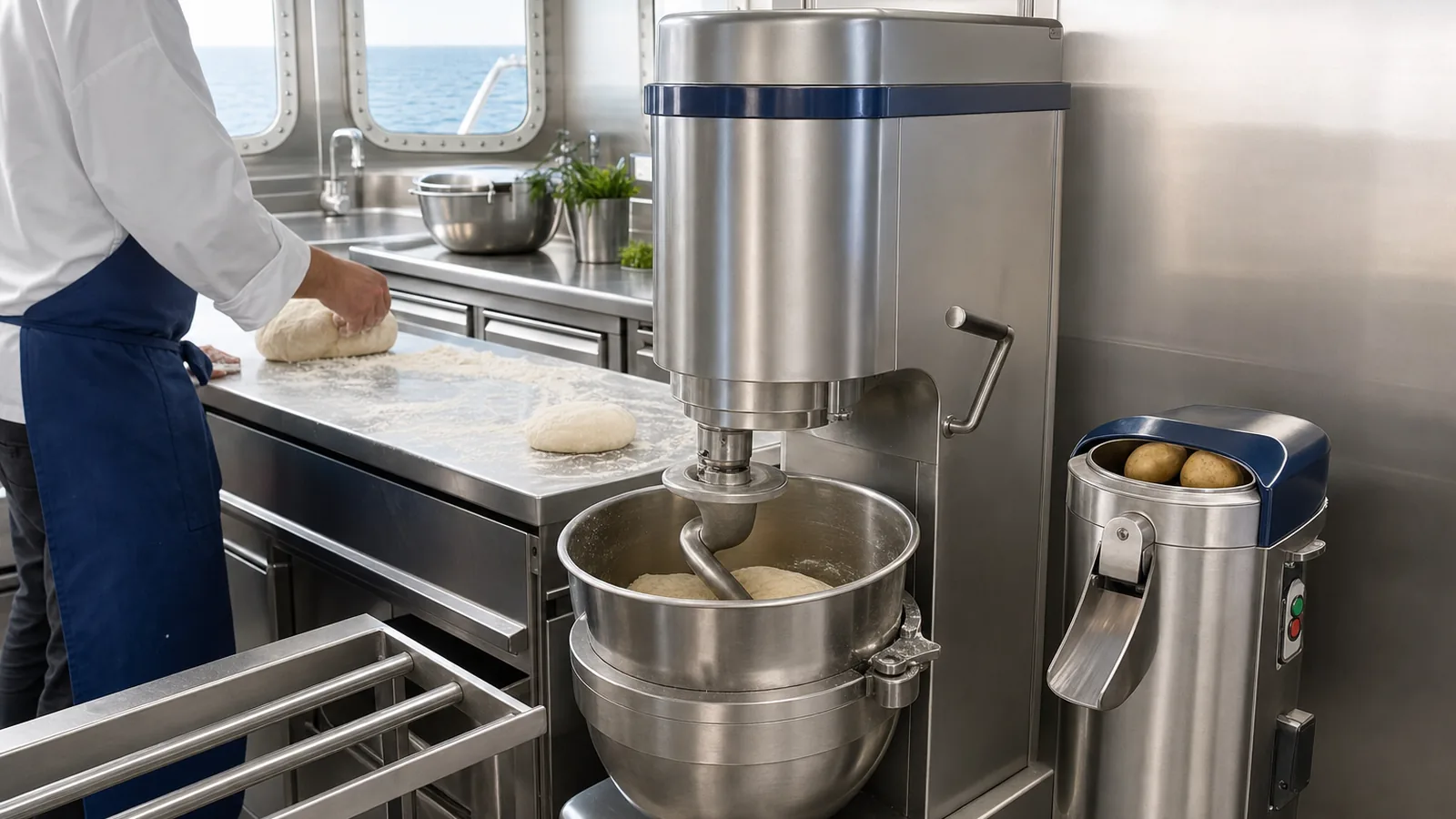
25-liter Electrolux Professional TI2536M vegetable peeler, up to 400 kg/hour, IP55, 220–277/380–480 V/3 ph/60 Hz marine-ready.
10‑liter countertop vegetable peeler rated up to 160 kg/hour, 100-120 V/1N/60 Hz, IP55, Electrolux Professional 600296.
60-liter planetary mixer 600286 with 20 kg cold water paste capacity and 440 V/3 ph/60 Hz marine supply.
From a 10 litre Electrolux Professional vegetable peeler up to a 129 litre MKN tilting dough roller, this category covers the bulk preparation work rather than finishing on the line. The smaller peeler quotes up to 160 kg per hour, which turns a sack of potatoes into a short batch job rather than a shift.
These units all run electric, which simplifies hook-up where steam is reserved for kettles and laundry. They take the repetitive bulk work off the galley team rather than off the cooking battery.
Widths in this group run from 440 mm to 685 mm on the listed products, so they sit comfortably in a 600 or 800 mm galley grid without awkward overhangs. The smallest vegetable peeler is 440 mm wide and 690 mm deep at a gross shipping weight of 49 kg, light enough for most deck structures but still needing a planned foundation and drain route. At the other end, the 129 litre MKN dough roller carries a net weight of 246 kg and a gross of 269 kg before product load, which is a material point for naval architects.
Heights and capacities matter for ergonomics as well as structure. A 10 litre chamber keeps loading and unloading close in and quick; once capacity climbs towards 129 litres the operator is working with long utensils and tilting or discharge becomes the specifier’s focus. In cramped galleys, the 401–600 mm width band on roughly half the line helps pull prep back from congested cooking aisles.
Across the four listed products, supply voltages span 100–120 V, 380–415 V, 440 V and 480 V. Three of them specify 60 Hz. The 100–120 V single-phase vegetable peeler suits smaller yachts or refit scenarios where only light-duty single-phase power is free in the prep area.
The higher-powered dough roller sits on 380–415 V with a quoted maximum electrical power of 20 kW, putting it into the same switchboard conversation as main cooking appliances. That figure drives cable sizing, breaker choice and discrimination, especially where other 20 kW-class units already sit on the same distribution section. Where ships operate mixed shore power at 50 Hz and onboard 60 Hz, matching the rated frequency of these motor-driven machines to the ship matters, because a motor run off its rated frequency does not run at its rated speed.
Facet data shows one product with AISI 316L wetted parts and one flagged as washdown protected. The 316L wetted interior matters where salt, starch and chlorinated cleaners linger, raising the corrosion threshold compared with 304 in those zones. Washdown protection ties directly to galley cleaning practice: where the galley is cleaned with a spray gun, the protected unit is the one that can stay in the wet zone.
This page holds four machines and is the wrong place when the task is cooking. Boiling at volume belongs with Boiling Kettles, searing and braising with Bratt Pans, and holding prepared food at temperature with Bain-Maries.
The Electrolux Professional 600296 peeler is 440 mm wide, 690 mm deep and 680 mm high, so it fits comfortably in a 600 mm module.
Yes, the category includes units specified at 440 V and three products list 60 Hz, which suits a 440 V/60 Hz ship distribution. One unit runs at 380–415 V with 20 kW max power, which is more suited to a three-phase galley board than to small local panels.
One product in this range is flagged with AISI 316L wetted parts, which is useful where salt, acids and chlorinated cleaners dwell in the bowl or tank. 316L resists pitting better than 304 where chlorides are present.
The MKN dough roller kettle in this category has a net weight of 246 kg and a gross of 269 kg before product, so fully loaded it adds a significant point load. Naval architects should factor that alongside the 129 litre capacity when checking deck plating and stiffener spans under the galley.
The constraints that actually decide a galley specification — service, power, space, water, heat, motion, materials and compliance — worked through in the order they bite.
Read guideA walk through a working galley, station by station, and the equipment found at each: stores, preparation, the hot line, holding, warewashing and the laundry beside it.
Read guideWhat actually changes when a commercial appliance is built for a ship — supply, fixing, water protection, materials, hygiene construction, refrigerant and certification — and why shore equipment fails at sea.
Read guide