

Miele Rotary Ironer PRI 318 [EL SOM LAM IB RF] – 3 AC 450V 50-60HZ, Octoblue
Rotary ironer PRI 318 with 300 mm roller, 1,750 mm width and 87 kg/h at 25% RM, 3 AC 440V 50–60HZ, Octoblue casing.
19.1 kW
Marine equipment by electrical supply
This page lists 440 V 60 Hz marine ironers: 7 Miele rotary ironers from the Professional series, rated 440-480 V for three-phase ship supplies and accepting 50 Hz as well as 60 Hz. Heating loads run from 5.8 kW on the PRI 210 to 24.6 kW on the PRI 421, and the example models connect as 3 AC, with no neutral conductor required.
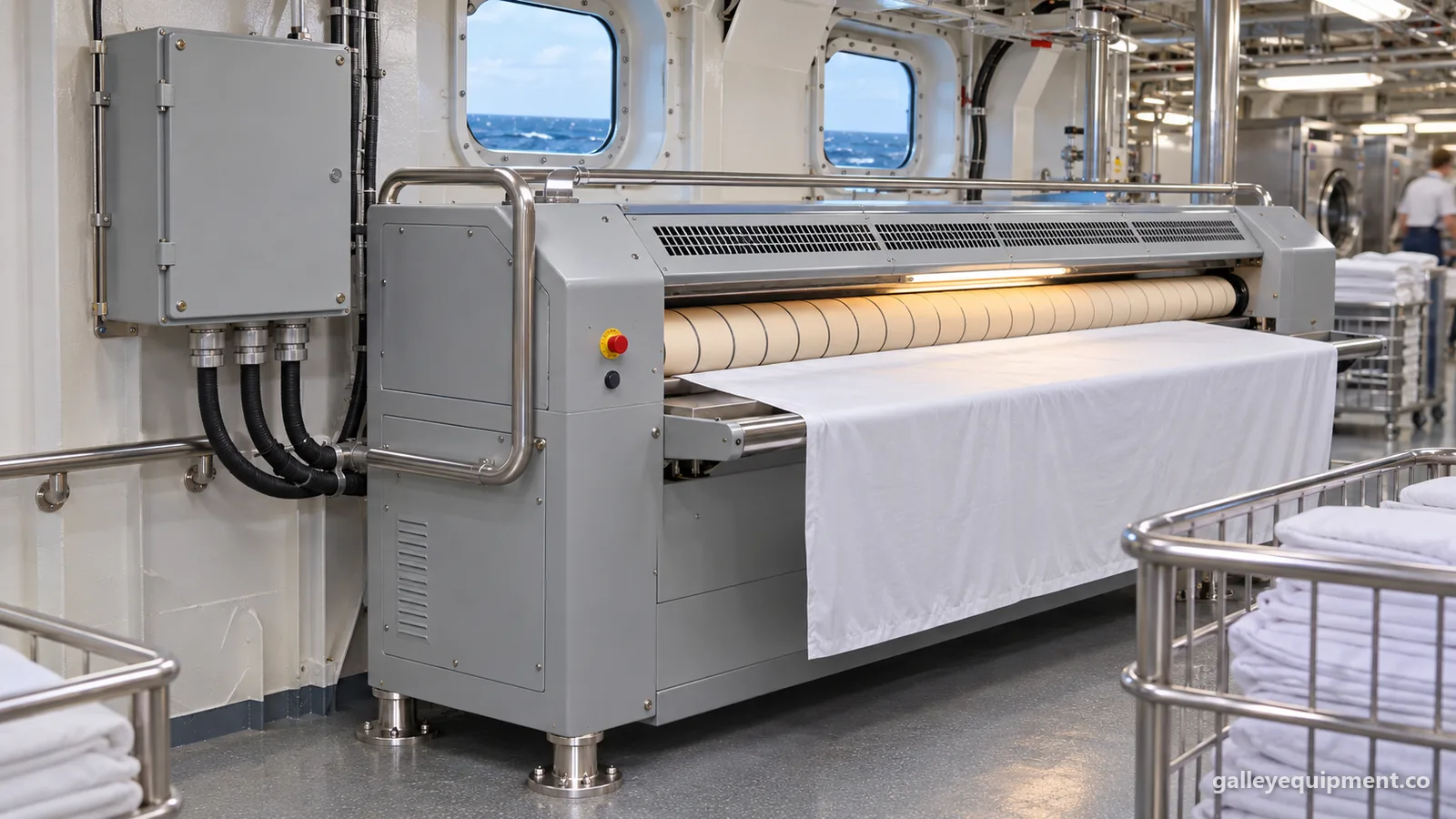
Miele Rotary Ironer PRI 318 [EL SOM LAM IB RF] – 3 AC 450V 50-60HZ, Octoblue
Rotary ironer PRI 318 with 300 mm roller, 1,750 mm width and 87 kg/h at 25% RM, 3 AC 440V 50–60HZ, Octoblue casing.
Miele Rotary Ironer PRI 418 [EL SOM LAM IB RF] – 3 AC 450V 50-60HZ, Iron grey
Miele PRI 418 rotary ironer, 365 mm roller and 1,750 mm width delivering up to 104 kg/h at 25% residual moisture for shipboard and offshore use.
Miele Rotary Ironer PRI 210 [EL SOM STW AB] – 3 AC 440V 50-60HZ, Iron grey
Miele PRI 210 rotary ironer, 30 kg/h at 15% RM across a 1,000 mm width, 3 AC 440V 50–60HZ for marine and offshore laundries.
Miele Rotary Ironer PRI 214 [EL SOM STW] – 3 AC 440V 50-60HZ, Iron grey
Rotary ironer with 210 mm roller and 1,400 mm working width, 35 kg/h at 25% RM. Miele PRI 214 [EL SOM STW], 3 AC 440V 50–60 Hz.
Miele Rotary Ironer PRI 217 [EL SOM STW] – 3 AC 440V 50-60HZ, Iron grey
Rotary ironer with 250 mm roller, 1,660 mm width and 64 kg/h output at 25% RM, 3 AC 440 V 50–60 Hz. PRI 217 [EL SOM STW].
Miele Rotary Ironer PRI 318 [EL SOM LAM IB RF] – 3 AC 450V 50-60HZ, Iron grey
Rotary ironer PRI 318 with 300 mm roller and 1,750 mm working width, 18.3 kW at 3 AC 440 V 50–60 Hz, iron grey, for offshore and shipboard use.
Miele Rotary Ironer PRI 421 [EL SOM LAM IB RF] – 3 AC 450V 50-60HZ, Iron grey
Miele PRI 421 rotary ironer, 365 mm roller, 2,040 mm working width, 113/67 kg/h at 25/50% RM, 3 AC 440 V 50–60 Hz.
The 440 V three-phase, 60 Hz supply is the standard main distribution on most large merchant ships, and the 440 V 60 Hz marine ironers in this list connect to it without a step-down transformer. Seven Miele rotary ironers from the Professional series are included, each rated 440-480 V and each accepting 50 Hz as well as 60 Hz. All seven are three-phase electric units.
Heating loads run from 5.8 kW to 24.6 kW. Two units fall in the 5 to 10 kW band, three in the 10 to 20 kW band and two in the 20 to 40 kW band, which leaves nothing below 5 kW: the selection is aimed at laundries that press linen for a full ship's company rather than a handful of cabins.
Six example models show the progression, and the seventh unit falls in the 10 to 20 kW band alongside the PRI 217 and PRI 318.
| Model | Name plate voltage | Heating kW | Band |
|---|---|---|---|
| PRI 210 | 3 AC 440V 50-60HZ | 5.8 kW | 5 - 10 kW |
| PRI 214 | 3 AC 440V 50-60HZ | 8.4 kW | 5 - 10 kW |
| PRI 217 | 3 AC 440V 50-60HZ | 13.9 kW | 10 - 20 kW |
| PRI 318 | 3 AC 450V 50-60HZ | 19.1 kW | 10 - 20 kW |
| PRI 418 | 3 AC 450V 50-60HZ | 23 kW | 20 - 40 kW |
| PRI 421 | 3 AC 450V 50-60HZ | 24.6 kW | 20 - 40 kW |
Heating load is the best single guide to how fast an ironer can process flatwork, because the roller has to take damp linen to dry and pressed in one pass. A cargo ship with a small crew presses mainly sheets and pillowcases and is well served by the PRI 217 rotary ironer at 13.9 kW or one of the smaller units. A vessel carrying large numbers of crew or passengers, with table linen from a dining service as well, moves up to the PRI 418 at 23 kW or the PRI 421.
Three examples are named for 440 V and three for 450 V, and all six fall inside the 440-480 V supply band the filter uses. On 440 V ships the generators are commonly set at 450 V, so that consumers at the end of long cable runs still see close to 440 V. Either label sits within the range the ship's voltage moves through between generator and consumer, and both connect to the same three-phase system. Heating output does follow the actual voltage, though, so a bus running well below nominal will lengthen pressing time.
Every example is marked 3 AC, which means three phases and no neutral conductor. That suits the insulated three-wire distribution used on most 440 V ships, where no neutral is brought to consumers and earth faults are monitored rather than tripped at once. An ironer that needed a neutral would require an isolating transformer with a star secondary; these do not. For the ship's electrician it means a three-core cable plus protective earth, with conductor size taken from the data-plate current.
For a ship that always runs 60 Hz, the dual rating mostly shows that the roller drive and any extraction fan were designed for either supply, so their speed stays within the maker's range. It becomes useful when the same ironer type is ordered for a fleet that mixes 50 Hz and 60 Hz hulls at 440 V, or when a vessel takes shore power at a different frequency during a long yard period. Heating elements ignore frequency and respond only to voltage. Our mixed-fleet frequency reference goes deeper into frequency mismatch and converters.
A rotary ironer works best in a laundry where washers and dryers share its supply, so that one switchboard section and one cable specification serve the whole room. The washer and dryer list for 440 V ships covers the rest of the line at the same voltage. Sheets can travel from washer to roller with some moisture left in them, since the heated roller completes the drying, and that keeps dryer time free for towels and work clothing while reducing the heat the laundry room has to reject.
Layout matters as much as wiring. The ironer needs clear space at both the feed and delivery sides, room for a folding table, and a route for the crate through hatches and doors that were often sized long before the laundry was planned.
A yacht or ship with a 400 V distribution should take the 400 V versions of these ironers instead, since a 440 V element on 400 V gives about 17% less heat and slower pressing. A vessel with only light flatwork, a few sheets per day, may not justify a fixed rotary ironer at all, and a laundry contract ashore or a hand press is the simpler answer. A 230 V-only supply rules out every unit on this page.
A complete first message lets our team propose a model and connection on the first reply:
Those points sent through the ironer quotation form are enough to match the ironer to the ship's wiring before anything is ordered.
Last reviewed by the Vista Marine galley engineering team.
Questions about 440 v 60 hz marine ironers
Can these ironers run on a 400 V supply?
They are rated 440-480 V, so a 400 V supply would leave the heating elements well short of their output, roughly 17% less heat, and pressing would slow down. A ship or yacht that distributes 400 V should use the 400 V versions of the same Miele rotary ironers, which are listed on the related 400 V page.
Do the 440 V ironers need a neutral conductor?
No. The example models are all marked 3 AC, meaning three phases without neutral, which matches the insulated three-wire 440 V systems used on most merchant ships. The supply cable needs three line conductors and a protective earth, chosen to suit the nameplate current of the selected ironer.
What is the largest ironer in this list?
The PRI 421 is listed at 24.6 kW, named for 3 AC 450 V 50-60 Hz, and the PRI 418 follows at 23 kW. These two make up the 20 to 40 kW band and suit laundries pressing bed and table linen in volume. Both need a dedicated circuit and clear space at the feed and delivery sides.
Is there a small 440 V ironer for a yacht?
The smallest unit here is the PRI 210 at 5.8 kW, followed by the PRI 214 at 8.4 kW. Neither is a small appliance, and both need a three-phase 440 V supply. Yachts more often run 400 V or 230 V, so the 400 V ironers or the yacht ironer selection are the usual starting points for them.
Why are some models named 440 V and others 450 V?
Both values sit inside the 440-480 V band. Ships commonly set generators at 450 V so that consumers see close to 440 V after cable losses, and the model names simply state a nominal value within that band. Either version connects to the same three-phase system without a transformer.
Related searches
Request a quotation for 440 v 60 hz marine ironers
Send the vessel type, supply voltage, frequency and phase and the quantities, and our team will come back with a specification and quotation.


