

Miele Rotary Ironer PRI 421 [EL SOM LAM IB RF] – 3N AC 400V 50-60HZ, Iron grey
Miele PRI 421 rotary ironer with 365 mm roller, 2040 mm width and up to 113 kg/h at 25 % residual moisture on 3N AC 400V 50–60HZ.
23.5 kW
Marine equipment by electrical supply
This page lists 400 V 60 Hz marine ironers: 12 Miele rotary ironers from the Professional series, each rated 380-415 V and accepting both 60 Hz and 50 Hz. All are three-phase electric units, with heated rollers drawing from 5 kW on the compact PRI 210 to 23.5 kW on the PRI 421, for use on yachts, ships and offshore accommodation units.
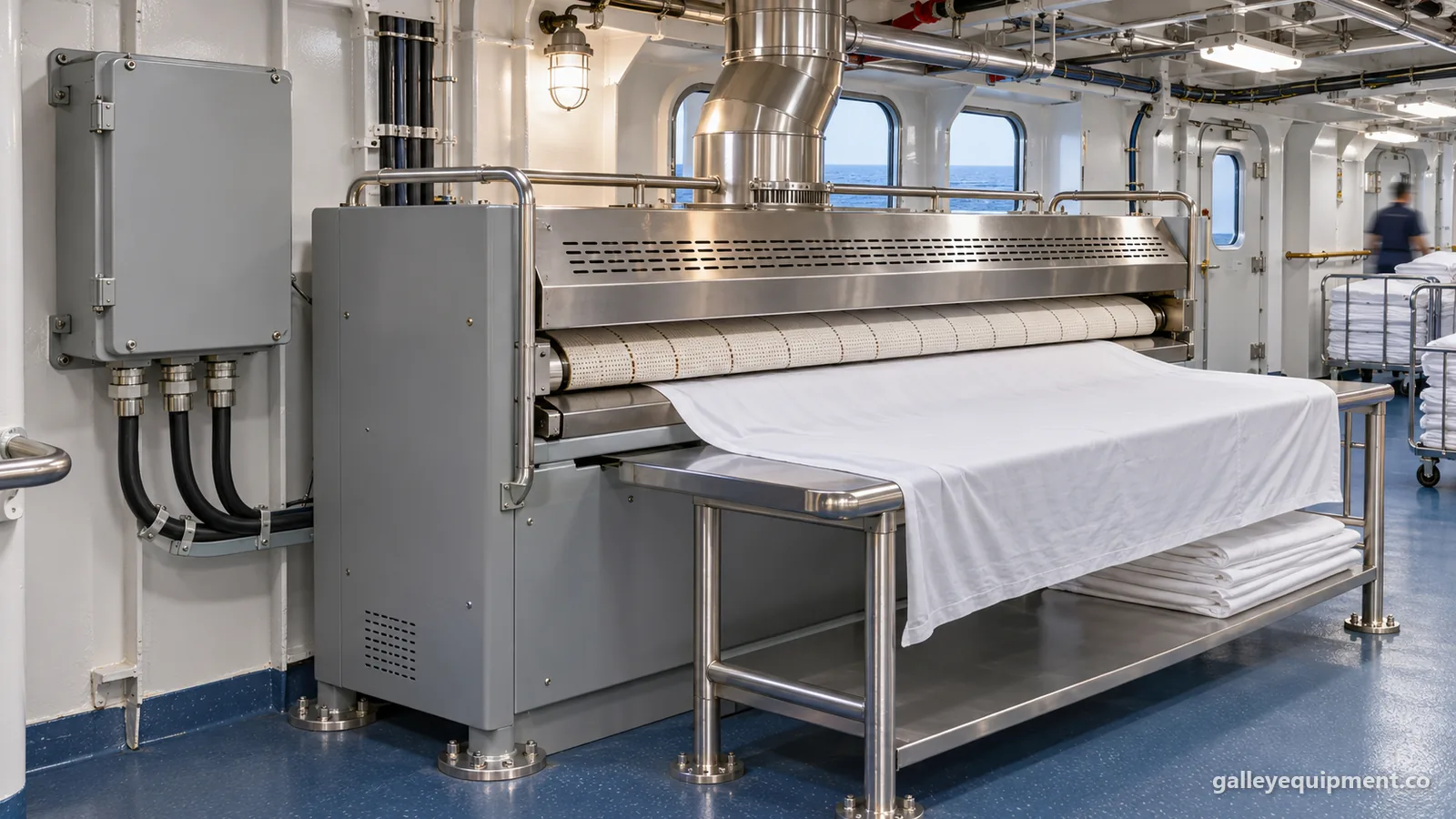
Miele Rotary Ironer PRI 421 [EL SOM LAM IB RF] – 3N AC 400V 50-60HZ, Iron grey
Miele PRI 421 rotary ironer with 365 mm roller, 2040 mm width and up to 113 kg/h at 25 % residual moisture on 3N AC 400V 50–60HZ.
Miele Rotary Ironer PRI 210 [EL SOM STW AB] – 3N AC 400V 50-60HZ, Iron grey
Miele PRI 210 rotary ironer, 30 kg/h at 15% RM over 1,000 mm width, 210 mm roller, 3N AC 400V 50–60HZ for shipboard use.
Miele Rotary Ironer PRI 214 [EL SOM STW] – 3N AC 400V 50-60HZ, Iron grey
Rotary ironer PRI 214 with 210 mm roller, 1,400 mm width and 33 kg/h output at 25% RM, 3N AC 400V 50–60HZ, steel-wool padding.
Miele Rotary Ironer PRI 214 [EL SOM STW] – 3 AC 400V 50-60HZ, Iron grey
Rotary ironer PRI 214 [EL SOM STW] with 210 mm roller, 1,400 mm width and 33 kg/h output at 25% residual moisture for marine laundries.
Miele Rotary Ironer PRI 217 [EL SOM STW] – 3N AC 400V 50-60HZ, Iron grey
Rotary ironer PRI 217 with 250 mm roller, 1,660 mm width, 60 kg/h at 25% RM, 3N AC 400V 50–60 Hz, specified for shipboard use.
Miele Rotary Ironer PRI 318 [EL SOM LAM IB RF] – 3 AC 400V 50-60HZ, Octoblue
Rotary ironer PRI 318 with 300 mm roller, 1,750 mm working width and 87 kg/h at 25% RM, 3 AC 400V 50–60HZ, Octoblue.
Miele Rotary Ironer PRI 318 [EL SOM LAM IB RF] – 3N AC 400V 50-60HZ, Octoblue
Rotary ironer with 300 mm roller and 1,750 mm working width, 87 kg/h at 25% RM, electric 18.3 kW, 3N AC 400V 50–60HZ, Octoblue casing.
Miele Rotary Ironer PRI 318 [EL SOM LAM IB RF] – 3 AC 400V 50-60HZ, Iron grey
Rotary ironer PRI 318 with 300 mm roller, 1,750 mm working width and up to 87 kg/h output at 25% residual moisture, 3 AC 400 V 50–60 Hz.
Miele Rotary Ironer PRI 318 [EL SOM LAM IB RF] – 3N AC 400V 50-60HZ, Iron grey
Rotary ironer PRI 318 with 300 mm roller, 1,750 mm width and 87 kg/h output at 25% residual moisture, 3N AC 400 V 50–60 Hz, iron grey.
Miele Rotary Ironer PRI 418 [EL SOM LAM IB RF] – 3 AC 400V 50-60HZ, Iron grey
Rotary ironer PRI 418 with 365 mm roller, 1,750 mm working width and 104 kg/h output at 25% residual moisture, 3 AC 400 V 50–60 Hz.
Miele Rotary Ironer PRI 418 [EL SOM LAM IB RF] – 3N AC 400V 50-60HZ, Iron grey
PRI 418 rotary ironer, 365 mm roller, 1,750 mm width, up to 104 kg/h at 25% RM, 3N AC 400 V 50–60 Hz, iron grey.
Miele Rotary Ironer PRI 421 [EL SOM LAM IB RF] – 3 AC 400V 50-60HZ, Iron grey
Rotary ironer PRI 421 with 365 mm roller, 2,040 mm working width and 113 kg/h max output at 25% residual moisture for marine laundries.
Twelve rotary ironers make up this list, all from the Miele Professional series and each carrying a 380-415 V, dual 50/60 Hz rating. Every one is a three-phase electric unit. The 400 V 60 Hz marine ironers therefore suit a vessel whose power system follows European voltage practice while its generators run at 60 Hz, a combination found on yachts built in Europe for charter in American waters and on ships ordered by owners who operate on 60 Hz.
Heating loads span 5 kW to 23.5 kW. One unit sits at or below 5 kW, two between 5 and 10 kW, five between 10 and 20 kW, and four above 20 kW, so the selection reaches from a compact ironer for a yacht crew laundry to machines sized for continuous flatwork on a large ship. All twelve are marked for yacht, ship, commercial vessel and offshore galley use.
Heating load is the quickest guide to throughput, since the heated roller has to dry and press linen at the speed it passes through.
| Model | Rated connection | Roller heating | kW band |
|---|---|---|---|
| PRI 210 | 3N AC 400V 50-60HZ | 5 kW | Up to 5 kW |
| PRI 214 | 3N AC 400V 50-60HZ | 7 kW | 5 - 10 kW |
| PRI 217 | 3N AC 400V 50-60HZ | 11.6 kW | 10 - 20 kW |
| PRI 318 | 3 AC 400V 50-60HZ | 18.3 kW | 10 - 20 kW |
| PRI 418 | 3 AC 400V 50-60HZ | 22 kW | 20 - 40 kW |
| PRI 421 | 3N AC 400V 50-60HZ | 23.5 kW | 20 - 40 kW |
These six examples cover every power band, and the remaining six entries in the grid fall into the same bands. A yacht with guest cabins and a crew mess usually presses napkins, pillowcases and sheets daily, and the PRI 210 compact rotary ironer at 5 kW handles that on a modest circuit. Laundries serving a full ship's company, or an offshore accommodation block, move up to the PRI 318, the PRI 418 or the PRI 421 at 23.5 kW. Roller width differs between models, and the working width should be checked against the largest sheet or tablecloth carried on board.
Four of the example models carry 3N AC in their names and two carry 3 AC. The N marks a neutral conductor: a 3N AC ironer expects three phases plus neutral, while a 3 AC ironer needs the three phases only. Many ships distribute 400 V as an insulated three-wire system with no neutral brought to consumers, and on such a vessel a 3N AC machine needs a neutral source, typically an isolating transformer with a star-connected secondary, or the 3 AC version instead. Yachts built to shore-style practice usually carry a neutral, and both versions then connect directly.
This one detail causes more surprises at installation than voltage or frequency, so it belongs in the first exchange about any rotary ironer on board.
Very little, because the main load is resistive heating, and heating elements respond to voltage rather than frequency. The parts that do care are the roller drive and any extraction fan, which would turn faster on 60 Hz if built only for 50 Hz. All 12 ironers here are rated 50-60 Hz, so the drive is designed for either supply and roller speed stays within the maker's range.
Voltage is the sensitive value. An element rated 400 V delivers about 10% less heat on a bus sagging to 380 V, which lengthens ironing time on a busy day. For fleets that mix frequencies, the frequency explainer for heated rollers walks through where converters help and where they only add weight.
A rotary ironer normally stands after the dryers in the laundry flow, and in many shipboard laundries flatwork goes to the roller slightly damp, so the ironer finishes the drying while it presses. That frees the dryers for towels and garments while sheets bypass them, which shortens the cycle for the whole room. The space plan needs a clear area at the feed side and the delivery side, plus a table for folding pressed linen.
Ironers at this voltage sit comfortably beside washers and dryers on the same supply, and the washers and dryers on the same 400 V supply show the full line so that one cable specification covers the room.
Three cases point elsewhere. A merchant ship that distributes 440 V and has no 400 V board should look at the ironers rated for 440 V ship supplies, which avoid a transformer. A small yacht where flatwork amounts to a few sheets a week rarely justifies a fixed rotary ironer at all, and a hand press or a laundry contract ashore may be more sensible. And a buyer searching by vessel rather than supply, typing something like "yacht ironer", will find the ironers grouped for yachts a faster route.
Pricing an ironer is quick once the electrical and space facts are known. The useful set is:
Those details sent with a rotary ironer quotation request let the right voltage and connection variant be offered first time.
All twelve units are Miele and all belong to the Professional series. The colour names in the model descriptions, iron grey and Octoblue, refer to finishes, and the bracketed codes such as EL, SOM, STW and LAM identify build options within each model. The ironers category carries every voltage and frequency variant, which helps when one fleet needs the same model at different supplies.
Last reviewed by the Vista Marine galley engineering team.
Questions about 400 v 60 hz marine ironers
Do these ironers run on both 50 Hz and 60 Hz?
Yes. Each of the 12 Miele Professional rotary ironers here is dual rated, 50 Hz or 60 Hz, within the 380-415 V band. The heating is resistive and follows voltage, and the roller drive is designed for either frequency. A vessel that changes generator frequency during a refit, or runs on shore power in different regions, can keep the same ironer as long as the voltage stays in that band.
What is the difference between 3N AC and 3 AC versions?
A 3N AC ironer needs three phases plus a neutral conductor, while a 3 AC ironer uses three phases only. In this list the PRI 210, PRI 214, PRI 217 and PRI 421 examples are 3N AC, and the PRI 318 and PRI 418 are 3 AC. Ships with an insulated three-wire 400 V system often have no neutral available at the laundry.
How much power does the largest ironer draw?
The PRI 421 is listed at 23.5 kW, the highest heating load among the examples, and four units in the selection fall in the 20 to 40 kW band. At 400 V three-phase that load needs a dedicated circuit whose cable and breaker follow the nameplate current, and the generator plan should allow for it running alongside the dryers.
Which ironer suits a small yacht laundry?
The PRI 210 at 5 kW is the smallest unit here and the only one in the up-to-5 kW band. It suits crew laundries pressing napkins, pillowcases and a moderate amount of bed linen. The PRI 214 at 7 kW is the next step for a busier yacht. Both still need a three-phase 400 V supply with a neutral.
Can a 400 V ironer be fed from a 440 V ship supply?
Only through a transformer that brings the voltage down into the 380-415 V band. Running a 400 V element at 440 V raises its heat output by roughly a fifth and shortens its life, so a direct connection is not acceptable. Where no 400 V board exists, the 440 V ironers on the related page avoid the extra transformer.
Related searches
Request a quotation for 400 v 60 hz marine ironers
Send the vessel type, supply voltage, frequency and phase and the quantities, and our team will come back with a specification and quotation.


