

Miele Tumble Dryer PDR 507 [EL MAR] – 7 kg, 3~ 440V 50/60HZ, Lotus white
7 kg Little Giants marine tumble dryer, 130 l drum, 0.5 kWh/kg specific energy use, PDR 507 [EL MAR] with Lloyd's Register approval.
7 kg · 5.4 kW
Marine equipment by electrical supply
Miele supplies the seven 440 V 60 Hz marine tumble dryers shown here: six Benchmark machines and one Little Giants unit, all air vented and three-phase, for ships whose laundry is fed straight from a 440-480 V bus. Rated power climbs from 5.4 kW for the 7 kg PDR 507 to 44.1 kW on the PDR 944, and every build also carries a 50 Hz rating.
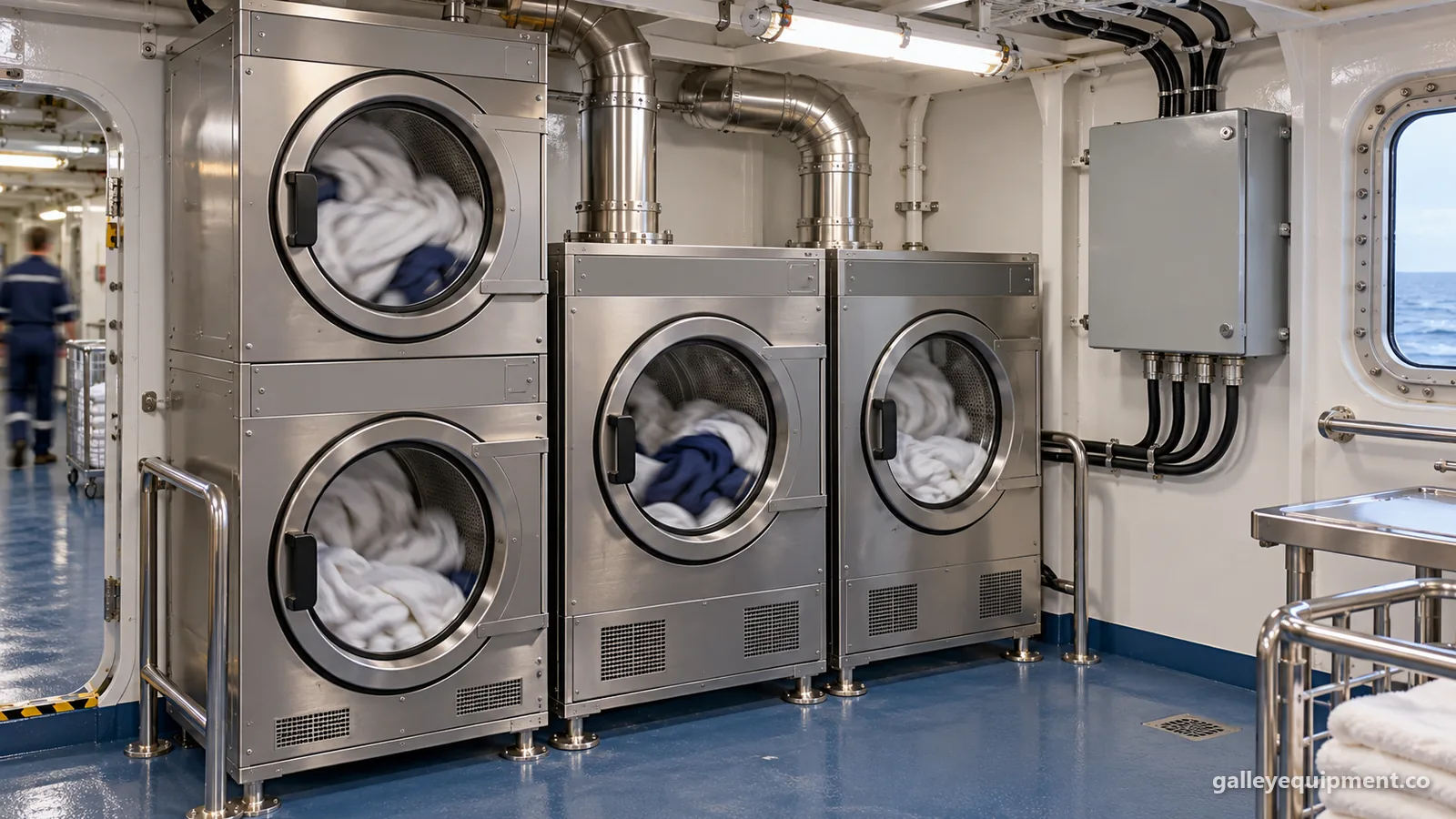
Miele Tumble Dryer PDR 507 [EL MAR] – 7 kg, 3~ 440V 50/60HZ, Lotus white
7 kg Little Giants marine tumble dryer, 130 l drum, 0.5 kWh/kg specific energy use, PDR 507 [EL MAR] with Lloyd's Register approval.
Miele Tumble Dryer PDR 914 [EL SOM] – 3 AC 480V 50/60HZ, Stainless steel
Benchmark Performance Plus marine vented dryer, 14 kg at 1:18 in a 250 l drum, 24 min cycle on 3 AC 440V 50/60HZ.
Miele Tumble Dryer PDR 918 [EL SOM] – 3 AC 480V 50/60HZ, Stainless steel
Benchmark PDR 918 [EL SOM] marine exhaust-air dryer, 18 kg load at 325 l drum volume, 3 AC 440V 50/60HZ, with M Touch Pro controls.
Miele Tumble Dryer PDR 922 [EL SOM] – 3 AC 480V 50/60HZ, Stainless steel
16–22 kg Benchmark Performance Plus vented dryer, 400 l drum, 3 AC 440V 50/60HZ, PDR 922 [EL SOM] for offshore and shipboard use.
Miele Tumble Dryer PDR 928 [EL SOM] – 3 AC 480V 50/60HZ, Stainless steel
Miele PDR 928 EL SOM Benchmark exhaust dryer, 28 kg at 1:18 in a 500 l drum, 3 AC 440V 50/60HZ.
Miele Tumble Dryer PDR 944 [EL SOM] – 3 AC 480V 50/60HZ, Stainless steel
Miele PDR 944 [EL SOM] Benchmark exhaust-air dryer, 800 l drum for 32–44 kg loads on 3 AC 440V 50/60HZ.
Miele Tumble Dryer PDR 910 [EL SOM] – 3 AC 440V 50/60HZ, Stainless steel
Benchmark Performance Plus exhaust-air marine dryer, 10 kg at 1:18 in a 180 l drum with 44 min programme. PDR 910 [EL SOM].
Six Benchmark models and one Little Giants unit form the whole list of 440 V 60 Hz marine tumble dryers, and its brevity reflects how specific the supply is. These machines connect directly to the 440-480 V three-phase systems used on most large merchant ships, offshore units and commercial vessels, without a step-down transformer between the switchboard and the laundry.
The application data lists all seven for offshore use and for yachts, six for commercial vessels and one for boats, the last being the compact PDR 507. None of them uses a heat pump, none is single-phase, and each is dual-rated for 50 and 60 Hz.
Higher voltage means lower current for the same power, and on a ship with long cable runs that saves copper, weight and space in the cable trays. A 440 V, 60 Hz three-phase network became the common choice for large merchant vessels and many offshore installations, with lighting and small loads stepped down to lower voltages. Large dryers are among the loads that make sense to keep on the main voltage, because their heating elements draw tens of kilowatts.
For a purely resistive load, the 44.1 kW PDR 944 draws in the region of 58 A per line at 440 V. Fed through a transformer at 230 V, the same heat would need nearly twice that current on the secondary side. The notes on frequency and voltage for 440 V hotel buses map what changes when a vessel mixes 50 Hz and 60 Hz equipment.
The table lists all seven models with the figures their listings publish.
| Model | Series | Rated power | Where it fits |
|---|---|---|---|
| PDR 507 | Little Giants | 5.4 kW, 7 kg load | Officers' or small crew laundry |
| PDR 910 | Benchmark | 5.5 kW | Second dryer beside a larger unit |
| PDR 914 | Benchmark | 16.5 kW | Mid-size crew of a cargo vessel |
| PDR 918 | Benchmark | 21.8 kW | Larger crew, daily linen change |
| PDR 922 | Benchmark | 27.5 kW | Busy laundry with heavy workwear |
| PDR 928 | Benchmark | 33 kW | Offshore unit or ferry crew laundry |
| PDR 944 | Benchmark | 44.1 kW | Central laundry with continuous loads |
The brackets hold one model up to 5 kW, one at 5-10 kW, a pair at 10-20 kW and a trio at 20-40 kW, with the PDR 944 above them all.
The supply group is 440-480 V, and the voltage labels inside it are 440 V on five listings, 480 V on one and 400 V on one. The Benchmark examples are marked 3 AC 480V 50/60HZ, while the PDR 507 for 3~ 440V and the PDR 910 for 3 AC 440V carry the lower figure. All of them belong to the same supply class and are offered for vessels with a 440 V bus.
Because a heating element's output follows the square of the applied voltage, the published kilowatt figure depends on the voltage at which it was rated. Engineers doing the load balance should use the rated figure from the listing and check it against the actual bus voltage on board, which on many ships sits close to 440 V under load.
All seven builds are three-phase without a neutral marking, which suits the insulated distribution many ships use at 440 V. The dryer connects to three line conductors and a protective earth, and the vessel's insulation monitoring continues to watch the circuit. No neutral has to be brought to the laundry, which avoids a transformer just for the dryer. An earth fault on a dryer heater then raises an insulation alarm rather than tripping the circuit at once, so the engineers can isolate the machine at a convenient moment instead of losing the laundry feeder in the middle of a cycle.
Each of the seven still needs its own exhaust route. On a steel ship the DN 100 duct is normally led to a weather-protected outlet through a casing or outer bulkhead, with access for regular lint cleaning, and those looking for 60hz dryers for ships on a 440 V network will find this duct requirement on every model here.
Seven models is a narrow choice, and the page is the wrong starting point for vessels that feed the laundry from a 400 V or 230 V board, or for anyone needing a ductless dryer. The full vented ship dryer selection carries 36 models across 208 V to 480 V, and the European-practice 400 V selection covers vessels built to European distribution practice. A shore-side 115-125 lb commercial electric dryer for 480 V, 60 Hz and 3 ph belongs to land laundries and is a different class of machine from the marine builds listed.
Include the vessel type and persons on board, the bus voltage and frequency, confirmation that the network is three-phase without neutral, and the circuit capacity available at the laundry. Describe the exhaust route and space, and say whether washers and ironers from the 440 V 60 Hz laundry equipment range are needed alongside. Send it to our team through the 440 V dryer quotation form, and the reply lists the matching builds.
Last reviewed by the Vista Marine galley engineering team.
Questions about 440 v 60 hz marine tumble dryers
Which 440 V 60 Hz marine tumble dryers are available?
Seven Miele models: the Little Giants PDR 507 with a 7 kg load at 5.4 kW, and the Benchmark PDR 910, PDR 914, PDR 918, PDR 922, PDR 928 and PDR 944. Rated power rises from 5.5 kW on the PDR 910 to 44.1 kW on the PDR 944. All seven are air vented, three-phase and rated for 50 Hz as well as 60 Hz.
Do these dryers need a neutral conductor?
The seven builds are listed as three-phase with markings such as 3 AC 480V or 3~ 440V, which do not call for a neutral. That suits insulated ship networks where no neutral is distributed. The dryer needs three line conductors and a protective earth, and the circuit can be watched by the vessel's insulation monitoring.
How much current does the largest 440 V dryer draw?
The PDR 944 is listed at 44.1 kW. Treated as a resistive load on a 440 V three-phase supply, that works out at about 58 A per line. The feeder, breaker and cable should be sized by the electrical designer using the listed rating and the actual bus voltage, alongside every other laundry machine on that circuit.
Can a 440 V dryer be used on a 50 Hz ship?
Yes, if the ship has a 440-480 V supply. Each of the seven is dual-rated for 50 and 60 Hz, so the frequency is not the limit. What matters is the voltage class. A 50 Hz vessel with a 400 V board would choose from the 400 V builds instead, since heating elements are rated for a specific voltage.
Why is there only one compact model on the 440 V page?
The compact Little Giants series is aimed mainly at yachts and small vessels on lower-voltage circuits. In the 440-480 V supply class only the PDR 507 for 3~ 440V appears, with a 7 kg load and a 5.4 kW rating. Ships on a 440 V bus that need more capacity move to the Benchmark models, which start at 5.5 kW.
Request a quotation for 440 v 60 hz marine tumble dryers
Send the vessel type, supply voltage, frequency and phase and the quantities, and our team will come back with a specification and quotation.


