
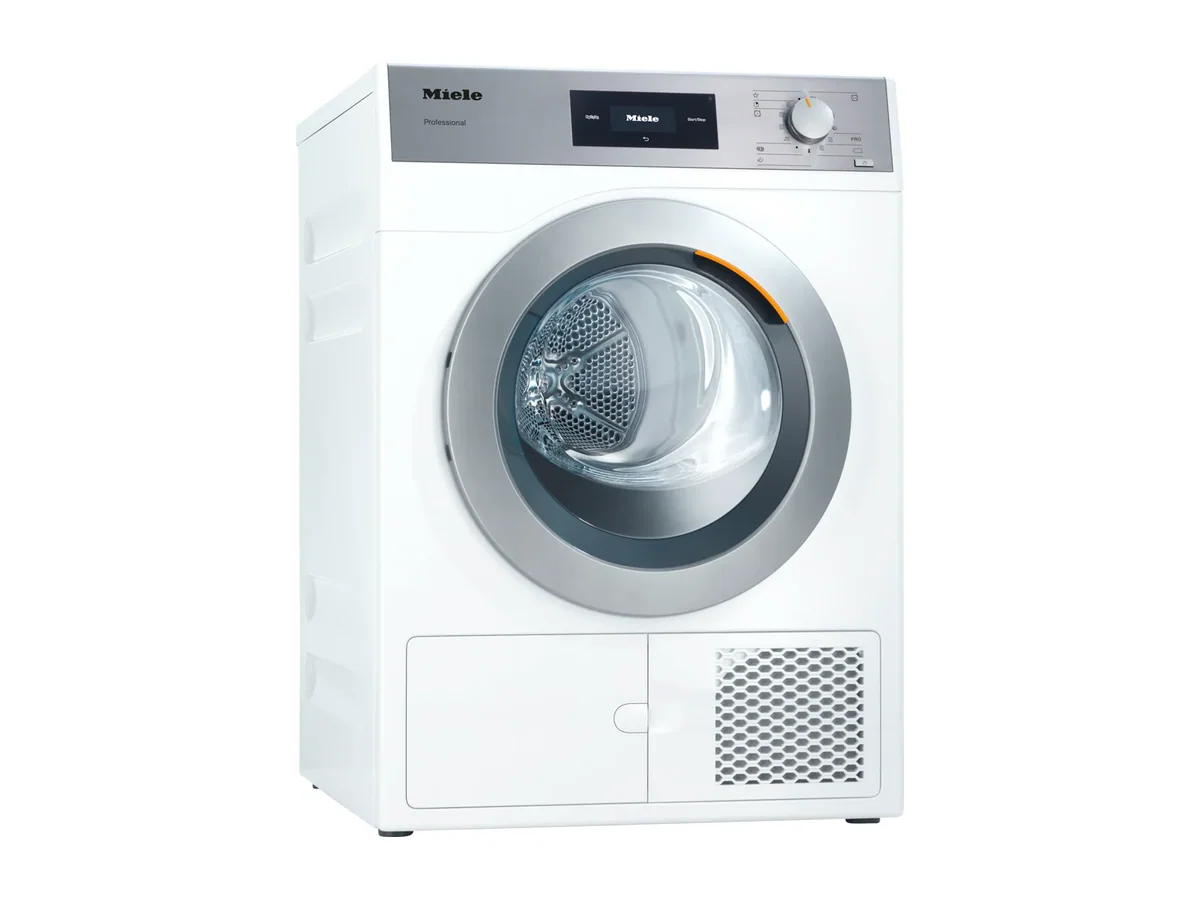
Miele Tumble Dryer PDR 507 HP [MAR] – 7 kg, 230V~ 60HZ, Lotus white
7 kg Little Giants marine heat-pump dryer, PDR 507 HP [MAR], 230V~ 60HZ, 1.2 kW connected load, Lloyd's Register approved.
7 kg · 1.2 kW
Marine equipment by electrical supply
Fourteen 230 V 60 Hz marine tumble dryers from Miele are listed on this page, seven from the Benchmark series and seven Little Giants units. Ten are air vented and four use a heat pump, nine are three-phase builds, and rated power spans 1.2 kW for the lightest heat-pump unit up to 37.7 kW on the PDR 944 with its 44 kg drum.
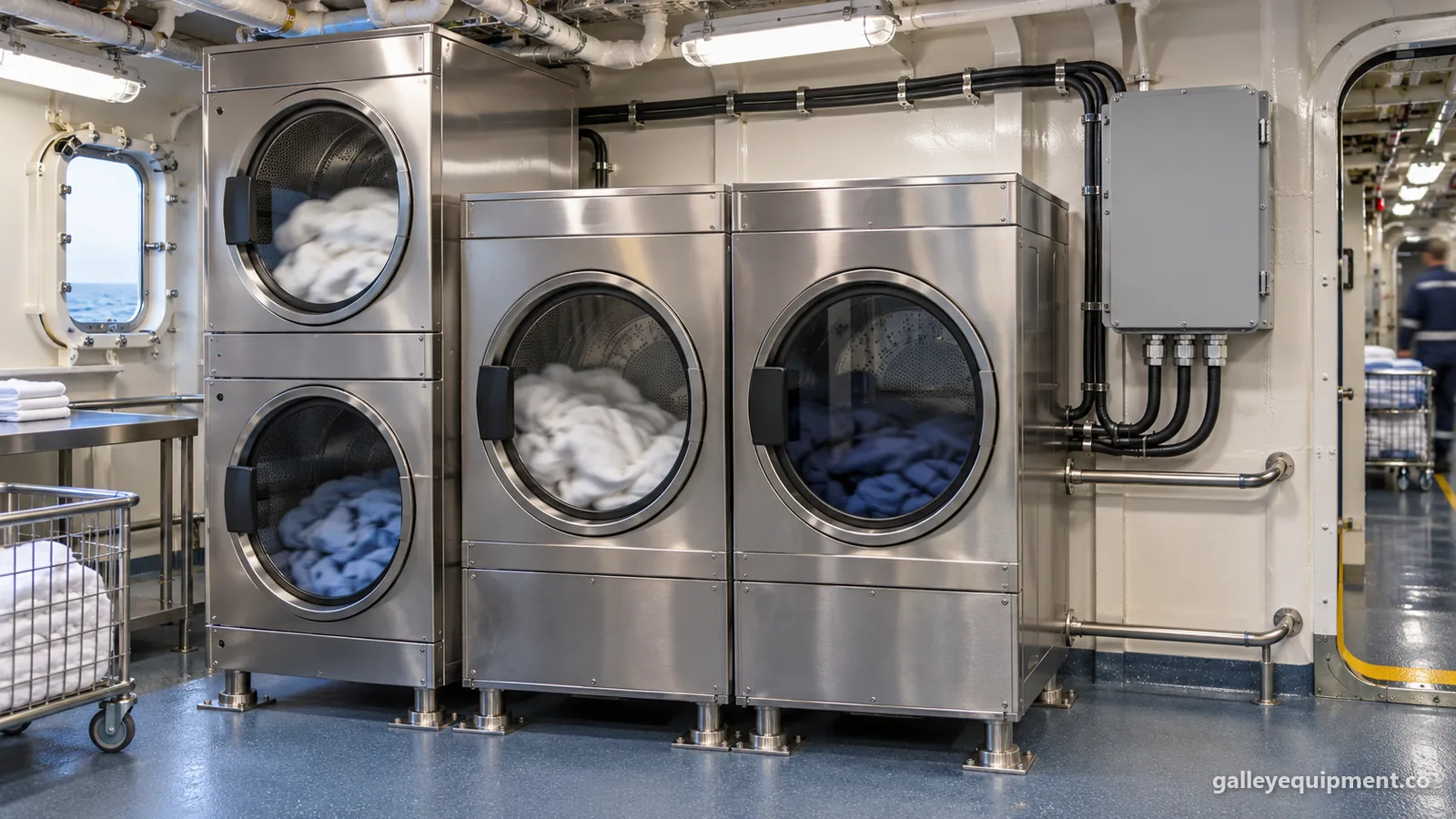
Miele Tumble Dryer PDR 507 HP [MAR] – 7 kg, 230V~ 60HZ, Lotus white
7 kg Little Giants marine heat-pump dryer, PDR 507 HP [MAR], 230V~ 60HZ, 1.2 kW connected load, Lloyd's Register approved.
Miele Tumble Dryer PDR 908 [EL MAR 2 AC 208-240V 60Hz] – 8 kg, 208–240 V, Stainless steel
8 kg Little Giants marine exhaust-air dryer, 130 l drum and 3.4–4.3 kW at 2~ 208–240 V 60 Hz, Lloyd’s Register approved. 11251140.
Miele Tumble Dryer PDR 908 [EL MAR 3 AC 230V 50-60Hz] – 8 kg, 230 V, Lotus white
8 kg Little Giants marine tumble dryer PDR 908 EL MAR, 3~230 V 50/60 Hz, 130 l exhaust‑air drum in lotus white with Lloyd's Register approval.
Miele Tumble Dryer PDR 908 [EL MAR 3 AC 230V 50-60Hz] – 8 kg, 230 V, Stainless steel
8 kg Little Giants marine tumble dryer PDR 908 EL MAR, 3~ 230 V 50/60 Hz, 130 l drum with 42 min cottons cycle and Lloyd's Register approval.
Miele Tumble Dryer PDR 908 HP [MAR 1N AC 230V 60Hz] – 8 kg, 230 V, Lotus white
Miele Little Giants PDR 908 HP MAR heat‑pump dryer, 8 kg with 130 l drum, 1.2 kW at 230V~ 60HZ, Lloyd’s Register approved for shipboard use.
Miele Tumble Dryer PDR 908 HP [MAR 1N AC 230V 60Hz] – 8 kg, 230 V, Stainless steel
8 kg Little Giants marine heat‑pump dryer, 1.2 kW at 230V~ 60HZ with 130 l drum and Lloyd’s Register approval. PDR 908 HP [MAR].
Miele Tumble Dryer PDR 908 HP [MAR 2 AC 208-240V 60Hz] – 8 kg, 208–240 V, Stainless steel
Miele Little Giants PDR 908 HP MAR heat‑pump dryer, 8 kg, 2~ 208–240 V 60 Hz, 1.2 kW, Lloyd’s Register approved for shipboard use.
Miele Tumble Dryer PDR 910 [EL SOM] – 3 AC 230V 50/60HZ, Stainless steel
Benchmark Performance Plus marine tumble dryer, up to 10 kg at 1:18 in a 180 l drum, 36 min exhaust-air cycle. PDR 910 [EL SOM].
Miele Tumble Dryer PDR 914 [EL SOM] – 3 AC 230V 50/60HZ, Stainless steel
Benchmark Performance Plus marine tumble dryer PDR 914, 250 l drum for up to 14 kg at 0.51 kWh/kg, 3 AC 230 V 50/60 Hz.
Miele Tumble Dryer PDR 918 [EL SOM] – 3 AC 230V 50/60HZ, Stainless steel
Miele Benchmark PDR 918 EL SOM marine exhaust-air dryer, 18 kg at 1:18 in a 325 l drum, 18.6 kW on 3 AC 230 V 50/60 Hz.
Miele Tumble Dryer PDR 922 [EL SOM] – 3 AC 230V 50/60HZ, Stainless steel
Benchmark PDR 922 [EL SOM] marine dryer, 400 l drum for up to 22 kg loads, 23.5 kW at 3 AC 230V 50/60HZ, exhaust air system.
Miele Tumble Dryer PDR 928 [EL SOM] – 3 AC 230V 50/60HZ, Stainless steel
Miele PDR 928 [EL SOM] Benchmark marine dryer, 500 l drum, up to 28 kg at 1:18, 3 AC 230V 50/60HZ.
Miele Tumble Dryer PDR 944 [EL SOM] – 44 kg, 3 AC 220-240V 50/60HZ, Stainless steel
44 kg Benchmark Performance Plus exhaust-air marine tumble dryer, 800 l drum, 3 AC 200–208 V 50–60 Hz, M Touch Pro controls. PDR 944 [EL SOM].
Miele Tumble Dryer PDR 944 [EL SOM] – 3 AC 230V 50/60HZ, Stainless steel
Benchmark Performance Plus marine tumble dryer PDR 944, 800 l drum and 37.2 l/h evaporation at 3 AC 230V 50/60HZ, electric exhaust-air design.
Eleven of the 14 models are rated at exactly 230 V, two at 240 V and one at 208 V, so these 230 V 60 Hz marine tumble dryers cover the lower-voltage end of a 60 Hz network. That supply appears on American-built yachts, on vessels whose hotel services run from a step-down transformer, and on ships where the laundry sits on a 230 V accommodation board rather than the main 440 V bus.
The list mixes two very different kinds of machine. Seven Little Giants units handle loads up to 8 kg and suit a cabin or crew laundry, while seven Benchmark models run all the way to the PDR 944, a 44 kg dryer at 37.7 kW. One heading, one voltage, but a span of more than thirty to one in rated power.
Nine listings are three-phase and two are single-phase, so the first check is how the 230 V reaches the laundry. A 230 V three-phase system, with 230 V between lines, is found on some American-built and older vessels, and it is what the Benchmark builds marked 3 AC 230V expect. A 230 V single-phase circuit, line to neutral, is what the small heat-pump units such as the PDR 908 HP in its 60 Hz version need.
The PDR 908 built for 2 AC 208-240V at 60 Hz sits between the two. It takes two line conductors of a 208 V or 240 V system and carries a 3.4 to 4.3 kW rating, a typical arrangement on vessels wired to American practice.
The table lists representative models with the data their listings publish.
| Model | Load | Rated power | Phase |
|---|---|---|---|
| PDR 507 HP | 7 kg | 1.2 kW | Not stated |
| PDR 908 HP (60 Hz) | 8 kg | 1.2 kW | Single-phase |
| PDR 908 (2 AC 208-240V) | 8 kg | 3.4 - 4.3 kW | Not stated |
| PDR 910 (3 AC 230V) | Not stated | 8.2 kW | Three-phase |
| PDR 918 (3 AC 230V) | Not stated | 18.6 kW | Three-phase |
| PDR 928 (3 AC 230V) | Not stated | 28.2 kW | Three-phase |
| PDR 944 (3 AC 220-240V) | 44 kg | 37.7 kW | Three-phase |
At 230 V a large dryer draws close to twice the line current of the same rating at 400 V, and that is the main design issue on this page. For a mostly resistive load, 37.7 kW on a 230 V three-phase supply works out at roughly 95 A per line, against about 54 A at 400 V. The PDR 928 at 28.2 kW draws around 71 A per line at 230 V.
Those currents set the cable size, the breaker frame and the voltage drop over the run from the switchboard. On a vessel where the laundry is several decks from the board, a heavy 230 V dryer may need a larger cable than the space in the cable tray allows. Where the main bus is 440 V, feeding a Benchmark dryer directly at that voltage is usually simpler than stepping down to 230 V.
Nine of the 14 models also carry a 50 Hz rating, which matters for a vessel that changes trading area or takes 50 Hz shore power in port. Heating elements care only about voltage, so the frequency mainly affects the drum motor and the fan. A dual-rated machine has been designed for both speeds. The remaining five builds are 60 Hz only, and the heat-pump units fall in that group because their compressors are matched to one frequency. Anyone searching for a 60hz tumble dryer for a vessel that might later run on 50 Hz should prefer the dual-rated builds, and the laundry notes on mixed 50 and 60 Hz supply go further into the trade-offs.
Four of the 14 models use a heat pump and ten are vented. The heat-pump units, the PDR 908 HP for 230 V, 60 Hz among them, suit cabins and interior laundries with no exhaust route and a single-phase circuit. The vented machines cover everything from compact 8 kg units to the heavy Benchmark drums, all needing a DN 100 duct to open air. Pairing either type with a washer on the same supply keeps the wiring simple, and the 230 V 60 Hz washing machine list carries those companions.
Where a merchant ship runs its main bus at 440 V and 60 Hz, with no 230 V three-phase board near the laundry, this page is the wrong source. The 440 V 60 Hz dryer selection avoids a transformer and the high currents described above. A vessel with a 400 V three-phase board at 60 Hz, more common on European-built hulls fitted with 60 Hz generators, is covered by the 400 V 60 Hz list. Buyers of a household 110-120v 60hz dryer will not find one here either.
Give the vessel type, confirm whether the 230 V supply is single-phase or three-phase, and state the frequency together with the breaker rating available at the laundry. Describe the exhaust route if a vented dryer is wanted, the space available and the number of dryers and washers required. Our team checks those figures against the Miele 230 V builds and replies through the 230 V dryer quotation request with the model codes that match.
Last reviewed by the Vista Marine galley engineering team.
Questions about 230 v 60 hz marine tumble dryers
Are 230 V 60 Hz marine tumble dryers single-phase or three-phase?
Both exist. Nine of the 14 listings are three-phase, including the Benchmark builds marked 3 AC 230V, and two are single-phase, such as the PDR 908 HP for 230 V, 60 Hz. The PDR 908 for 2 AC 208-240V uses two line conductors of a 208 V or 240 V system. The vessel's distribution decides which one is right.
What is the largest 230 V dryer listed?
The PDR 944 for 3 AC 220-240V, with a 44 kg drum and a rated power of 37.7 kW. At 230 V three-phase that load draws roughly 95 A per line, so it needs a substantial feeder and breaker. On ships with a 440 V main bus, a 440 V build of a large dryer is usually easier to wire.
Can these dryers also run on 50 Hz?
Nine of the 14 models carry a 50 Hz rating as well as 60 Hz, which helps vessels that change trading area or connect to 50 Hz shore power. The other five are 60 Hz builds only, including the heat-pump units, whose compressors are matched to a single frequency. The supply voltage must still be 230 V class in every case.
Is there a 110 V or 120 V version?
No. The lowest voltage on this page is 208 V, on one listing, with most models at 230 V and two at 240 V. A vessel with only 110 V or 120 V circuits would need a dedicated 230 V or 208-240 V feed for the laundry before any of these dryers could be installed.
Which 230 V dryers need no exhaust duct?
The four heat-pump models. They condense moisture into a drain and draw about 1.2 kW, which suits interior laundries and cabins on a single-phase circuit. The other ten exhaust through a DN 100 duct to open air, but they dry each load faster and include much larger drums.
Request a quotation for 230 v 60 hz marine tumble dryers
Send the vessel type, supply voltage, frequency and phase and the quantities, and our team will come back with a specification and quotation.


