

Miele Tumble Dryer PDR 514 ROP [EL SOM] – 14 kg, 3 AC 400V 50/60HZ, Iron grey
Benchmark PDR 514 ROP [EL SOM] vented dryer, 14 kg, 0.53 kWh/kg with 24 min cycle on 3 AC 400V 60 HZ, iron grey front.
14 kg · 14.1 kW
Marine equipment by electrical supply
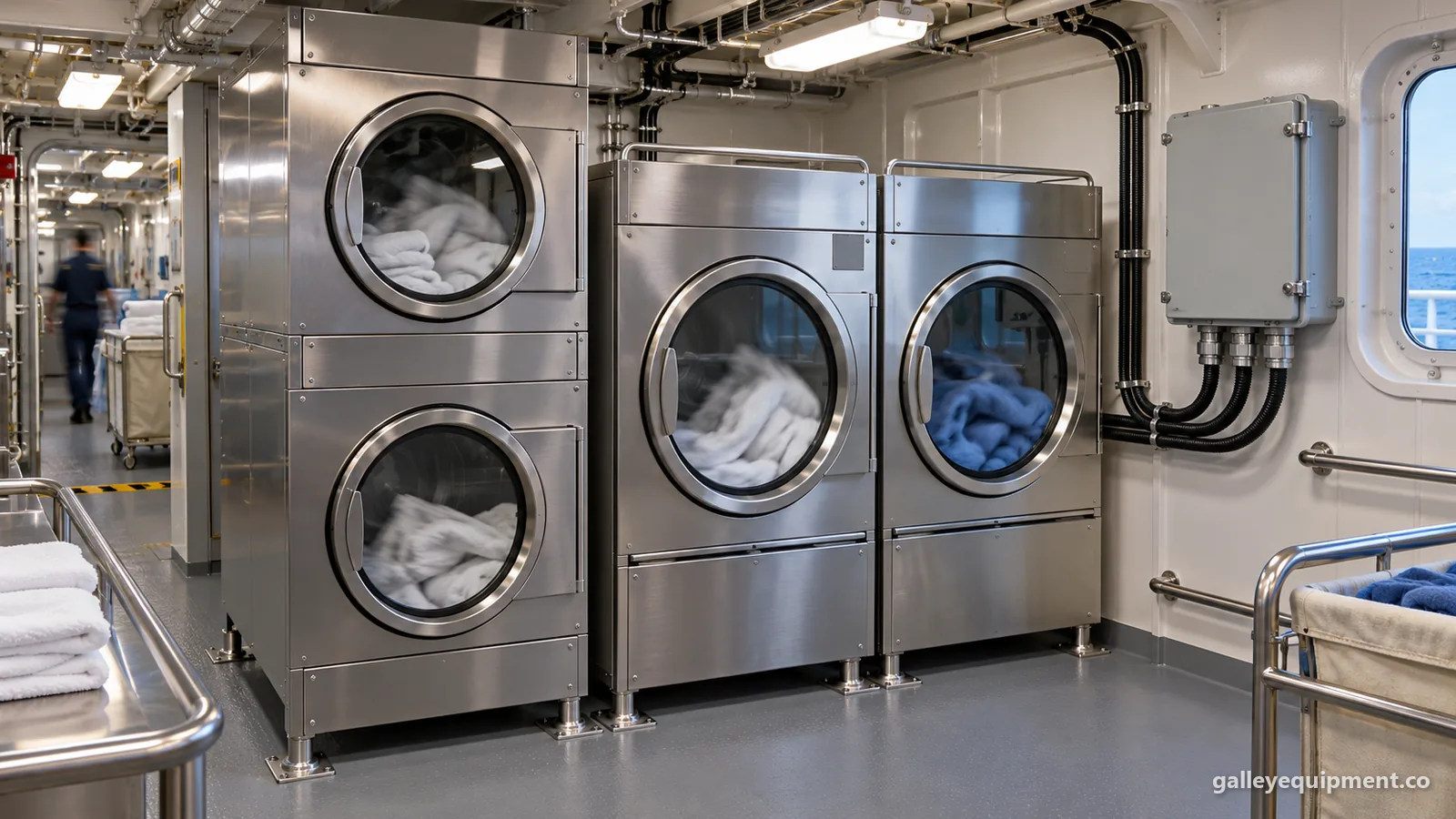
The 400 V 60 Hz marine tumble dryers on this page are 19 Miele machines, 15 from the Benchmark series and 4 from Little Giants. Every one is air vented, every one is three-phase, and every one also carries a 50 Hz rating, with rated power climbing to 37.7 kW on the PDR 944 and drum sizes from compact 8 kg units to the 21 to 30 kg band.
Miele Tumble Dryer PDR 514 ROP [EL SOM] – 14 kg, 3 AC 400V 50/60HZ, Iron grey
Benchmark PDR 514 ROP [EL SOM] vented dryer, 14 kg, 0.53 kWh/kg with 24 min cycle on 3 AC 400V 60 HZ, iron grey front.
Miele Tumble Dryer PDR 910 [EL SOM] – 3N AC 400V 50/60HZ, Stainless steel
Benchmark PDR 910 [EL SOM] vented marine dryer, 10 kg load at 1:18, 180 l drum, 3N AC 400V 50/60HZ, stainless steel front.
Miele Tumble Dryer PDR 908 [EL MAR 3 AC 400-480V 50-60Hz] – 8 kg, 400–480 V, Lotus white
8 kg Little Giants PDR 908 EL MAR vented dryer, 130 l drum, 6.4 kW at 3~ 480 V 50/60 Hz, Lloyd's Register approved for shipboard use.
Miele Tumble Dryer PDR 908 [EL MAR 3 AC 400-480V 50-60Hz] – 8 kg, 400–480 V, Stainless steel
8 kg Little Giants marine tumble dryer PDR 908 EL MAR, 130 l drum, 3~ 480 V 50/60 Hz exhaust-air model with Lloyd's Register approval.
Miele Tumble Dryer PDR 908 [EL MAR 3N AC 400V 50-60Hz] – 8 kg, 400 V, Lotus white
8 kg Little Giants marine tumble dryer, 130 l drum, 42 min cottons at 0.5 kWh/kg, exhaust air, Lloyd’s Register approved. PDR 908 EL MAR.
Miele Tumble Dryer PDR 908 [EL MAR 3N AC 400V 50-60Hz] – 8 kg, 400 V, Stainless steel
8 kg Little Giants exhaust-air dryer, 130 l drum and 5.5 l/h evaporation, Miele PDR 908 [EL MAR 3N AC 400V 50-60Hz], Lloyd’s Register approved.
Miele Tumble Dryer PDR 914 [EL SOM] – 3 AC 400V 50/60HZ, Stainless steel, Mat. no. 11722680
Miele Benchmark PDR 914 [EL SOM] exhaust‑air dryer, 250 l drum, 24 min cycle at 3 AC 400V 50/60HZ for marine use.
Miele Tumble Dryer PDR 914 [EL SOM] – 3N AC 400V 50/60HZ, Stainless steel
Benchmark PDR 914 exhaust-air marine dryer with 250 l drum, up to 14 kg at 1:18 load ratio on 3N AC 400 V 50/60 Hz.
Miele Tumble Dryer PDR 914 [EL SOM] – 3 AC 400V 50/60HZ, Stainless steel, Mat. no. 11911200
Benchmark PDR 914 exhaust-air dryer, 14 kg at 1:18 load ratio, 250 l drum, 3 AC 400V 50/60HZ, stainless-steel front.
Miele Tumble Dryer PDR 918 [EL SOM] – 3 AC 400V 50/60HZ, Stainless steel, Mat. no. 11722700
Benchmark PDR 918 EL SOM marine dryer, 18 kg load at 325 l drum volume, 18.6 kW exhaust-air unit on 3 AC 400V 50/60HZ.
Miele Tumble Dryer PDR 918 [EL SOM] – 3N AC 400V 50/60HZ, Stainless steel
Benchmark PDR 918 [EL SOM] marine exhaust‑air dryer, 18 kg at 1:18, 325 l drum on 3N AC 400V 50/60HZ, 18.6 kW.
Miele Tumble Dryer PDR 918 [EL SOM] – 3 AC 400V 50/60HZ, Stainless steel, Mat. no. 11911190
Benchmark Performance Plus exhaust-air dryer, 18 kg at 1:18 with 325 l drum and 23 min programme. Miele PDR 918 [EL SOM] 11911190.
Miele Tumble Dryer PDR 922 [EL SOM] – 3 AC 400V 50/60HZ, Stainless steel
Benchmark PDR 922 [EL SOM] marine tumble dryer, 22 kg at 1:18 load ratio, 400 l drum, 3 AC 400V 50/60HZ, front in stainless steel.
Miele Tumble Dryer PDR 922 [EL SOM] – 3N AC 400V 50/60HZ, Stainless steel
Benchmark Performance Plus marine tumble dryer PDR 922 EL SOM, 22 kg load at 400 l drum volume, 3N AC 400 V 50/60 Hz exhaust air.
Miele Tumble Dryer PDR 922 [EL SOM] – 22 kg, 3 AC 400V 50/60HZ, Stainless steel
22 kg Benchmark Performance Plus marine vented dryer, 400 l drum, 3 AC 400V 50/60HZ, M Touch Pro control. PDR 922 [EL SOM].
Miele Tumble Dryer PDR 928 [EL SOM] – 3 AC 400V 50/60HZ, Stainless steel
Benchmark PDR 928 [EL SOM] exhaust-air marine dryer, 500 l drum and 28 kg capacity at 1:18 load ratio, 3 AC 400V 50/60HZ.
Miele Tumble Dryer PDR 928 [EL SOM] – 3N AC 400V 50/60HZ, Stainless steel
Exhaust-air marine tumble dryer, 500 l drum and 28 kg load at 1:18 ratio, Benchmark Performance Plus PDR 928 [EL SOM].
Miele Tumble Dryer PDR 944 [EL SOM] – 3 AC 400V 50/60HZ, Stainless steel
Benchmark PDR 944 EL SOM vented dryer, 800 l drum and 37.2 l/h evaporation at 3 AC 400V 50/60Hz for offshore and shipboard laundries.
Miele Tumble Dryer PDR 944 [EL SOM] – 3N AC 400V 50/60HZ, Stainless steel
Benchmark PDR 944 vented marine dryer, 800 l drum for 32–44 kg loads, 36 kW electric, 3N AC 400V 50/60Hz, stainless-steel front.
Nineteen models share three traits: a 380-415 V three-phase supply, an air-vented drying system and a rating for both 50 Hz and 60 Hz. That uniformity is the main point of these 400 V 60 Hz marine tumble dryers. A yard or a refit engineer can pick a drum size without worrying that a 60 Hz build behaves differently from the 50 Hz version installed on a sister vessel.
Fifteen of the 19 are Benchmark machines for crew and charter laundries, and four are compact Little Giants units. Fifteen carry a 400 V voltage label, two are labelled 480 V and two 230 V within the 380-415 V supply group, which reflects multi-voltage builds such as the PDR 908 marked 3 AC 400-480V. The application data lists all 19 for offshore use, 18 for yachts and 15 for commercial vessels.
A 400 V board fed by 60 Hz generators is found on vessels built to European electrical practice but operated where 60 Hz is the norm, and on some yachts and offshore units specified that way from new. It is a rarer pairing than either the European 50 Hz board or the merchant 440 V standard, which is why a dual-frequency dryer is useful: the same model code works whichever frequency the generators deliver.
Heating elements in a tumble dryer respond to voltage, not frequency, so the drying heat is the same on both supplies. The drum motor and the exhaust fan are what change speed, and a machine rated for both frequencies has been designed to tolerate that. The frequency briefing on 400 V hotel boards juxtaposes the two supplies side by side for laundry and galley equipment.
The listings publish the following for the 400 V builds.
| Model | Load | Rated power | Supply marking |
|---|---|---|---|
| PDR 908 | 8 kg | 5.4 kW | 3 AC 400-480V 50-60Hz |
| PDR 910 | Not stated | 8.2 kW | 3N AC 400V 50/60Hz |
| PDR 514 ROP | 14 kg | 14.1 kW | 3 AC 400V 50/60Hz |
| PDR 914 | Not stated | 14.1 kW | 3 AC 400V 50/60Hz |
| PDR 918 | Not stated | 18.6 kW | 3 AC 400V 50/60Hz |
| PDR 922 | Not stated | 23.5 kW | 3 AC 400V 50/60Hz |
| PDR 928 | Not stated | 28.2 kW | 3 AC 400V 50/60Hz |
| PDR 944 | Not stated | 37.7 kW | 3 AC 400V 50/60Hz |
Two of the 19 fall up to 5 kW and three in the 5-10 kW bracket, while the 10-20 kW and 20-40 kW brackets hold seven apiece. The upper half of the list therefore needs dedicated feeders, and the PDR 944 alone draws around 54 A per line at 400 V when treated as a resistive load.
The marking tells the installer which conductors to run, and it differs within this list. 3N AC means three phases plus a neutral, as on the PDR 910 for 3N AC 400V; the neutral usually supplies 230 V control circuits or part of the heating from line to neutral. A plain 3 AC marking calls for the three phases alone, as on the PDR 914 to PDR 944 builds.
This matters on board because many marine networks are insulated systems without a distributed neutral. A 3 AC dryer connects to such a network directly. A 3N AC dryer needs a neutral at the laundry, which may mean a transformer or a different distribution board, so the marking should be checked against the single-line diagram before the order is placed.
The PDR 908 for 3 AC 400-480V is the compact option on this page, with an 8 kg load and 5.4 kW rating across 400 V to 480 V at 50 or 60 Hz. That wide window lets one model serve a fleet where some vessels run 400 V and others 440 V or 480 V, which simplifies spare parts. It still needs a DN 100 exhaust duct like every other machine here.
For heavier laundries, the PDR 922 at 23.5 kW sits in the middle of the Benchmark range, a common size where one dryer serves a full crew, and those who type heavy duty tumbler dryer 60 hz into a search bar are usually looking at this class of machine.
A cargo ship or tanker with a 440 V, 60 Hz main bus should not take its dryer from this list, since that network needs the 440 V 60 Hz dryer builds or the multi-voltage PDR 908. A vessel whose laundry is fed from a 230 V three-phase or single-phase board belongs on the 230 V 60 Hz dryer page, which also holds the heat-pump models that this vented-only list does not include. A plain 3 phase dryer bought for a shore laundry is also not the same as a marine build, so the supply marking matters more than the phase count alone.
State the vessel type, the switchboard voltage and frequency, and whether the laundry board carries a neutral. Add the exhaust duct route, the floor space, the number of dryers and the washers they will pair with, noting that the 400 V 60 Hz washing machine list carries matching companions. Our team reviews the details and returns model codes through the 400 V laundry quotation page.
Last reviewed by the Vista Marine galley engineering team.
Questions about 400 v 60 hz marine tumble dryers
Do 400 V 60 Hz marine tumble dryers also run on 50 Hz?
Yes. All 19 listings carry both a 50 Hz and a 60 Hz rating within the 380-415 V supply group. The heating elements depend on voltage only, and the drum motor and fan are designed for either frequency. That lets the same model code be used on sister vessels with different generator frequencies, or on a yacht that changes cruising area.
What does 3N AC 400V mean on a dryer listing?
It means three phases plus a neutral conductor at 400 V. The PDR 910 is listed this way. A dryer marked 3 AC needs only the three phases, which suits insulated marine networks without a distributed neutral. Checking the marking against the vessel's distribution before ordering avoids adding a transformer or neutral later.
Which is the largest 400 V dryer in the list?
The PDR 944 for 3 AC 400V, rated at 37.7 kW. Seven models fall between 20 and 40 kW, including the PDR 922 at 23.5 kW and the PDR 928 at 28.2 kW. Machines of this size need a dedicated three-phase feeder and a short, clean DN 100 exhaust duct to dry at their rated pace.
Are there heat pump dryers for 400 V 60 Hz?
No. All 19 models on this page are air vented. The heat-pump dryers in the catalogue are compact Little Giants units built for 230 V or 240 V single-phase circuits. A vessel with a 400 V board that needs a ductless dryer would feed one from a 230 V circuit or accept a vented model with an exhaust route.
Can one dryer cover both 400 V and 480 V vessels?
The PDR 908 built for 3 AC 400-480V at 50 or 60 Hz covers that whole window with an 8 kg drum and a 5.4 kW rating. It suits fleets that mix 400 V and 440 V or 480 V vessels. The larger Benchmark models are built for a specific voltage, so the order must name the one that matches each vessel.
Request a quotation for 400 v 60 hz marine tumble dryers
Send the vessel type, supply voltage, frequency and phase and the quantities, and our team will come back with a specification and quotation.


