
Miele Washing Machine PWM 908 [EL DP MAR 3 AC 400-480V 50-60Hz] – 8 kg, 400–480 V, Stainless steel
PWM 908 Little Giants marine washer, 8 kg at 1,600 rpm, g‑factor 704 and 73 l drum with Lloyd’s Register approval.
8 kg · 4.2 kW
Miele commercial washer-extractors for shipboard laundries, from 6 kg to 35 kg, supplied in the supply voltage and frequency of the vessel.
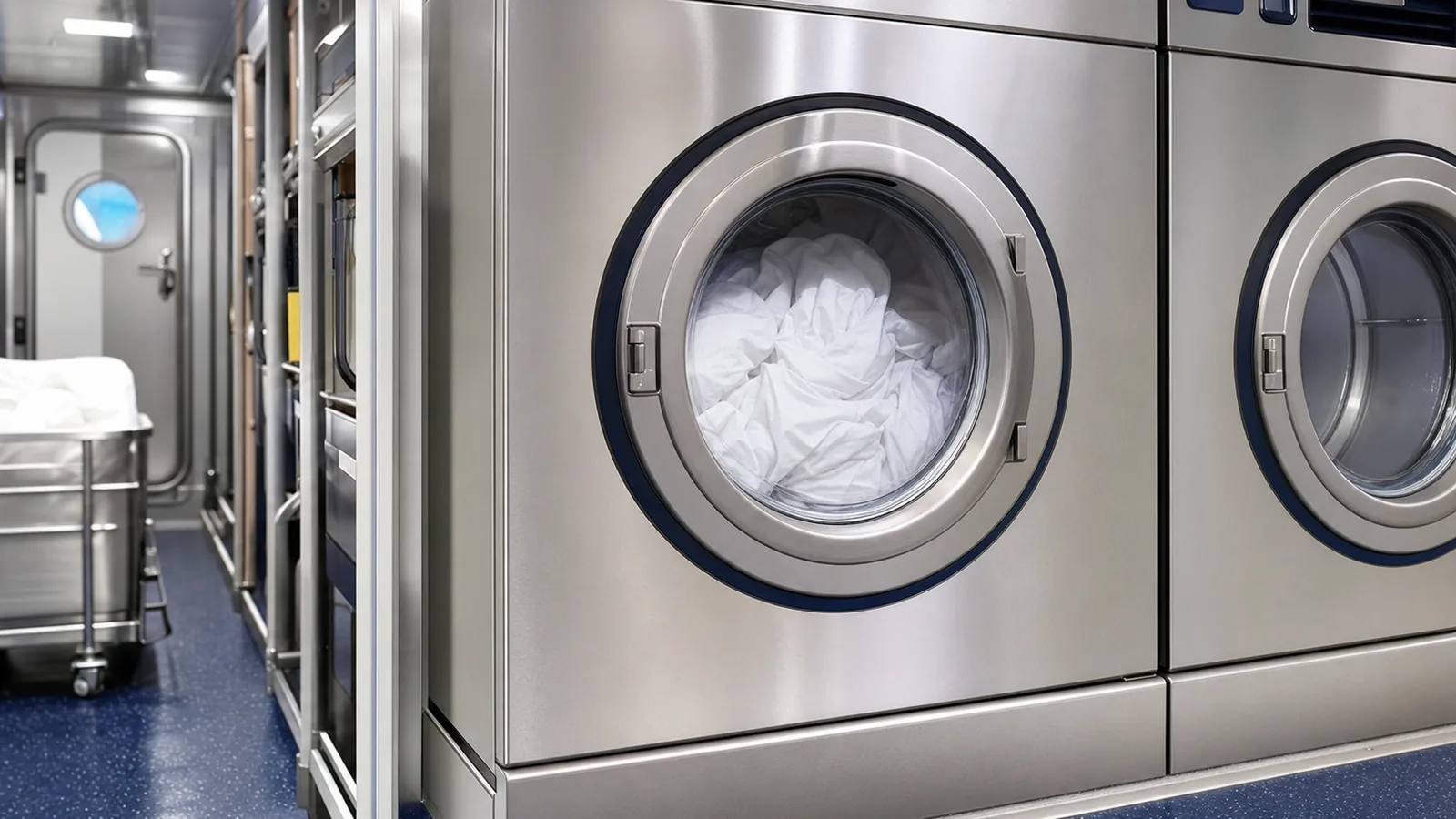
PWM 908 Little Giants marine washer, 8 kg at 1,600 rpm, g‑factor 704 and 73 l drum with Lloyd’s Register approval.
Miele PWM 908 Little Giants 8 kg marine washer, 73 l drum, 1,600 rpm, g-factor 704, EL DP MAR 3~ 480V 50/60HZ, Lloyd’s Register approved.
8 kg Little Giants marine washer PWM 908 EL DP MAR, 73 l drum, 1,600 rpm and g factor 704, 3~ 230 V 50/60 Hz, Lloyd's Register approved.
8 kg Little Giants PWM 908 marine washer, 73 l drum, 3~ 230 V 50/60 Hz with DN 22 drain pump and Lloyd’s Register approval.
8 kg Little Giants marine washer, PWM 908 EL DP MAR, 73 l drum, 1,600 rpm spin and 704 g-factor in stainless steel front.
8 kg Little Giants PWM 908 marine washer with 73 l honeycomb drum, 1,600 rpm spin and 704 g-factor for shipboard and offshore laundry rooms.
8 kg Little Giants marine washer, 73 l honeycomb drum, 1,600 rpm, g-factor 704 at 2~208–240 V 60 Hz.
Miele PWM 906 Little Giants marine washer, 6 kg in a 57 l drum at 1,600 rpm (g‑factor 704) on 3~ 480 V 50/60 Hz, stainless steel front.
6 kg Miele PWM 906 EL DP MAR Little Giants marine washer, 57 l drum, 3~ 480V 50/60HZ with ≤70 dB(A) noise level.
6 kg Little Giants marine washer PWM 906, 57 l drum, 1,600 rpm spin at g‑factor 704, 3~ 230V 50/60HZ, Lloyd’s Register approved.
Miele PWM 906 Little Giants marine washer, 6 kg in 57 l drum at 1,600 rpm, g‑factor 704, Lloyd’s Register approved 3~ 230 V 50/60 Hz unit.
6 kg PWM 906 Little Giants marine washer with 57 l honeycomb drum, 1,600 rpm spin and 704 g-factor for shipboard and offshore use.
6 kg PWM 906 Little Giants marine washer with 57 l drum, 1,600 rpm spin, 704 g-factor and Lloyd’s Register approval in Lotus white.
Miele PWM 906 marine washer, 6 kg Little Giants, 57 l drum, 1,600 rpm at 2~208-240V 60HZ, Lloyd's Register approved.
7 kg Little Giants marine washer-extractor, PWM 507 EL DP MAR, 3~ 480 V 50/60 Hz with 1,600 rpm spin and 704 g-factor for shipboard laundries.
7 kg Little Giants marine washer, PWM 507 MAR, 1N AC 230 V 60 Hz with 64 l drum and 1,600 rpm spin, tested for 30,000 h, Lloyd’s Register approved.
These marine washing machines run from 6 kg Little Giants up to 35 kg Benchmark units, with drum volumes between 57 and 320 litres. That spread lets a designer cover small crew laundries and full hotel services with the same brand, instead of mixing platforms. Net weights move from under 110 kg for the smallest machines to just under 700 kg for the largest, so floor loading and vibration transfer into the deck change significantly as the load class increases.
Most machines on this page are electric, with a small number of steam-heated variants where the vessel has steam available. Width ranges from 596 mm to 1090 mm, which is the practical corridor and doorway question: Little Giants sit below 605 mm, while Benchmark machines start at 700 mm wide and rise, so refit access and route to the laundry need checking before specifying the larger sizes.
Little Giants cover 6 to 8 kg with 57 to 73 litre drums, sitting in the 2.85 to 5 kW band. All are marine approved and offshore specified, and every Little Giants model on this page carries a disinfection programme and a honeycomb drum. The combination suits smaller crew laundries on yachts and offshore units where each cycle may be a mixed load of workwear, personal clothing and galley linen rather than bulk hotel linen.
Their 596 to 605 mm width and net weight around 100 kg make them realistic for stacked columns and for spaces that started life as domestic laundries. Little Giants are also the most flexible on supply: across the series there are models at 208–240 V, 230 V, 400 V and 400–480 V, with every listed Little Giants unit named for 60 Hz and most also for 50 Hz. That matters on a vessel that changes trade, because the laundry can follow the ship's supply without a transformer in front of it.
Benchmark washer-extractors start at 9 kg and rise to 35 kg with drums from 80 to 320 litres and power draws from 5.25 up to 31.6 kW. They are specified where the laundry is handling bedding, towelling and uniforms at scale and where the higher electrical connection and deck load can be justified by throughput. As with the smaller machines, all Benchmark models here are marine approved, offshore specified and carry disinfection programmes, with most also tested virucidal.
Benchmark width runs from 700 to 1090 mm and net weight from 140 to 692 kg, so they sit firmly in the “planned plant” bracket rather than opportunistic refits. Supply voltages run to 230 V, 400 V, 440 V and 480 V variants, and there are both 50 Hz and 60 Hz machines, with 50 Hz the more common. That allows a naval architect to match a 440 V or 480 V / 60 Hz main distribution without creating a one‑off voltage just for the laundry, but it does mean that the final model choice must follow the ship’s single supply standard.
Across the whole category, electrical power spans from 2.85 to 31.6 kW, and the machines spread fairly evenly through that range rather than clustering at one size. On a shipboard switchboard designed around 440 V or 690 V, a pair of high‑end Benchmark washers can represent a noticeable block of load, so aligning machine size with the real daily tonnage is more than a theoretical exercise. The presence of a small number of steam‑heated machines in the range gives designers with a central boiler the option to move some of that load off the electrical side, provided the ship’s steam is available when the laundry is busiest.
Every machine on the page carries a disinfection programme and a marine approval, so the differentiation is not about basic suitability but about footprint and connection. Width facets show that some units sit in the 401–600 mm band, others between 601–800 mm and a similar number between 801–1200 mm. In practice that means a designer can build from narrow stackable columns at one end to wide, high‑capacity Benchmarks at the other, as long as door widths, escape routes and maintenance access are planned around the largest machines in the layout.
This page is only about washer‑extractors; it does not cover drying, finishing or combined footprints. Where the driving constraint is deck area rather than washing capacity, the Washer‑Dryer Stacks category is often a better starting point, because it shows what can be achieved vertically without increasing the footprint. If the bottleneck is drying rather than washing, the Tumble Dryers page carries both vented and heat‑pump machines sized to match the loads here.
For flatwork finishing such as table linen, napkins and bedding, the Ironers category is the relevant section of the catalogue. In a fully specified shipboard laundry the washing machines on this page, selected by load class and supply voltage, will normally be paired with at least one category of those sibling products rather than specified in isolation.
Little Giants cover 6–8 kg with 57–73 litre drums and 2.85–5 kW connections, suited to smaller laundries or stacked installations. Benchmark machines run from 9–35 kg with 80–320 litre drums and up to 31.6 kW, so they fit main laundry rooms with the electrical capacity and deck strength to support them.
Across the page you will find models at 208–240 V, 230 V, 400 V, 400–480 V, 440 V and 480 V, with many series offering several options. Supply frequencies span 50 Hz and 60 Hz, with all Little Giants listed for 60 Hz and most Benchmark machines specified for 50 Hz, so model choice can follow the vessel’s existing distribution.
Net weights for Benchmark models rise to 692 kg with widths up to 1090 mm and electrical power up to 31.6 kW. That combination means the heaviest 35 kg units sit firmly in the “plant item” category and should be checked against the deck’s structural loading and vibration criteria, rather than treated as light equipment.
Every washing machine listed here is shown with a disinfection programme, and all are marked marine approved and offshore specified. In the Little Giants series that disinfection function is combined with a honeycomb drum across all 16 models, while in the Benchmark series it appears on all 27 machines with most also tested virucidal.
What actually changes when a commercial appliance is built for a ship — supply, fixing, water protection, materials, hygiene construction, refrigerant and certification — and why shore equipment fails at sea.
Read guideWhere a yacht galley differs from a ship's: two services from one small room, very little water, AC power from generators, noise near guest areas, and finish that guests see.
Read guideThe constraints that actually decide a galley specification — service, power, space, water, heat, motion, materials and compliance — worked through in the order they bite.
Read guide