

Miele Tumble Dryer PDR 514 ROP [EL SOM] – 14 kg, 3 AC 400V 50/60HZ, Iron grey
Benchmark PDR 514 ROP [EL SOM] vented dryer, 14 kg, 0.53 kWh/kg with 24 min cycle on 3 AC 400V 60 HZ, iron grey front.
14 kg · 14.1 kW
Marine galley equipment by vessel
This page lists 60 Hz offshore laundry equipment for accommodation platforms, drilling units and offshore support vessels: 7 Miele machines from the Benchmark series, four washing machines and three tumble dryers. Every unit is three-phase and electric, drum loads start at 14 kg and reach 44 kg, and the four washers are built for a 440-480 V supply at 60 Hz.
Miele Tumble Dryer PDR 514 ROP [EL SOM] – 14 kg, 3 AC 400V 50/60HZ, Iron grey
Benchmark PDR 514 ROP [EL SOM] vented dryer, 14 kg, 0.53 kWh/kg with 24 min cycle on 3 AC 400V 60 HZ, iron grey front.
Miele Washing Machine PWM 916 [EL DV DD SOM] – 16 kg, 3 AC 480V 60HZ, Stainless steel
Benchmark PWM 916 SOM washer, 16 kg at 1:9 load ratio on a 140 l drum with 502 g factor and 3 AC 440 V 60 HZ electric heating.
Miele Washing Machine PWM 920 [EL DV DD SOM] – 20 kg, 3 AC 480V 60HZ, Stainless steel
20 kg Benchmark Performance Plus marine washer, 180 l drum, 1120 rpm spin on 3 AC 440V 60HZ, PWM 920 [EL DV DD SOM].
Miele Washing Machine PWM 927 [EL DV DD SOM] – 27 kg, 3 AC 480V 60HZ, Stainless steel
27 kg Miele PWM 927 Benchmark Performance Plus marine washer, 240 l drum, 3 AC 440V 60HZ, 23.6 kW connected load.
Miele Washing Machine PWM 935 [EL DV DD SOM] – 35 kg, 3 AC 480V 60HZ, Stainless steel
35 kg Benchmark Performance Plus marine washer with 320 l drum, 3 AC 440V 60HZ supply and 9656 N floor load. Miele PWM 935.
Miele Tumble Dryer PDR 922 [EL SOM] – 22 kg, 3 AC 400V 50/60HZ, Stainless steel
22 kg Benchmark Performance Plus marine vented dryer, 400 l drum, 3 AC 400V 50/60HZ, M Touch Pro control. PDR 922 [EL SOM].
Miele Tumble Dryer PDR 944 [EL SOM] – 44 kg, 3 AC 220-240V 50/60HZ, Stainless steel
44 kg Benchmark Performance Plus exhaust-air marine tumble dryer, 800 l drum, 3 AC 200–208 V 50–60 Hz, M Touch Pro controls. PDR 944 [EL SOM].
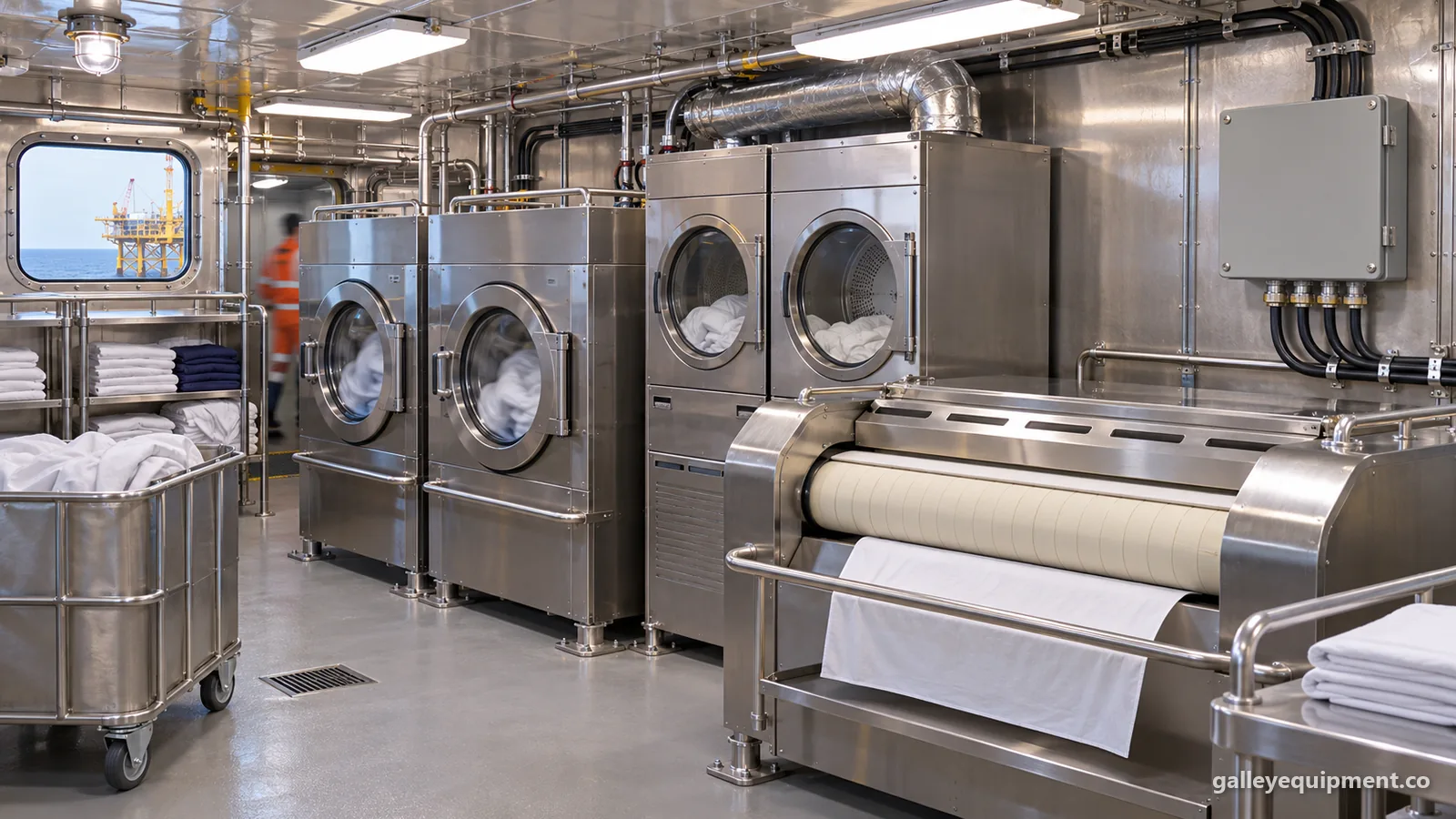
The grid holds seven machines, all drawn from the Miele Benchmark series. Four are washing machines and three are tumble dryers, which mirrors how an offshore laundry room is normally built: a washer feeding a dryer of similar or larger drum volume, repeated as the number of beds grows. The filter keeps only units marked for offshore accommodation and galley use and rated for a 60 Hz supply, so the 60 Hz offshore laundry equipment shown above is a short, specific set rather than a full catalogue.
None of the seven is a light-duty appliance. The smallest drum belongs to the 14 kg PDR 514 ROP dryer and the largest to the 44 kg PDR 944, and connected loads run from 14.1 kW to 37.7 kW. Those numbers follow the work an offshore laundry does: coveralls, bedding and towels for a rotating crew, washed every day of the hitch rather than once a week.
The four washers climb from 16 kg to 35 kg and the three dryers sit at 14 kg, 22 kg and 44 kg, so each washer has a dryer partner of comparable or larger capacity in the same list.
| Model | Type | Load | Connected load | Rated supply |
|---|---|---|---|---|
| PWM 916 | Washing machine | 16 kg | 15.7 kW | 440-480 V, 60 Hz |
| PWM 920 | Washing machine | 20 kg | 22.5 kW | 440-480 V, 60 Hz |
| PWM 927 | Washing machine | 27 kg | 27.6 kW | 440-480 V, 60 Hz |
| PWM 935 | Washing machine | 35 kg | 34.1 kW | 440-480 V, 60 Hz |
| PDR 514 ROP | Tumble dryer | 14 kg | 14.1 kW | 380-415 V, 50/60 Hz |
| PDR 922 | Tumble dryer | 22 kg | 23.5 kW | 380-415 V, 50/60 Hz |
| PDR 944 | Tumble dryer | 44 kg | 37.7 kW | 208-240 V, 50/60 Hz |
Drying usually takes longer than washing, and textiles leaving a washer are heavier than their dry rating suggests. Offshore laundries therefore tend to give the dryer some spare drum volume: the 20 kg PWM 920 next to the 22 kg PDR 922, or the 35 kg PWM 935 next to the 44 kg PDR 944. Across the filter, three units fall in the 13 to 20 kg band, two in the 21 to 30 kg band and two above 30 kg, while the power split is three machines at 10 to 20 kW against four at 20 to 40 kW.
The frequency is shared; the voltage is not. Each of the four washers carries a 440-480 V, 60 Hz rating, matching the 440 V three-phase main supply found on most large offshore units and merchant hulls. The PDR 514 ROP and PDR 922 dryers are rated 380-415 V, the PDR 944 offered here is the 220-240 V version, and all three dryers accept 50 Hz as well as 60 Hz.
For the electrical designer this matters more than drum size. On a platform whose switchboard delivers only 440 V, a 400 V or 230 V dryer needs a transformer or a dedicated sub-board, and that brings weight, heat and cabinet space into a room that is often already tight. Where the accommodation module has its own 400 V distribution, the two 380-415 V dryers connect to it directly. If the aim is a laundry that runs entirely from one voltage, the single-voltage laundry line rated for 440 V adds dryers and ironers rated for the higher supply.
A washing machine designed for 50 Hz and wired to a 60 Hz supply spins its motors roughly 20% faster than intended. Drum speed, drain pump flow and the spin profile all move away from the values the maker tested, and the controls may not correct for it. That is the short answer behind searches for "50hz washing machine on 60hz": the machine may start, but it is no longer running to its design. The four washers here sidestep the problem because they are built for 60 Hz from the outset.
The dryers handle it differently. Their fans and drum drives are specified for either frequency, and their heating elements respond to voltage rather than frequency, which is why the dryer voltage, not the 60 Hz rating, decides how they are connected. Frequency converters can bridge a mismatch but add cost, weight and heat, and our frequency note for offshore laundries tallies that penalty against simply buying native 60 Hz washers.
Two numbers set the size of the laundry: persons on board at peak and the hours a laundry attendant actually works. Bed linen change intervals and the number of coveralls issued per person per shift give a daily kilogram total, and dividing it by the staffed hours gives the hourly throughput the machines must reach.
Drum size follows from there. A supply vessel with a modest crew may need no more than the 16 kg PWM 916 with the 14 kg PDR 514 ROP. A large accommodation unit points towards the 35 kg PWM 935 washing machine beside the PDR 944, or towards two mid-size pairs so that one line keeps working while the other is serviced. Redundancy often counts for more offshore than peak capacity, because a service technician may be weeks away.
All three dryers are air vented. Each needs an exhaust duct to open air, or into a ventilation trunk able to take warm, moist air, sized for the dryer's airflow. That duct route is worth fixing at layout stage, since it is far harder to add once bulkheads and cable trays are in place.
Projects on 50 Hz, small hulls and single-machine orders are better served elsewhere. If the unit or vessel runs on 50 Hz, the full offshore laundry catalogue, 50 Hz included, holds models for that supply. If the laundry serves a handful of crew on a small hull, drums of 14 kg and upward are oversized, and a compact yacht or boat machine will fit the room and the load better. And if the requirement is a single washer rather than a matched line, the washer-only 60 Hz listing narrows the choice faster across all vessel types.
A quotation for this equipment comes back sooner when the first message already holds the details our team would otherwise ask for:
Send it through the offshore quotation request and the machines can be matched to the supply before any order is placed.
All seven units carry the Miele name and the Benchmark series label. Keeping washers and dryers in one series keeps spare parts, control layout and operator familiarisation consistent for crews that change every few weeks, a practical gain on a platform where the laundry attendant may rotate as often as the drill crew. Two of the seven are also marked for yacht galleys, but the drum sizes make clear that this set was assembled for heavy, daily offshore duty.
Last reviewed by the Vista Marine galley engineering team.
Questions about 60 hz offshore laundry equipment
Can the washers in this offshore selection run on a 400 V supply?
No. The four Benchmark washers, PWM 916, PWM 920, PWM 927 and PWM 935, are rated 440-480 V at 60 Hz. On a 400 V distribution they would need a step-up transformer, or a different model built for 380-415 V. The PDR 514 ROP and PDR 922 dryers are the items in this list that connect to 380-415 V directly, at either 50 Hz or 60 Hz.
Which dryer suits the largest washer?
The PWM 935 washes 35 kg and the PDR 944 dryer takes 44 kg, so the pair gives the dryer extra drum volume for wet, heavy textiles such as coveralls and towels. The PDR 944 in this list is the 220-240 V version, so it needs a 230 V three-phase circuit rather than the 440 V feed that serves the washer.
Are all seven machines three-phase?
Yes. Every washer and dryer in this selection is a three-phase electric machine, with connected loads between 14.1 kW and 37.7 kW, and none of them runs from a single-phase socket. Cable sizing and breaker selection should follow the rated current on the data plate for the exact voltage chosen, since the same model at a lower voltage draws more current.
Do these tumble dryers need an exhaust duct?
Yes. The PDR 514 ROP, PDR 922 and PDR 944 are air-vented machines, and each has to discharge warm, moist air through a duct, either to open deck or into a ventilation trunk that can accept it. Heat pump dryers without a vent are not part of this offshore list, so duct space should be planned from the first layout drawing.
Can these machines be used on a yacht as well?
Two of the seven are also marked for yacht galley use, but the set is built around offshore duty with drums from 14 kg to 44 kg. Most yachts carry smaller laundries and often a 230 V or 400 V supply, so the yacht laundry range or the 230 V and 400 V 60 Hz lists usually fit the space and crew size better.
Related searches
Request a quotation for 60 hz offshore laundry equipment
Send the vessel type, supply voltage, frequency and phase and the quantities, and our team will come back with a specification and quotation.


