

Miele Washing Machine PWM 507 [EL DP MAR 1N AC 230 V 60Hz] – 7 kg, 230 V, Lotus white
7 kg Little Giants marine washer, PWM 507 MAR, 1N AC 230 V 60 Hz with 64 l drum and 1,600 rpm spin, tested for 30,000 h, Lloyd’s Register approved.
7 kg · 2.85 kW
Marine equipment by electrical supply
This page lists 60 Hz marine washing machines, 24 in all, from Miele: 16 compact Little Giants models up to 8 kg and 8 Benchmark machines that reach 35 kg. Each build is rated for 60 Hz in one of three voltage bands (the low 208-240 V band, the 380-415 V band or the 440-480 V band), and 13 of them also carry a 50 Hz rating.
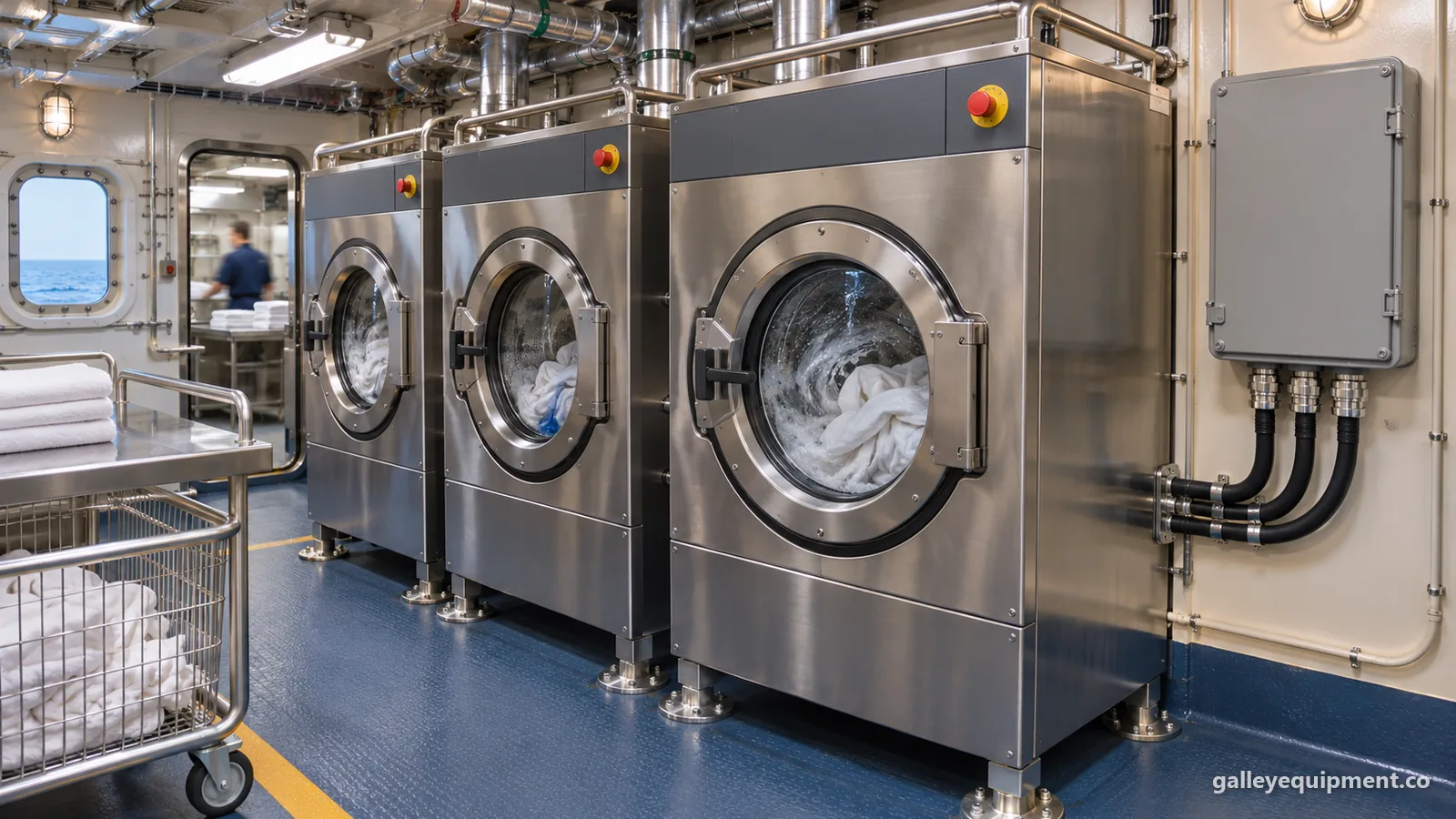
Miele Washing Machine PWM 507 [EL DP MAR 1N AC 230 V 60Hz] – 7 kg, 230 V, Lotus white
7 kg Little Giants marine washer, PWM 507 MAR, 1N AC 230 V 60 Hz with 64 l drum and 1,600 rpm spin, tested for 30,000 h, Lloyd’s Register approved.
Miele Washing Machine PWM 511 [EL DP DD SOM] – 11 kg, 3 AC 440V 60HZ, Iron grey
Miele PWM 511 Benchmark marine washer, 11 kg at 1:9 load with 100 l drum, 1,100 rpm spin and 370 g-factor on 3 AC 400V 60 HZ.
Miele Washing Machine PWM 906 [EL DP MAR 2 AC 208-240V 60Hz] – 6 kg, 208–240 V, Stainless steel
Miele PWM 906 marine washer, 6 kg Little Giants, 57 l drum, 1,600 rpm at 2~208-240V 60HZ, Lloyd's Register approved.
Miele Washing Machine PWM 908 [EL DP MAR 2 AC 208-240V 60Hz] – 8 kg, 208–240 V, Stainless steel
8 kg Little Giants marine washer, 73 l honeycomb drum, 1,600 rpm, g-factor 704 at 2~208–240 V 60 Hz.
Miele Washing Machine PWM 912 [EL DV DD SOM] – 12 kg, 3 AC 480V 60HZ, Stainless steel
Miele PWM 912 [EL DV DD SOM] 12 kg marine washer with 110 l drum, 504 g-factor and 30,000 h tested life for Benchmark Performance Plus laundries.
Miele Washing Machine PWM 916 [EL DV DD SOM] – 16 kg, 3 AC 480V 60HZ, Stainless steel
Benchmark PWM 916 SOM washer, 16 kg at 1:9 load ratio on a 140 l drum with 502 g factor and 3 AC 440 V 60 HZ electric heating.
Miele Washing Machine PWM 920 [EL DV DD SOM] – 20 kg, 3 AC 480V 60HZ, Stainless steel
20 kg Benchmark Performance Plus marine washer, 180 l drum, 1120 rpm spin on 3 AC 440V 60HZ, PWM 920 [EL DV DD SOM].
Miele Washing Machine PWM 507 [EL DP MAR 3 AC 400-480V 50-60Hz] – 7 kg, 400–480 V, Lotus white
7 kg Little Giants marine washer-extractor, PWM 507 EL DP MAR, 3~ 480 V 50/60 Hz with 1,600 rpm spin and 704 g-factor for shipboard laundries.
Miele Washing Machine PWM 906 [EL DP MAR 2N AC 400V 50-60Hz] – 6 kg, 400 V, Lotus white
6 kg PWM 906 Little Giants marine washer with 57 l drum, 1,600 rpm spin, 704 g-factor and Lloyd’s Register approval in Lotus white.
Miele Washing Machine PWM 906 [EL DP MAR 2N AC 400V 50-60Hz] – 6 kg, 400 V, Stainless steel
6 kg PWM 906 Little Giants marine washer with 57 l honeycomb drum, 1,600 rpm spin and 704 g-factor for shipboard and offshore use.
Miele Washing Machine PWM 906 [EL DP MAR 3 AC 230V 50-60Hz] – 6 kg, 230 V, Lotus white
Miele PWM 906 Little Giants marine washer, 6 kg in 57 l drum at 1,600 rpm, g‑factor 704, Lloyd’s Register approved 3~ 230 V 50/60 Hz unit.
Miele Washing Machine PWM 906 [EL DP MAR 3 AC 230V 50-60Hz] – 6 kg, 230 V, Stainless steel
6 kg Little Giants marine washer PWM 906, 57 l drum, 1,600 rpm spin at g‑factor 704, 3~ 230V 50/60HZ, Lloyd’s Register approved.
Miele Washing Machine PWM 906 [EL DP MAR 3 AC 400-480V 50-60Hz] – 6 kg, 400–480 V, Lotus white
6 kg Miele PWM 906 EL DP MAR Little Giants marine washer, 57 l drum, 3~ 480V 50/60HZ with ≤70 dB(A) noise level.
Miele Washing Machine PWM 906 [EL DP MAR 3 AC 400-480V 50-60Hz] – 6 kg, 400–480 V, Stainless steel
Miele PWM 906 Little Giants marine washer, 6 kg in a 57 l drum at 1,600 rpm (g‑factor 704) on 3~ 480 V 50/60 Hz, stainless steel front.
Miele Washing Machine PWM 908 [EL DP MAR 2 NAC 400V 50-60Hz] – 8 kg, 400 V, Lotus white
8 kg Little Giants PWM 908 marine washer with 73 l honeycomb drum, 1,600 rpm spin and 704 g-factor for shipboard and offshore laundry rooms.
Miele Washing Machine PWM 908 [EL DP MAR 2 NAC 400V 50-60Hz] – 8 kg, 400 V, Stainless steel
8 kg Little Giants marine washer, PWM 908 EL DP MAR, 73 l drum, 1,600 rpm spin and 704 g-factor in stainless steel front.
Miele Washing Machine PWM 908 [EL DP MAR 3 AC 230V 50-60Hz] – 8 kg, 230 V, Lotus white
8 kg Little Giants PWM 908 marine washer, 73 l drum, 3~ 230 V 50/60 Hz with DN 22 drain pump and Lloyd’s Register approval.
Miele Washing Machine PWM 908 [EL DP MAR 3 AC 230V 50-60Hz] – 8 kg, 230 V, Stainless steel
8 kg Little Giants marine washer PWM 908 EL DP MAR, 73 l drum, 1,600 rpm and g factor 704, 3~ 230 V 50/60 Hz, Lloyd's Register approved.
Miele Washing Machine PWM 908 [EL DP MAR 3 AC 400-480V 50-60Hz] – 8 kg, 400–480 V, Lotus white
Miele PWM 908 Little Giants 8 kg marine washer, 73 l drum, 1,600 rpm, g-factor 704, EL DP MAR 3~ 480V 50/60HZ, Lloyd’s Register approved.
Miele Washing Machine PWM 908 [EL DP MAR 3 AC 400-480V 50-60Hz] – 8 kg, 400–480 V, Stainless steel
PWM 908 Little Giants marine washer, 8 kg at 1,600 rpm, g‑factor 704 and 73 l drum with Lloyd’s Register approval.
Miele Washing Machine PWM 909 [EL DP DD SOM] – 9 kg, 3 AC 440V 60HZ, Stainless steel
Miele PWM 909 Benchmark Performance Plus marine washer, 9 kg at 1:9 load ratio in an 80 l drum with 1300 rpm spin and M Touch Pro Plus control.
Miele Washing Machine PWM 909 [EL DP DD SOM] – 9 kg, 3 AC 230V 60HZ, Stainless steel
Miele PWM 909 EL DP DD SOM marine washer, 9 kg at 1:9 load ratio in an 80 l drum with 1300 rpm spin at g‑factor 518, 3 AC 230V 60HZ.
Miele Washing Machine PWM 927 [EL DV DD SOM] – 27 kg, 3 AC 480V 60HZ, Stainless steel
27 kg Miele PWM 927 Benchmark Performance Plus marine washer, 240 l drum, 3 AC 440V 60HZ, 23.6 kW connected load.
Miele Washing Machine PWM 935 [EL DV DD SOM] – 35 kg, 3 AC 480V 60HZ, Stainless steel
35 kg Benchmark Performance Plus marine washer with 320 l drum, 3 AC 440V 60HZ supply and 9656 N floor load. Miele PWM 935.
Every one of the 24 builds carries a 60 Hz rating on its plate, which is the frequency of most large merchant ships, of vessels under the US flag and of a good share of yachts built in America. Beyond that shared rating they divide into three voltage bands with different series, drum sizes and vessel types. Sixteen are compact Little Giants machines, all in the up-to-8 kg band, and eight are Benchmark machines. Load bands run up to 8 kg (16 builds), 9 to 12 kg (4), 13 to 20 kg (2), 21 to 30 kg (1) and over 30 kg (1).
Published connected load spans 2.85 kW to 34.1 kW, so the same frequency filter covers a small yacht laundry and the main laundry of a cargo ship.
The voltage band is the second decision after frequency, and it follows the switchboard that will feed the laundry.
| Supply band | Builds rated 60 Hz | Also rated 50 Hz | Example model codes |
|---|---|---|---|
| 208-240 V, 60 Hz | 8 | 4 | PWM 507, PWM 906, PWM 908 |
| 380-415 V, 60 Hz | 9 | 9 | dual-frequency Little Giants builds |
| 440-480 V, 60 Hz | 7 | none | PWM 909, PWM 912, PWM 920, PWM 935 |
Yachts with American-style 208 V or 240 V circuits fall in the first row, and the eight builds for 208-240 V at 60 Hz list them in detail. The middle row suits yachts on a 400 V supply, and every machine in it holds both frequency ratings; the nine dual-rated 380-415 V Little Giants are gathered on their own page. Merchant ships on a 440 V main supply belong in the last row, and the Benchmark washers for 440-480 V switchboards set out all seven. Seventeen listings name a three-phase connection, against a single one for single-phase.
A drum motor or drain pump built for 50 Hz turns about 20 percent faster on 60 Hz, which changes spin speed, pump flow and the load on bearings and belts. The heating element behaves differently: it responds to voltage, not frequency, so a correctly rated voltage keeps the heater within its rating even when the frequency is wrong. The motor side is what makes a mismatch a problem, and on a washer the motor does most of the mechanical work.
Frequency converters can feed a 50 Hz machine from a 60 Hz supply, but they add cost, weight and heat to a laundry that already runs warm. Ordering a build rated for the vessel's frequency avoids all three. Our guide on what a mismatched supply does to spin and pump speeds prices those trade-offs in more detail.
Thirteen of the 24 builds also carry a 50 Hz rating: all nine in the 380-415 V band and four in the 208-240 V band. A 50/60 Hz washing machine of this kind is useful on a yacht that changes between European and American shore power, on a newbuild where the generator frequency is not yet fixed, and on a fleet that wants one spare-parts list for vessels on different supplies. None of the seven 440-480 V builds holds a 50 Hz rating, so any vessel in this group that connects to a 50 Hz shore supply during dry dock is better off running its laundry from its own generators.
No build on this page is rated for 110 V or 120 V; the lowest voltage band is 208-240 V. On American boats that usually means a dedicated 240 V circuit, which most 50 A shore connections and many marine generators already provide alongside 120 V. Someone searching for a marine washer at 7 kg, 110 V and 60 Hz will find the closest match in the PWM 507, a 7 kg single-phase machine built for 1N AC 230 V 60Hz with a 2.85 kW connected load.
The eight Benchmark machines carry the larger loads. Seven sit in the 440-480 V band, from the 9 kg PWM 909 at 6.3 kW and the 11 kg PWM 511, also at 6.3 kW, up through the 12 kg PWM 912 at 10.4 kW and the 16 kg PWM 916 at 15.7 kW, to the 20 kg PWM 920 at 22.5 kW, the 27 kg PWM 927 at 27.6 kW and the 35 kg PWM 935 at 34.1 kW. The eighth Benchmark build sits in the 208-240 V band. For a heavy duty washing machine at 60 Hz on a merchant ship, those 440-480 V drums are the place to start.
60 Hz marine washing machines are the wrong filter for a vessel on a 50 Hz supply, which should start from the complete washing machine category, since 13 dual-rated builds are only part of what suits 50 Hz. Offshore units that need dryers and ironers on the same 60 Hz supply can compare all three together on the 60 Hz offshore laundry list. A vessel with a 120 V-only system needs a 240 V or three-phase circuit before any of these machines can be fitted.
The fastest answers come from enquiries that state supply voltage, frequency and phase arrangement as read from the switchboard, the vessel type and the number of people the laundry serves, the space and access route, and the water and drain arrangements. Add the number of washers and whether dryers are needed alongside them, then send everything through the 60 Hz washer quotation form.
Last reviewed by the Vista Marine galley engineering team.
Questions about 60 hz marine washing machines
Can a 50 Hz washing machine run on a 60 Hz supply?
It is not recommended without a frequency converter. The drum motor and drain pump of a 50 Hz machine turn about 20 percent faster on 60 Hz, which changes spin speed and pump flow and adds wear. The heating element follows voltage rather than frequency. Ordering one of the 24 builds rated for 60 Hz avoids the problem entirely.
Are there 110 V or 120 V marine washers on this page?
No. The lowest voltage band among the 24 machines is 208-240 V. American boats usually provide 240 V through a dedicated circuit from a 50 A shore connection or the generator. The closest match to a 7 kg, 110 V washer is the PWM 507, a single-phase 7 kg build for 230 V at 60 Hz.
Which 60 Hz machines also work on 50 Hz?
Thirteen builds carry both ratings: all nine in the 380-415 V band and four in the 208-240 V band. They suit vessels that switch between shore supplies of different frequency or fleets that want one model on every vessel. The seven 440-480 V Benchmark builds are rated for 60 Hz only.
What is the largest 60 Hz drum listed?
The 35 kg PWM 935, built for 3 AC 480V 60HZ, is the largest machine on the page and draws 34.1 kW. It is one of seven Benchmark builds in the 440-480 V band, which cover 9 kg to 35 kg and suit merchant ship and offshore laundries on a 440 V main supply.
Is a three-phase supply needed for a 60 Hz marine washer?
Not always, but it is the norm. Where the phase is stated, 17 of the builds on this page are three-phase and one is single-phase, the 7 kg PWM 507 for 230 V. A 3 phase washing machine spreads the heating load across the supply, which matters on larger drums that draw 10 kW or more.
Request a quotation for 60 hz marine washing machines
Send the vessel type, supply voltage, frequency and phase and the quantities, and our team will come back with a specification and quotation.


