
Miele Washer-Dryer Stack PDW 909 [EL DP DD SOM] – 3N AC 400 V 50 Hz, Stainless steel
Miele PDW 909 Benchmark washer-dryer stack, 9+9 kg in 692 mm width, 3N AC 400 V, stainless front, specified for shipboard and offshore use.
Commercial laundry equipment for ships, yachts and offshore units: washer-extractors, tumble dryers, rotary ironers and washer-dryer stacks, supplied in the vessel's own supply voltage and frequency.
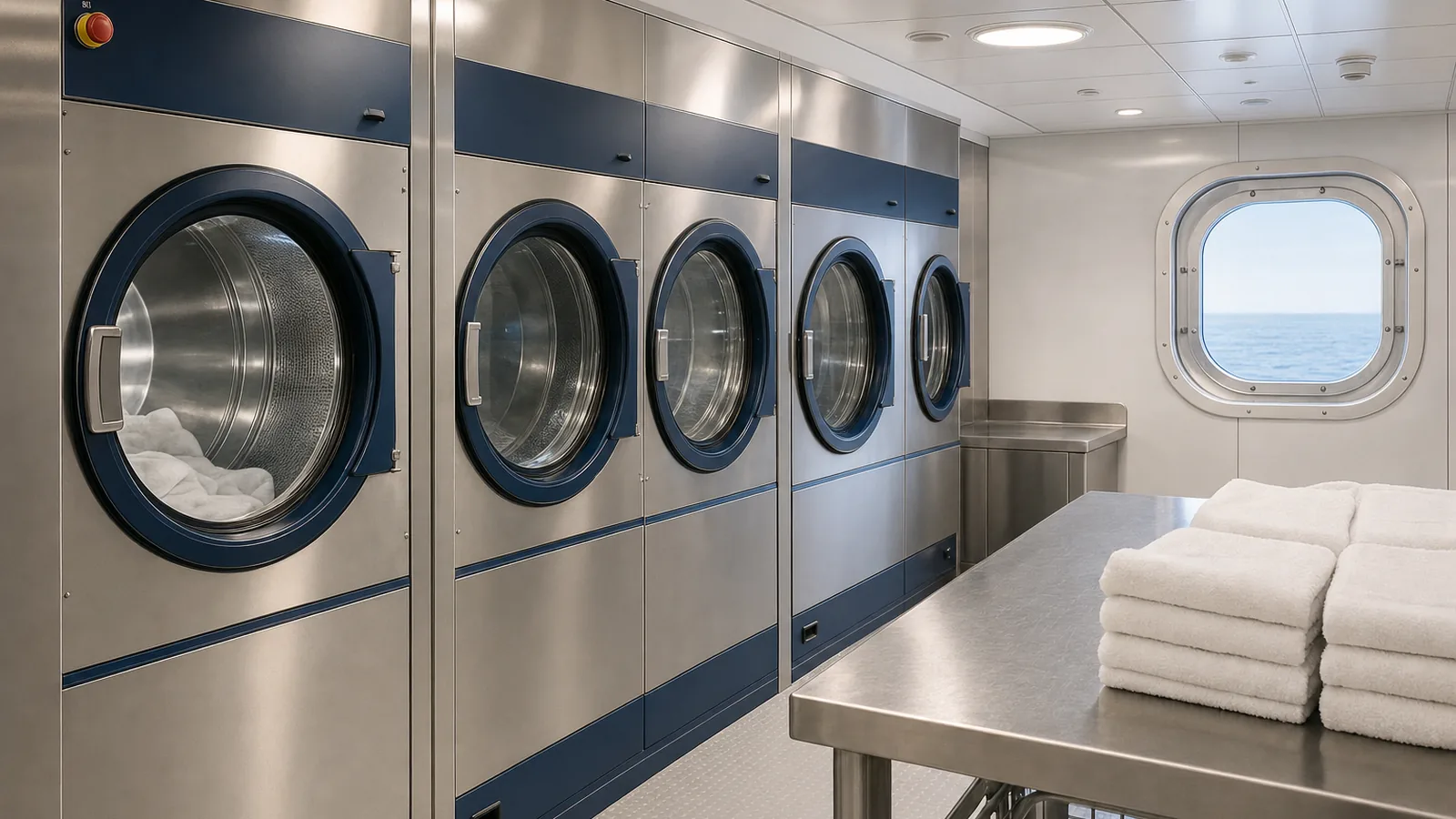
Miele PDW 909 Benchmark washer-dryer stack, 9+9 kg in 692 mm width, 3N AC 400 V, stainless front, specified for shipboard and offshore use.
Miele PDW 909 Benchmark washer-dryer stack, 9+9 kg, 692 mm wide, 3 AC 230 V electric heating for marine and offshore use.
Miele PDW 909 Benchmark washer-dryer stack, 9+9 kg with 80/180 l drums and 3N AC 400 V 60 Hz washer supply.
Benchmark Performance Plus PDW 909 stack, 9+9 kg with 80 l washer and 180 l dryer drums in a 1,940 mm-high stainless front column.
Benchmark Performance Plus marine tumble dryer PDR 944, 800 l drum and 37.2 l/h evaporation at 3 AC 230V 50/60HZ, electric exhaust-air design.
44 kg Benchmark Performance Plus exhaust-air marine tumble dryer, 800 l drum, 3 AC 200–208 V 50–60 Hz, M Touch Pro controls. PDR 944 [EL SOM].
Benchmark PDR 944 vented marine dryer, 800 l drum for 32–44 kg loads, 36 kW electric, 3N AC 400V 50/60Hz, stainless-steel front.
Benchmark PDR 944 EL SOM vented dryer, 800 l drum and 37.2 l/h evaporation at 3 AC 400V 50/60Hz for offshore and shipboard laundries.
Miele PDR 944 [EL SOM] Benchmark exhaust-air dryer, 800 l drum for 32–44 kg loads on 3 AC 440V 50/60HZ.
Miele PDR 928 [EL SOM] Benchmark marine dryer, 500 l drum, up to 28 kg at 1:18, 3 AC 230V 50/60HZ.
Exhaust-air marine tumble dryer, 500 l drum and 28 kg load at 1:18 ratio, Benchmark Performance Plus PDR 928 [EL SOM].
Benchmark PDR 928 [EL SOM] exhaust-air marine dryer, 500 l drum and 28 kg capacity at 1:18 load ratio, 3 AC 400V 50/60HZ.
Miele PDR 928 EL SOM Benchmark exhaust dryer, 28 kg at 1:18 in a 500 l drum, 3 AC 440V 50/60HZ.
Benchmark PDR 922 [EL SOM] marine dryer, 400 l drum for up to 22 kg loads, 23.5 kW at 3 AC 230V 50/60HZ, exhaust air system.
22 kg Benchmark Performance Plus marine vented dryer, 400 l drum, 3 AC 400V 50/60HZ, M Touch Pro control. PDR 922 [EL SOM].
Benchmark Performance Plus marine tumble dryer PDR 922 EL SOM, 22 kg load at 400 l drum volume, 3N AC 400 V 50/60 Hz exhaust air.
Benchmark PDR 922 [EL SOM] marine tumble dryer, 22 kg at 1:18 load ratio, 400 l drum, 3 AC 400V 50/60HZ, front in stainless steel.
16–22 kg Benchmark Performance Plus vented dryer, 400 l drum, 3 AC 440V 50/60HZ, PDR 922 [EL SOM] for offshore and shipboard use.
Miele Benchmark PDR 918 EL SOM marine exhaust-air dryer, 18 kg at 1:18 in a 325 l drum, 18.6 kW on 3 AC 230 V 50/60 Hz.
Benchmark Performance Plus exhaust-air dryer, 18 kg at 1:18 with 325 l drum and 23 min programme. Miele PDR 918 [EL SOM] 11911190.
Benchmark PDR 918 [EL SOM] marine exhaust‑air dryer, 18 kg at 1:18, 325 l drum on 3N AC 400V 50/60HZ, 18.6 kW.
Benchmark PDR 918 EL SOM marine dryer, 18 kg load at 325 l drum volume, 18.6 kW exhaust-air unit on 3 AC 400V 50/60HZ.
Benchmark PDR 918 [EL SOM] marine exhaust-air dryer, 18 kg load at 325 l drum volume, 3 AC 440V 50/60HZ, with M Touch Pro controls.
Benchmark Performance Plus marine tumble dryer PDR 914, 250 l drum for up to 14 kg at 0.51 kWh/kg, 3 AC 230 V 50/60 Hz.
From 6 to 44 kg load and 57 to 800 litre drums, this laundry range runs from Little Giants up to the largest Benchmark washer-extractors and tumble dryers. Widths start at 596 mm and go up to 2759 mm on the biggest Professional rotary ironers, with net weights between 39 and 692 kg, so the naval architect gets clear bounds for deck loading and plant-room space. Electrical power spans 1.2 to 37.7 kW, with Benchmark reaching 37.7 kW and Little Giants confined to 1.2–6.4 kW.
On a vessel this spread lets a designer cover anything from a compact yacht laundry to a full production set-up for commercial vessels and offshore units, still within a single brand. Smaller 596–606 mm machines suit narrow laundries and stair cores, while widths over 1200 mm give the roller length needed for serious flatwork throughput. Knowing the extremes means beam, deck height and cable sizes can be locked in early instead of retrofitted around an under-specified plant.
Little Giants cover 6–8 kg loads with drum volumes from 57 to 130 litres and widths between 596 and 606 mm, all in net weights from 49 to 108 kg. Electrical power in this class runs from 1.2 to 6.4 kW, which makes them easier to feed from a constrained hotel-services board than a 20 kW machine. Supply options include 230 V, 208–240 V, 400 V and 400–480 V, at both 50 Hz and 60 Hz, so a single series can be matched to European, US or 440 V shipboard systems.
These are the natural candidates for yacht laundries, boat galleys carrying a few crew cabins, and any vessel where stacked columns have to live in a pantry or corridor recess. All Little Giants are tagged Marine approved and Offshore specified, and many carry disinfection and tested virucidal programmes where hygiene control matters more than sheer throughput. Where vertical space allows, using washer-dryer stacks from the Benchmark range lets a similar footprint carry bigger single-batch loads without giving up the flexibility of separate machines.
Benchmark covers 9–44 kg loads with drum volumes from 80 to 800 litres, widths from 700 to 1206 mm and net weights from 72 up to 692 kg. Power ratings in this series stretch from 4.6 to 37.7 kW, so the same platform can sit on modest or heavily provisioned electrical services. Supply voltages span 230 V through 400 V, 440 V and 480 V at both 50 Hz and 60 Hz on many models, supporting mixed-fleet standardisation where shore and ship supplies differ.
Professional rotary ironers in the same marine catalogue run from 985 to 2759 mm wide and electrical loads from 3.2 to 23.5 kW. These are the pieces that turn washer capacity into usable linen throughput on cruise, ferry and offshore accommodation laundries. A significant part of the Benchmark and Professional ranges is flagged Energy management ready, Payment system ready and Network connectable, which matters if the owner wants to monitor consumption, run coin or card systems, or link machines into a ship-wide management platform instead of leaving them as stand-alone islands.
Across the 113 products the data plate voltages range from 208–240 V and 220–240 V up to 400 V, 400–480 V, 440 V and 450 V. Both 50 Hz and 60 Hz are represented on most of the catalogue, mirroring the reality that ships and shore power are not standardised to a single combination. Benchmark and Little Giants machines in particular show 50 Hz on dozens of products and 60 Hz on a similar count, allowing like-for-like models to be chosen for different flags without redesigning the laundry.
Almost all of the equipment is electrically heated; only two products are steam heated, so on a vessel with steam available the laundry will still be mainly an electrical load. Heat-pump dryers without exhaust vents sit alongside air-vented models, giving naval architects a choice between an exhaust duct run through fire zones and a condensate drain connection instead.
This Marine Laundry Equipment page is the right place when the specification involves a complete laundry mix of washing machines, tumble dryers, rotary ironers and washer-dryer stacks, sized and powered to work together. It is the wrong place if the task is to drill into only one equipment type in detail, or to compare models purely within a single function. For that, the separate Washing Machines, Tumble Dryers, Ironers and Washer-Dryer Stacks sub-categories give a tighter view by load class, width band and heating method within each function.
Little Giants cover 6–8 kg loads with 57–130 litre drums and 1.2–6.4 kW power, in widths around 596–606 mm, making them suitable for smaller laundries and stacked columns. Benchmark runs from 9 to 44 kg with 80–800 litre drums and up to 37.7 kW, in widths from 700 to 1206 mm, better suited to main laundries on ferries, cruise ships and offshore units.
Across the 113 products, supply voltages include 208–240 V, 220–240 V, 230 V, 400 V, 400–480 V, 440 V and 450 V, so both low-voltage and 400+ V three-phase systems are covered. Frequencies of 50 Hz and 60 Hz are listed on most machines, meaning like-for-like models can be matched to different shipboard and shore-power standards.
Heat pump dryers in this range are marked as "Heat pump (no vent)" and avoid the need for exhaust ducting, which is useful where cutting through bulkheads or decks for air vents is constrained. Air-vented dryers, of which there are 36 models, need an exhaust duct and a make-up air path through the vessel.
Professional series rotary ironers span widths from 985 to 2759 mm and net weights from 39 to 458 kg, with electrical power between 3.2 and 23.5 kW. A large-unit main laundry needs to reserve both deck area for a machine more than 2,000 mm wide and enough structural capacity to carry several hundred kilograms plus the live load of operators.
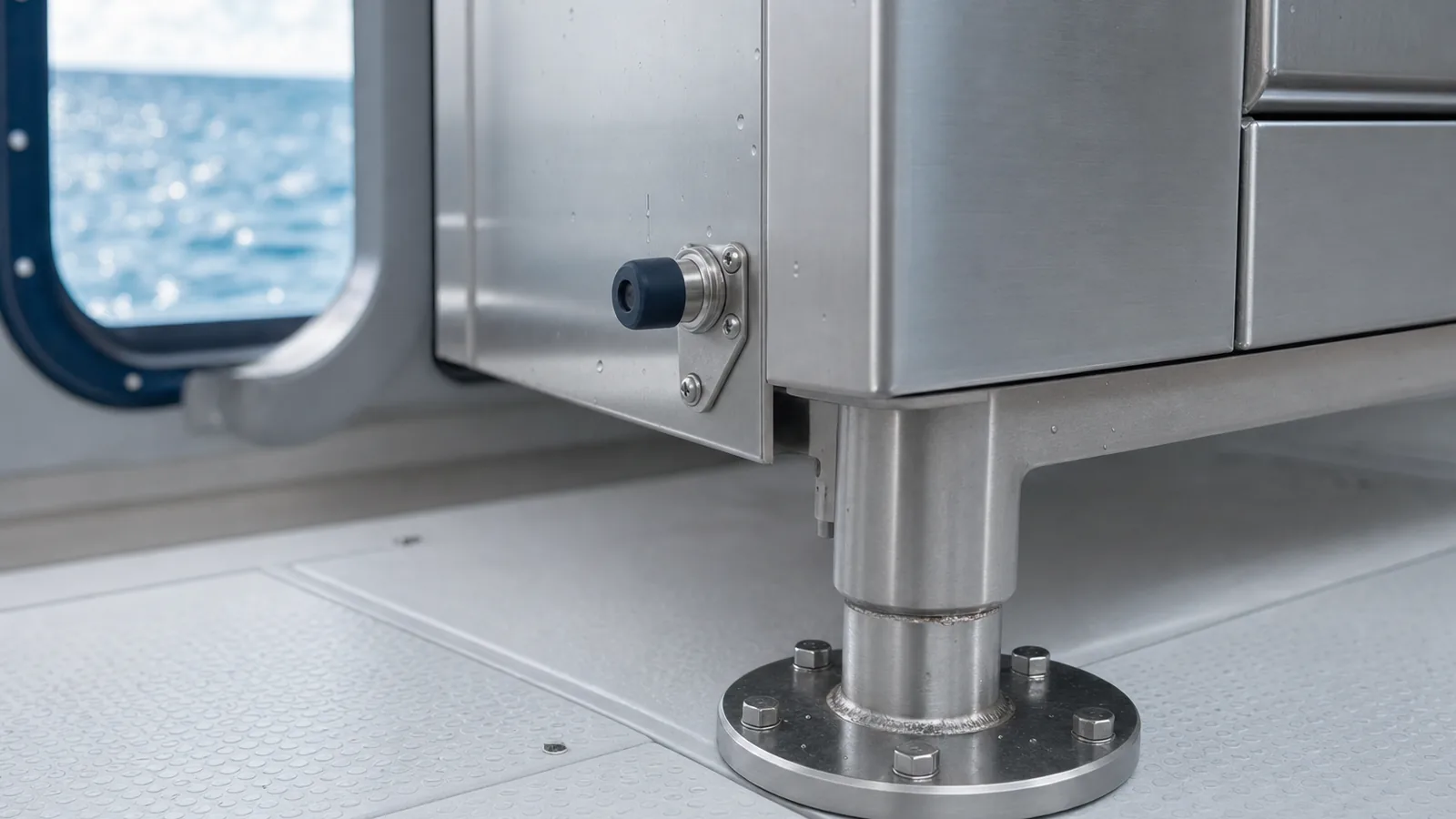
What actually changes when a commercial appliance is built for a ship — supply, fixing, water protection, materials, hygiene construction, refrigerant and certification — and why shore equipment fails at sea.
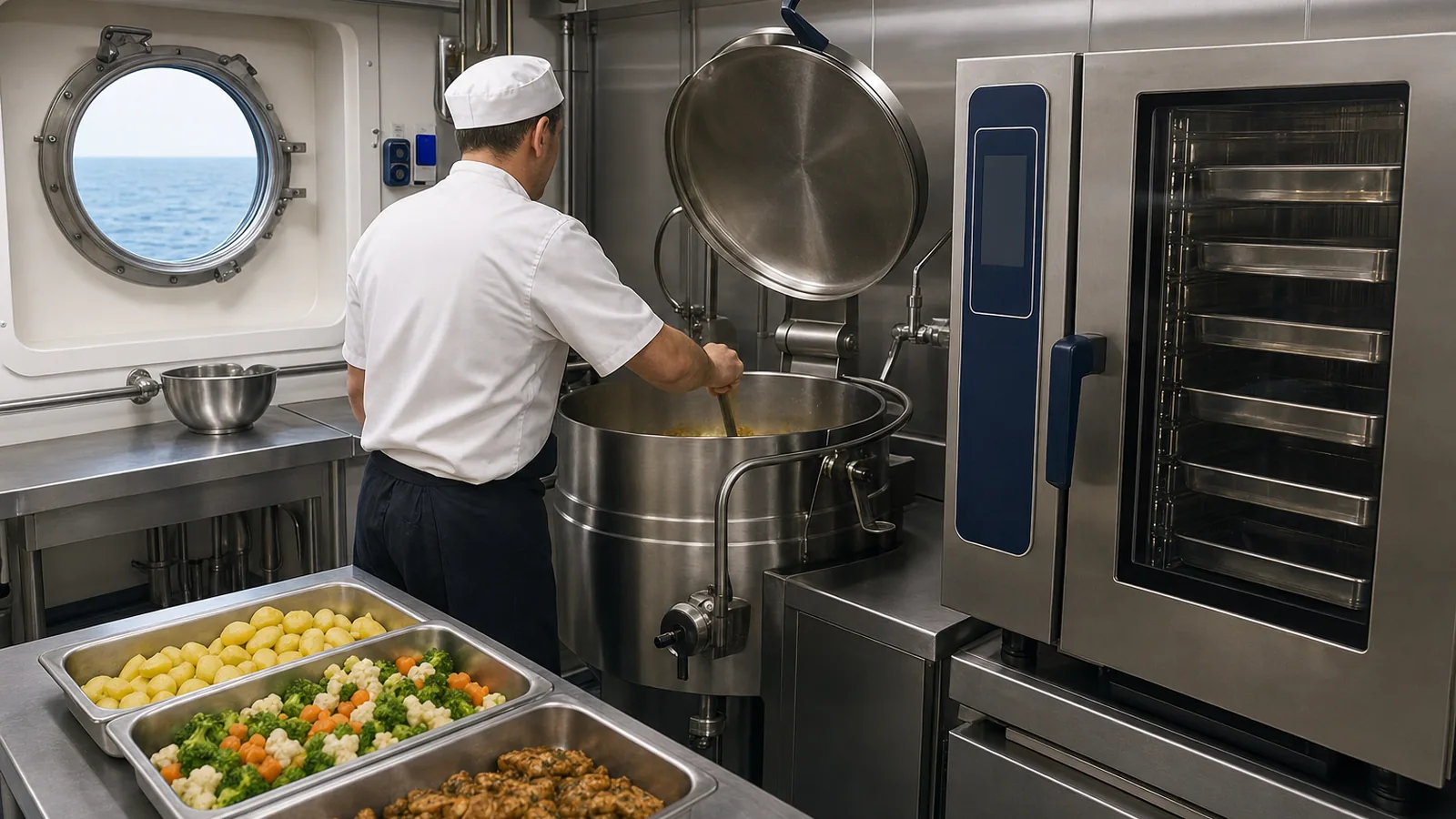
Read guideHow a ship galley is planned from the people it feeds: crew size and service pattern, rotation and provisioning, volume cooking, the scullery, power and steam, fire rules and the laundry.
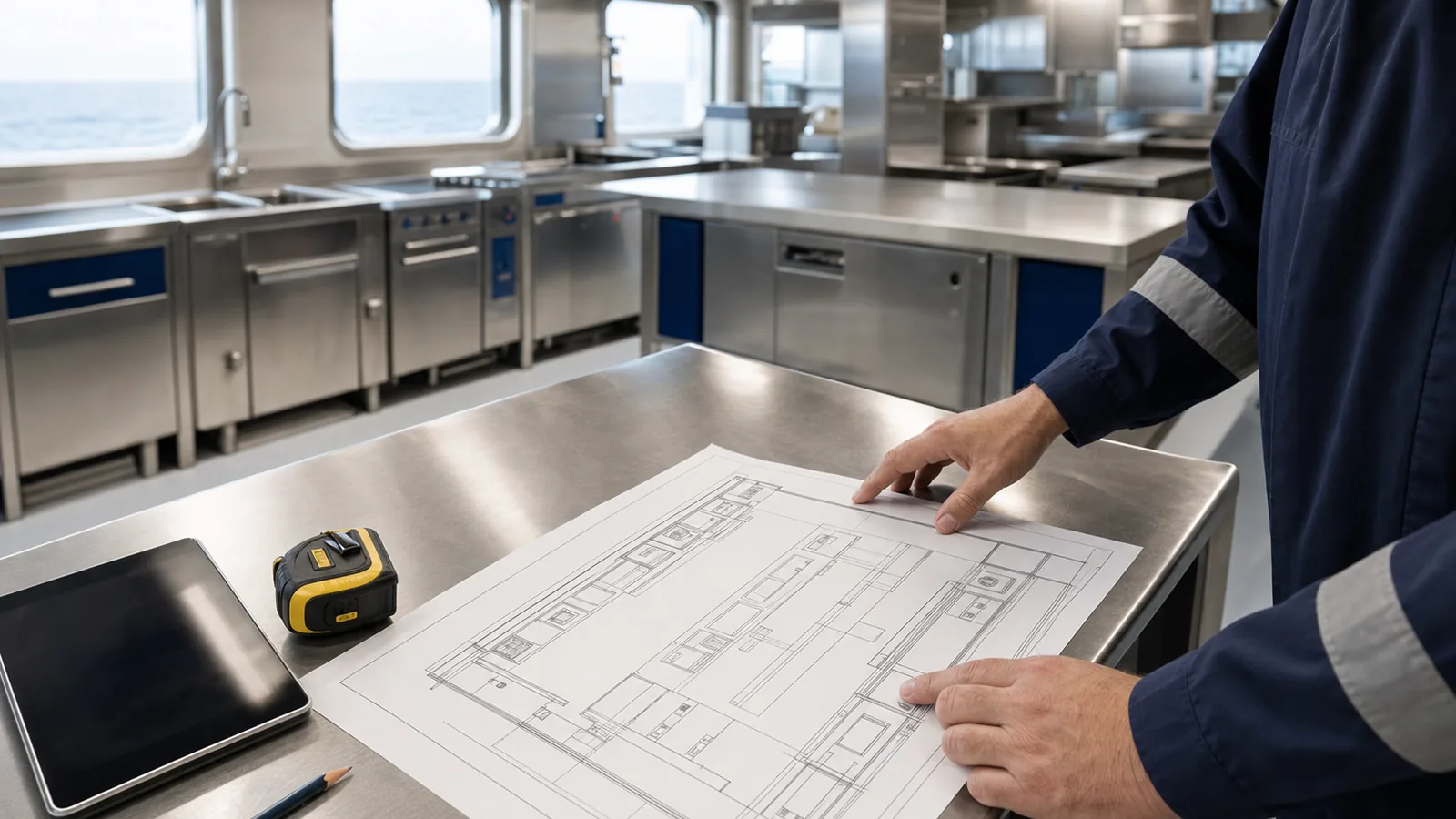
Read guideThe constraints that actually decide a galley specification — service, power, space, water, heat, motion, materials and compliance — worked through in the order they bite.
Read guide