

Steam tilting boiling pan, 150 lt net useful capacity in a 710 mm round vessel, 700 mm body height. Electrolux Professional 587180.
0.2 kW · 150 lt
Marine equipment by electrical supply
This page lists 230 V 60 Hz Marine Boiling Kettles: 10 steam-heated Electrolux Professional boiling pans with a single-phase 208-240 V connection rated at both 60 Hz and 50 Hz. Each unit draws only 0.2 kW of electricity because the cooking heat comes from the ship's steam. Capacity bands run from 51-100 up to 201-400 litres, split evenly between wall-mounted and freestanding units.
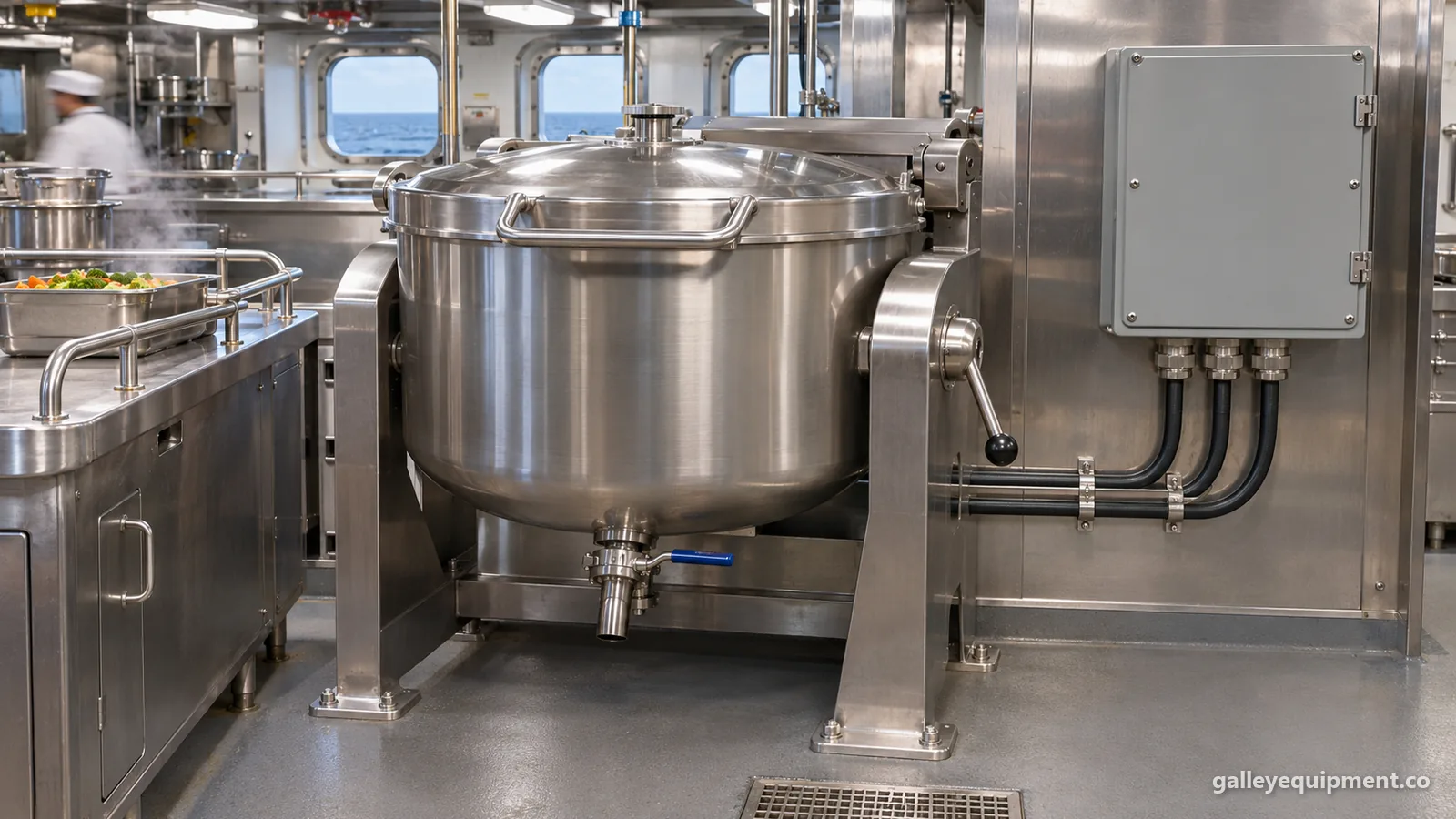
Steam tilting boiling pan, 150 lt net useful capacity in a 710 mm round vessel, 700 mm body height. Electrolux Professional 587180.
60 lt round tilting boiling pan, 1100 x 900 mm wall-mounted body at 400 mm height, fed by external steam up to 1.5 bar. PNC 587177.
150 lt wall-mounted steam tilting boiling pan, 710 mm round vessel, indirect heating from 1–1.5 bar external steam. PNC 587181.
60 lt steam-heated tilting boiling pan, 1100 x 900 mm footprint, external steam 1–1.5 bar, IPX6, 230 V single-phase. PNC 587176.
100 lt round tilting boiling pan, indirect steam-heated from external source, 1200 x 900 mm footprint. Marine ProThermetic 587178.
300 lt round tilting boiling pan, 900 mm diameter and 570 mm depth, wall mounted, indirect steam from external source. PNC 587185.
Steam tilting boiling pan, 200 lt net capacity with 800 mm round vessel and external steam at 1–1.5 bar. Electrolux ProThermetic PNC 587182.
Steam-fed 200 lt wall-mounted tilting boiling pan, 800 mm round vessel, 50–110 °C, external steam 1–1.5 bar. PNC 587183.
Steam-fed 300 lt tilting boiling pan with 900 mm round vessel, 570 mm depth and automatic tilting, 230 V/1 ph controls, IPX6, double jacket.
Electrolux Professional Boiling Pan 587179 – Steam Tilting Boiling Pan, 100lt Wall mounted d=900
100 lt round steam tilting boiling pan, 640 mm vessel, wall-mounted 1200×900 mm body, 230 V/1 ph, external steam 1–1.5 bar. PNC 587179.
All 10 of the 230 V 60 Hz Marine Boiling Kettles are steam heated, so the 0.2 kW on each data sheet covers controls and auxiliary functions, not cooking heat. Steam from the vessel's boiler enters the jacket around the pan, gives up its heat to the contents and leaves as condensate. The electrical connection only has to power the control circuit, which is why a pan of up to 400 litres can run from a small single-phase supply.
That is the whole point of this filter. A galley on a ship with steam service can install large boiling pans without adding tens of kilowatts to the switchboard. Electrolux Professional makes all ten, and the site lists each of them for use on ships, yachts and offshore units. The wider boiling kettle category carries electric alternatives for vessels without steam.
Every model shares the same electrical data, and the differences lie in size and mounting.
| Specification | Models |
|---|---|
| 208-240 V, 60 Hz, single-phase | 10 |
| 208-240 V, 50 Hz, single-phase | 10 |
| Electrical load 0.2 kW | 10 |
| 51 - 100 litres | 4 |
| 101 - 200 litres | 4 |
| 201 - 400 litres | 2 |
| Wall mounted / freestanding | 5 / 5 |
The 208-240 V band takes in 208 V, the phase-to-phase value of American 120/208 V systems, as well as the 220 V, 230 V and 240 V circuits found on ships and in shore kitchens worldwide. Because the rating includes both 50 Hz and 60 Hz, the pans need no frequency converter on either type of vessel. With only control equipment on the electrical side, frequency would matter little anyway, but a maker's dual rating removes any doubt about relays and timers. Our frequency note for steam pan controls explains where 50 and 60 Hz differences do bite in a galley.
These pans are only as good as the steam supply behind them. The vessel needs a steam line run to the galley position, delivered at the pressure stated on each data sheet, with an isolating valve, a strainer and a steam trap. Condensate has to go somewhere: either back to the boiler's hot well, which saves feed water and energy, or to a drain.
Ships that already pipe steam to the galley are usually those with auxiliary boilers for cargo or fuel heating, such as tankers. On those vessels, a steam boiling pan is the natural choice because the heat source already exists and runs anyway. On an all-electric ship, a yacht without a boiler or an offshore unit with an electric galley, these pans cannot work and an electric kettle is the only answer.
The ten divide five and five between bulkhead fixing and deck standing, at widths of 1100 to 1500 mm. A wall-mounted steam pan keeps the floor clear for washing down and suits galleys where the steam and condensate lines already run along the bulkhead. The bulkhead must take the weight of a full pan and the moment of tilting it.
A freestanding pan suits island cooking blocks, with the steam line brought up through the deck or across from a nearby bulkhead. The example on this page, model 587179, is a tilting 100-litre wall-mounted pan, so its contents pour forward into a gastronorm container instead of being ladled out on a moving deck. By size, the 51-100 and 101-200 litre bands each hold four models, and the 201-400 litre band holds two.
Searches for a 110v kettle or a 120v kettle usually come from people looking for a small electric kettle for a cabin, a crew mess or a wheelhouse pantry on an American-wired boat. None of the pans here runs at 110 V or 120 V; the lowest supply they accept is 208 V. They are industrial steam pans for a galley, not countertop water boilers.
A common related question asks whether a 120 V 60 Hz electric kettle will still boil water. It will: boiling point depends on air pressure, not on the frequency or voltage of the supply. A 120 V kettle simply has a lower wattage than its 230 V equivalent, so it takes longer. For buyers who search kettle 50 60hz, the dual rating on every model listed here is the relevant detail.
A vessel without galley steam needs an electric kettle, and for most ships that means a three-phase unit; the electric three-phase boiling pans for 440-480 V ships are the closest match from the same maker. Steam kettles from other makers and in other supplies appear among the steam-jacketed kettles for ship galleys. A European-built ship that runs an MKN modular line will find steam and electric kettles that join its block among the MKN Optima kettle range.
Start with the steam: pressure available at the galley, pipe size and whether condensate returns to the boiler. Then the electrical side, which here is simple: a 208-240 V single-phase supply and its frequency. Say how many people eat at each sitting and what the main dishes are, since that sets the capacity band, and say whether the pan goes on the bulkhead or the deck, with the width available. A steam kettle pricing request holding those points is enough for our team to propose model codes, and the Electrolux Professional product line-up shows the maker's related galley equipment.
Last reviewed by the Vista Marine galley engineering team.
Questions about 230 v 60 hz marine boiling kettles
Why do these kettles draw so little electricity?
All ten are steam heated. Steam from the ship's boiler heats the jacket around the pan, so the 0.2 kW electrical rating only covers the controls and auxiliary functions. That lets a pan of up to 400 litres run from a single-phase 208-240 V supply, provided the vessel has steam service at the galley.
Do these steam pans work on both 50 Hz and 60 Hz?
Yes. Every model is rated for 208-240 V single-phase at 60 Hz and at 50 Hz, so the same code suits American-wired and European-wired vessels. With only control equipment on the electrical side, frequency matters little, and the dual rating confirms the relays and timers have been checked by the maker.
Can a 120 V supply run these kettles?
No. The lowest voltage the pans accept is 208 V, the phase-to-phase value of a 120/208 V system. A 120 V outlet suits a small domestic kettle for a cabin or pantry, which is a different appliance. These are galley boiling pans of 51 to 400 litres heated by the ship's steam.
What does the vessel need to supply besides electricity?
A steam line to the galley at the pressure stated on the data sheet, with an isolating valve, strainer and steam trap, and a route for condensate back to the boiler or to a drain. Without steam service the pans cannot heat, and an electric three-phase kettle is the alternative.
Which sizes and mountings are available?
The 51-100 litre and 101-200 litre bands hold four models each, and two models reach the 201-400 litre band. Half of the ten hang on a bulkhead and half stand on the deck, at widths of 1100 to 1500 mm. The listed example, 587179, is a tilting 100-litre wall-mounted pan that pours into a container instead of being ladled at sea.
Request a quotation for 230 v 60 hz marine boiling kettles
Send the vessel type, supply voltage, frequency and phase and the quantities, and our team will come back with a specification and quotation.


