

Electric tilting boiling pan, 100 lt round indirect-heated vessel, 18.6 kW, 440 V/3 ph/50/60 Hz, freestanding with stirrer prep. PNC 587158.
18.6 kW · 100 lt
Marine equipment by electrical supply
This page lists 21 Three-Phase Marine Boiling Kettles, all Electrolux Professional boiling pans. Every one is built for a 440-480 V supply on 60 Hz or 50 Hz, and 20 of them accept 380-415 V, 50 Hz too. Capacity bands run from 51-100 litres up to 201-400 litres, ratings reach 36.6 kW, and the list splits into 11 freestanding and 10 wall-mounted units.
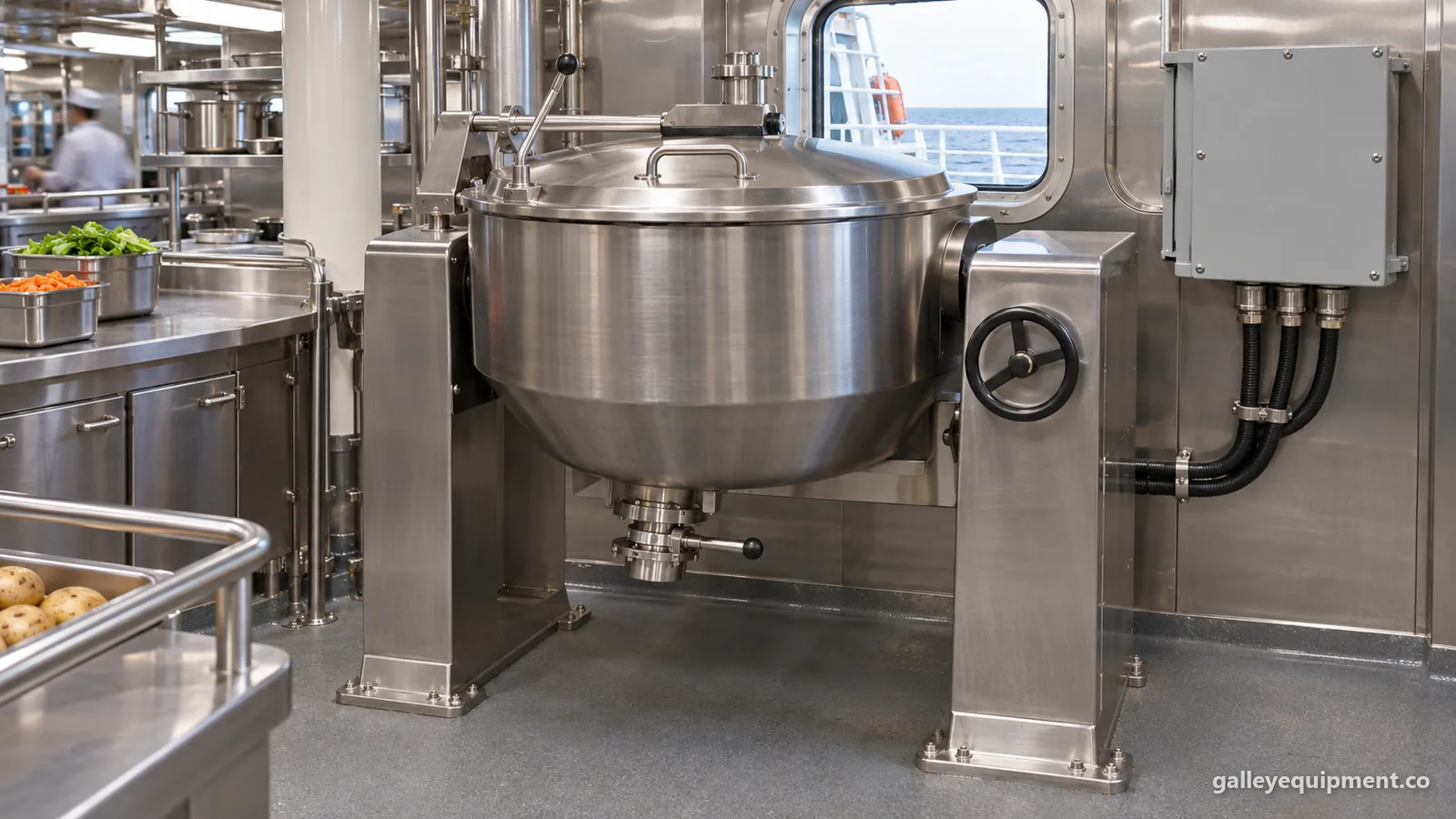
Electric tilting boiling pan, 100 lt round indirect-heated vessel, 18.6 kW, 440 V/3 ph/50/60 Hz, freestanding with stirrer prep. PNC 587158.
60 lt round electric tilting boiling pan, 12.5 kW, 50–110 °C, wall-mounted at 400 mm body height with stirrer preparation, PNC 587157.
Electrolux Professional Boiling Pan 587109 – Electric Tilting Boiling Pan, 300lt , Wall mounted
300 lt round electric tilting boiling pan, 36.2 kW, wall-mounted at 400 mm body height with 900 mm vessel. Electrolux 587109.
Electrolux Professional Boiling Pan 587107 – Electric Tilting Boiling Pan, 200lt , Wall mounted
200 lt round electric tilting boiling pan, 30.2 kW, wall mounted at 400 mm body height with automatic tilt. thermaline ProThermetic 587107.
100 lt electric tilting boiling pan, 18.2 kW, 440 V/3 ph/50/60 Hz, round 640 mm vessel, indirect heating, freestanding marine ProThermetic.
300 lt electric tilting boiling pan, 900 mm round vessel and 36.2 kW indirect heating, thermaline ProThermetic marine, PNC 587108.
Electric tilting boiling pan, 200 lt net in an 800 mm round vessel, 30.2 kW indirect heating at 440 V/3 ph/50/60 Hz, PNC 587106.
Electrolux Professional Boiling Pan 587105 – Electric Tilting Boiling Pan, 150lt , Wall mounted
Electric tilting boiling pan, 150 lt net capacity, wall mounted, 24.2 kW indirect heating with IPX6, Electrolux ProThermetic 587105.
150 lt electric tilting boiling pan with 24.2 kW indirect heating and 710 mm round vessel, Electrolux Professional PNC 587104.
Electrolux Professional Boiling Pan 587103 – Electric Tilting Boiling Pan, 100lt , Wall mounted
100 lt round electric tilting boiling pan, 18.2 kW, wall-mounted 1200 x 900 mm body with automatic tilting and IPX6. PNC 587103.
Electrolux Professional Boiling Pan 587101 – Electric Tilting Boiling Pan, 60lt , Wall mounted
60 lt electric tilting boiling pan, 1100 x 900 mm wall-mounted body at 400 mm height, indirect 12.2 kW heating. ProThermetic 60 lt, PNC 587101.
Electric tilting boiling pan, 60 lt net useful capacity with 579 mm round vessel, 12.2 kW, 440 V/3 ph/50/60 Hz, IPX6, freestanding.
300 lt electric tilting boiling pan, 36.6 kW, wall mounted with stirrer-ready round vessel, 900 mm diameter, 400 mm body height.
Electric 200 lt round tilting boiling pan, 800 mm diameter, 30.6 kW, 440 V/3 ph/50/60 Hz, IPX6, with double jacket and stirrer-ready.
Electric tilting boiling pan, 150 lt useful capacity with stirrer, wall mounted at 400 mm body height, 24.6 kW, IPX6, PNC 587161.
Electric tilting boiling pan PBOT15RCIO, 150 lt net capacity, 32.6 min heat-up from 20–90 °C at 24.6 kW, indirect double-jacketed vessel.
Electric 100 lt wall-mounted tilting boiling pan, 18.6 kW, 440 V/3 ph/50/60 Hz, pre-arranged for stirrer with automatic tilting.
Wall-mounted 200 lt electric tilting boiling pan with 30.6 kW indirect heating, 800 mm round vessel and stirrer-ready design.
60 lt electric tilting boiling pan, 50–110 °C, 12.5 kW, 440 V/3 ph/50/60 Hz, round vessel with automatic tilting and stirrer, PNC 587156.
300 lt electric tilting boiling pan, 36.6 kW, 900 mm round vessel with stirrer-ready configuration, IPX6, AISI 316L wetted parts.
Steam-heated 300 lt tilting boiling pan with 900 mm round vessel, 700 mm body height and IPX6 rating, prepared for stirrer. Electrolux 587214.
The 21 Three-Phase Marine Boiling Kettles on this page are all Electrolux Professional products, sold by that maker under the name boiling pan, and every one is rated for a 440-480 V, 60 Hz supply. Twenty heat electrically and one takes its heat from the ship's steam line. They belong to the wider marine boiling kettle category, where single-phase and other brands also appear.
A three-phase rating is what separates a galley boiling pan from anything a household or small pantry uses. The kettles here span the 51-100 litre band up to 400 litres and draw up to 36.6 kW, loads that only a three-phase circuit can carry at sensible current. The vessel flags on all 21 take in ships, yachts and offshore installations alike.
All 21 carry the two 440-480 V ratings, which is what makes this list useful on merchant ships.
| Rating or build | Models |
|---|---|
| 440-480 V, 60 Hz | 21 |
| 440-480 V, 50 Hz | 21 |
| 380-415 V, 50 Hz | 20 |
| Freestanding | 11 |
| Wall mounted | 10 |
Large merchant ships and US-flagged tonnage commonly feed their galleys from a 440 V, 60 Hz board, and 480 V appears on some American-built vessels. The 440-480 V, 50 Hz rating covers ships that run high voltage at European frequency. The 380-415 V, 50 Hz rating fits European-built vessels and shore kitchens. One model, the steam-heated pan, lists only the two 440-480 V ratings. That spread lets a fleet operator standardise on one kettle family across ships with different supplies.
Twelve of the kettles draw between 20 and 40 kW and eight between 10 and 20 kW, and loads like that are only practical on three phases. At 440 V three-phase, a 36.6 kW kettle draws roughly 48 A per phase. The same load on a single-phase 230 V circuit would need about 159 A, far beyond any galley socket circuit or ordinary cable size.
Spreading the load across three phases also keeps the generator balanced. A large single-phase load on one leg of a ship's supply unbalances the system and can upset other consumers on the same phase. Anyone searching for a 3 phase kettle for a ship galley is usually arriving at the same conclusion from the electrical side. A domestic marine kettle on a cabin pantry circuit draws 1.5 to 3 kW and belongs to a different class of equipment altogether.
Twenty of the kettles are electric and one is steam heated, and comparing a matched pair shows why the choice matters. The electric 300-litre tilting pan with stirrer, 587164, is rated 36.6 kW, all of it on the switchboard. Its steam counterpart, model 587214, holds the same 300 litres and also has a stirrer, but its electrical rating is 0.6 kW, because the heat arrives as steam in the jacket and the electrical side only drives the stirrer and controls.
On a ship with steam already piped to the galley, the steam pan removes a 36 kW step from the galley's peak load. On a ship without a boiler it is of no use, and the electric version is the only option. The steam model is the one kettle in the list that skips the 380-415 V rating.
The list divides evenly at the lower end: eight kettles between 51 and 100 litres, eight between 101 and 200 litres, and five between 201 and 400 litres. Both 300-litre examples on this page come with a stirrer, which keeps thick soups, sauces and porridge moving without a cook working a paddle for half an hour.
At sea the working fill should sit below the brim, since a full kettle will surge over its lip in a seaway. A vessel that would choose 150 litres ashore often orders the next size up and runs it part-full. Tilting models pour forward into a container or trolley, so the cook does not ladle hot liquid on a moving deck.
Ten of the kettles hang on a bulkhead and eleven stand on the deck, in widths between 1100 and 1500 mm. Hanging a kettle keeps the deck beneath it clear, which makes washing down and draining the galley floor faster and leaves no feet to collect grease. It needs a bulkhead strong enough to carry the full kettle and the moment of tilting, which may mean structural reinforcement on a refit.
A freestanding kettle suits island blocks and galleys where the bulkhead is a thin lining or carries services. It needs deck fixings that hold it while it tilts full. In either case, the Electrolux marine boiling pan selection shows the same maker's single-phase and other versions for comparison.
A galley on a vessel with steam but limited electrical capacity may do better with pans that need only a single-phase control supply; the single-phase steam kettles for 230 V suit that case. A European-built ship on 400 V, 50 Hz that already runs an MKN cooking line will find matching modules among the MKN kettles for Optima blocks. A yacht galley that feeds a few people rarely needs a 50-litre kettle at all, and a small boat with only shore-style single-phase supply is outside this list.
State the board voltage between phases, the frequency and the spare current on the galley feeder first, because those fix the build. Then describe the crew count at each sitting and the dishes the kettle will cook, which together set the capacity and whether a stirrer is worth having. Say whether the kettle goes on the deck or a bulkhead, and give the available width. For a steam pan, add the steam pressure at the galley and the condensate arrangement. A three-phase kettle enquiry with these figures lets us match model codes quickly, and the frequency guide for kettle stirrers and drives shows why those supply details carry weight.
Last reviewed by the Vista Marine galley engineering team.
Questions about three-phase marine boiling kettles
Which supplies do these three-phase kettles accept?
Every one of the 21 kettles accepts 440-480 V at either 60 Hz or 50 Hz, and 20 of them also accept 380-415 V, 50 Hz. The steam-heated model lists only the 440-480 V ratings. That combination covers merchant ships on 440 V, 60 Hz, ships that run high voltage at 50 Hz and European-built vessels on 400 V.
Why is a three-phase supply needed for a boiling kettle?
The kettles here draw up to 36.6 kW, with twelve rated between 20 and 40 kW. At 440 V three-phase, 36.6 kW is roughly 48 A per phase, while the same load on single-phase 230 V would need about 159 A. Three phases keep the current manageable and the generator load balanced.
Is there a steam-heated kettle in this list?
One of the 21 is steam heated: a 300-litre tilting pan with stirrer, model 587214, rated at only 0.6 kW electrically because the cooking heat comes from steam. Its electric counterpart of the same size draws 36.6 kW. The steam pan only makes sense on ships that already supply steam to the galley.
What capacities are available?
Capacity is filed in three bands: eight kettles between 51 and 100 litres, eight between 101 and 200 litres and five between 201 and 400 litres. The two 300-litre examples on this page include a stirrer. At sea a kettle should run below its brim, so many galleys choose one size larger than ashore.
Should a ship kettle be wall-mounted or freestanding?
The list holds ten wall-mounted and eleven freestanding kettles, 1100 mm to 1500 mm wide. Wall-mounting keeps the floor clear for cleaning but needs a bulkhead that can carry a full kettle as it tilts. Freestanding kettles suit island blocks and thin bulkheads and need firm deck fixings.
Request a quotation for three-phase marine boiling kettles
Send the vessel type, supply voltage, frequency and phase and the quantities, and our team will come back with a specification and quotation.


