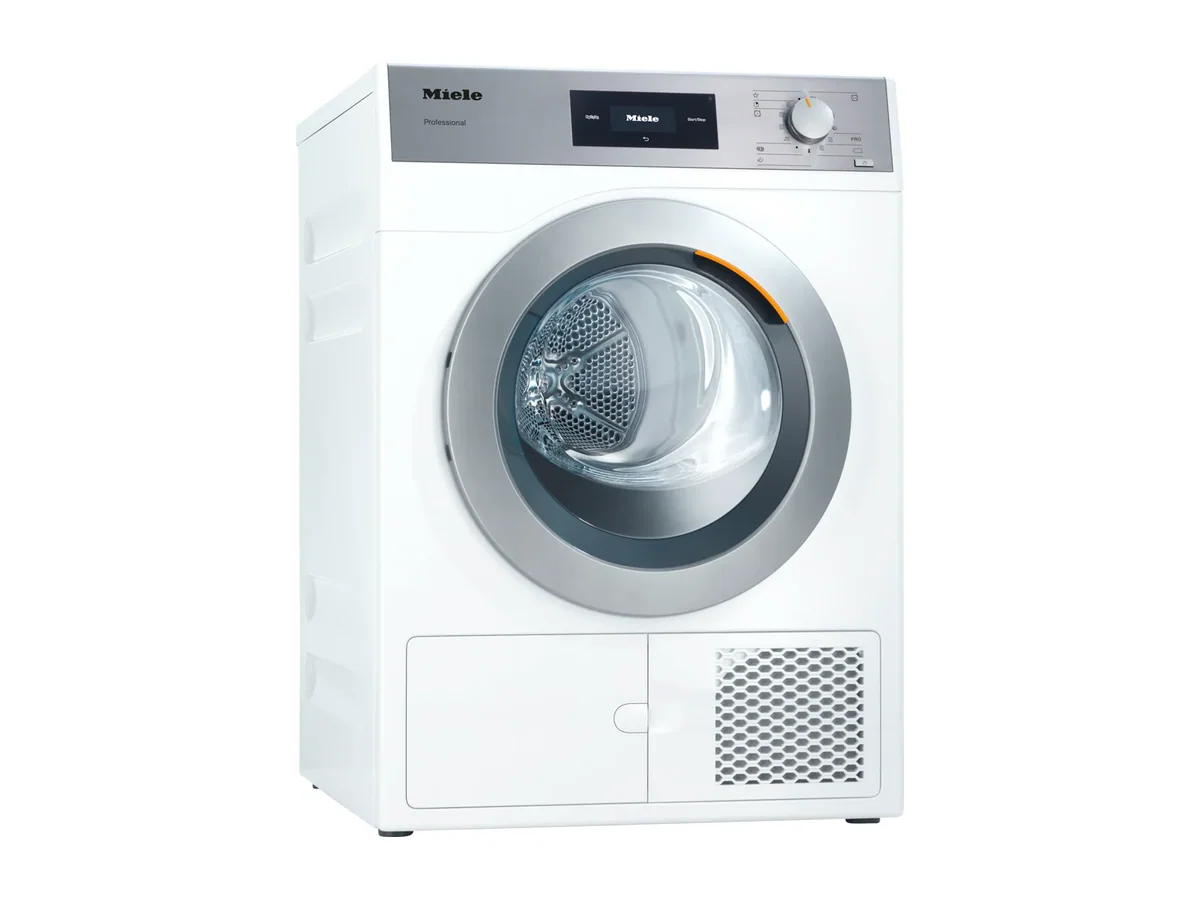

Miele Washing Machine PWM 507 [EL DP MAR 1N AC 230 V 60Hz] – 7 kg, 230 V, Lotus white
7 kg Little Giants marine washer, PWM 507 MAR, 1N AC 230 V 60 Hz with 64 l drum and 1,600 rpm spin, tested for 30,000 h, Lloyd’s Register approved.
7 kg · 2.85 kW
Marine equipment by electrical supply
This page lists 230 V 60 Hz marine laundry equipment: 28 Miele machines rated for 208-240 V at 60 Hz, covering 8 washing machines, a washer-dryer stack, 5 rotary ironers and, making up half the list, 14 tumble dryers. They come from the Little Giants, Benchmark and Professional series, with single-phase heat pump dryers at 1.2 kW at one end and a 37.7 kW three-phase dryer at the other.
Miele Washing Machine PWM 507 [EL DP MAR 1N AC 230 V 60Hz] – 7 kg, 230 V, Lotus white
7 kg Little Giants marine washer, PWM 507 MAR, 1N AC 230 V 60 Hz with 64 l drum and 1,600 rpm spin, tested for 30,000 h, Lloyd’s Register approved.
Miele Tumble Dryer PDR 507 HP [MAR] – 7 kg, 230V~ 60HZ, Lotus white
7 kg Little Giants marine heat-pump dryer, PDR 507 HP [MAR], 230V~ 60HZ, 1.2 kW connected load, Lloyd's Register approved.
Miele Washing Machine PWM 906 [EL DP MAR 2 AC 208-240V 60Hz] – 6 kg, 208–240 V, Stainless steel
Miele PWM 906 marine washer, 6 kg Little Giants, 57 l drum, 1,600 rpm at 2~208-240V 60HZ, Lloyd's Register approved.
Miele Rotary Ironer HM 16-80 D [EL SOM] – AC 220-240V 50-60HZ, Lotus white
Rotary ironer with 160 mm roller and 830 mm working width, 13 kg/h at 20% residual moisture, AC 220–240V 50–60Hz. Miele HM 16-80 D.
Miele Washing Machine PWM 908 [EL DP MAR 2 AC 208-240V 60Hz] – 8 kg, 208–240 V, Stainless steel
8 kg Little Giants marine washer, 73 l honeycomb drum, 1,600 rpm, g-factor 704 at 2~208–240 V 60 Hz.
Miele Tumble Dryer PDR 908 [EL MAR 2 AC 208-240V 60Hz] – 8 kg, 208–240 V, Stainless steel
8 kg Little Giants marine exhaust-air dryer, 130 l drum and 3.4–4.3 kW at 2~ 208–240 V 60 Hz, Lloyd’s Register approved. 11251140.
Miele Rotary Ironer PRI 210 [EL SOM STW AB] – 3 AC 230V 50-60HZ, Iron grey
Rotary ironer PRI 210 with 210 mm roller, 1,000 mm working width, 30 kg/h at 15% RM, 3 AC 230 V 50–60 Hz, iron grey.
Miele Rotary Ironer PRI 214 [EL SOM STW] – 3 AC 230V 50-60HZ, Iron grey
Rotary ironer PRI 214 with 210 mm roller, 1,400 mm width and 33 kg/h at 25% RM, 3 AC 230 V 50–60 Hz marine version.
Miele Rotary Ironer PRI 217 [EL SOM STW] – 3 AC 230V 50-60HZ, Iron grey
Rotary ironer PRI 217, 250 mm roller and 1,660 mm width, 60 kg/h at 25% residual moisture, 3 AC 230V 50–60HZ, iron grey.
Miele Washing Machine PWM 906 [EL DP MAR 3 AC 230V 50-60Hz] – 6 kg, 230 V, Lotus white
Miele PWM 906 Little Giants marine washer, 6 kg in 57 l drum at 1,600 rpm, g‑factor 704, Lloyd’s Register approved 3~ 230 V 50/60 Hz unit.
Miele Washing Machine PWM 906 [EL DP MAR 3 AC 230V 50-60Hz] – 6 kg, 230 V, Stainless steel
6 kg Little Giants marine washer PWM 906, 57 l drum, 1,600 rpm spin at g‑factor 704, 3~ 230V 50/60HZ, Lloyd’s Register approved.
Miele Washing Machine PWM 908 [EL DP MAR 3 AC 230V 50-60Hz] – 8 kg, 230 V, Lotus white
8 kg Little Giants PWM 908 marine washer, 73 l drum, 3~ 230 V 50/60 Hz with DN 22 drain pump and Lloyd’s Register approval.
Miele Washing Machine PWM 908 [EL DP MAR 3 AC 230V 50-60Hz] – 8 kg, 230 V, Stainless steel
8 kg Little Giants marine washer PWM 908 EL DP MAR, 73 l drum, 1,600 rpm and g factor 704, 3~ 230 V 50/60 Hz, Lloyd's Register approved.
Miele Washing Machine PWM 909 [EL DP DD SOM] – 9 kg, 3 AC 230V 60HZ, Stainless steel
Miele PWM 909 EL DP DD SOM marine washer, 9 kg at 1:9 load ratio in an 80 l drum with 1300 rpm spin at g‑factor 518, 3 AC 230V 60HZ.
Miele Tumble Dryer PDR 908 [EL MAR 3 AC 230V 50-60Hz] – 8 kg, 230 V, Lotus white
8 kg Little Giants marine tumble dryer PDR 908 EL MAR, 3~230 V 50/60 Hz, 130 l exhaust‑air drum in lotus white with Lloyd's Register approval.
Miele Tumble Dryer PDR 908 [EL MAR 3 AC 230V 50-60Hz] – 8 kg, 230 V, Stainless steel
8 kg Little Giants marine tumble dryer PDR 908 EL MAR, 3~ 230 V 50/60 Hz, 130 l drum with 42 min cottons cycle and Lloyd's Register approval.
Miele Tumble Dryer PDR 908 HP [MAR 1N AC 230V 60Hz] – 8 kg, 230 V, Lotus white
Miele Little Giants PDR 908 HP MAR heat‑pump dryer, 8 kg with 130 l drum, 1.2 kW at 230V~ 60HZ, Lloyd’s Register approved for shipboard use.
Miele Tumble Dryer PDR 908 HP [MAR 1N AC 230V 60Hz] – 8 kg, 230 V, Stainless steel
8 kg Little Giants marine heat‑pump dryer, 1.2 kW at 230V~ 60HZ with 130 l drum and Lloyd’s Register approval. PDR 908 HP [MAR].
Miele Tumble Dryer PDR 908 HP [MAR 2 AC 208-240V 60Hz] – 8 kg, 208–240 V, Stainless steel
Miele Little Giants PDR 908 HP MAR heat‑pump dryer, 8 kg, 2~ 208–240 V 60 Hz, 1.2 kW, Lloyd’s Register approved for shipboard use.
Miele Tumble Dryer PDR 910 [EL SOM] – 3 AC 230V 50/60HZ, Stainless steel
Benchmark Performance Plus marine tumble dryer, up to 10 kg at 1:18 in a 180 l drum, 36 min exhaust-air cycle. PDR 910 [EL SOM].
Miele Tumble Dryer PDR 914 [EL SOM] – 3 AC 230V 50/60HZ, Stainless steel
Benchmark Performance Plus marine tumble dryer PDR 914, 250 l drum for up to 14 kg at 0.51 kWh/kg, 3 AC 230 V 50/60 Hz.
Miele Tumble Dryer PDR 918 [EL SOM] – 3 AC 230V 50/60HZ, Stainless steel
Miele Benchmark PDR 918 EL SOM marine exhaust-air dryer, 18 kg at 1:18 in a 325 l drum, 18.6 kW on 3 AC 230 V 50/60 Hz.
Miele Tumble Dryer PDR 922 [EL SOM] – 3 AC 230V 50/60HZ, Stainless steel
Benchmark PDR 922 [EL SOM] marine dryer, 400 l drum for up to 22 kg loads, 23.5 kW at 3 AC 230V 50/60HZ, exhaust air system.
Miele Tumble Dryer PDR 928 [EL SOM] – 3 AC 230V 50/60HZ, Stainless steel
Miele PDR 928 [EL SOM] Benchmark marine dryer, 500 l drum, up to 28 kg at 1:18, 3 AC 230V 50/60HZ.
Twenty-eight Miele machines carry a 208-240 V, 60 Hz rating, and 18 of them accept 50 Hz as well. That band covers the low-voltage side of shipboard power: the 230 V or 240 V circuits on yachts running 60 Hz generators, and the 208 V and 240 V supplies common on American-built hulls. The 230 V 60 Hz marine laundry equipment in this list suits boats whose switchboard never reaches 400 V or 440 V, and larger ships where the crew laundry is fed from a hotel transformer rather than the main bus.
The voltage labels in the filter break down into 21 units at 230 V, five at 240 V and two at 208 V. All 28 are electric, and the mix of machine types is broad: tumble dryers make up half the list, with washing machines, rotary ironers and a single washer-dryer stack filling the rest.
Nineteen units connect three-phase and three are single-phase; the other six have no phase entry in the data, and their model names show either a 230V~ supply or a 2 AC 208-240V connection that takes two line conductors.
| Model | Type | Load | Connected load | Connection in model name |
|---|---|---|---|---|
| PWM 507 | Washing machine | 7 kg | 2.85 kW | 1N AC 230 V 60Hz |
| PDR 908 HP | Heat pump tumble dryer | 8 kg | 1.2 kW | 1N AC 230V 60Hz |
| PWM 908 | Washing machine | 8 kg | 4 - 5.2 kW | 2 AC 208-240V 60Hz |
| PDR 908 | Tumble dryer | 8 kg | 3.4 - 4.3 kW | 2 AC 208-240V 60Hz |
| PWM 909 | Washing machine | 9 kg | 8.2 kW | 3 AC 230V 60HZ |
| PDR 928 | Tumble dryer | not stated | 28.2 kW | 3 AC 230V 50/60HZ |
| PDR 944 | Tumble dryer | 44 kg | 37.7 kW | 3 AC 220-240V 50/60HZ |
The single-phase models are the ones a small yacht can usually run from an existing circuit. The PWM 507 single-phase washing machine takes 7 kg at 2.85 kW, and the PDR 908 HP dryer beside it draws only 1.2 kW. The 2 AC versions of the PWM 908 and PDR 908 suit 208-240 V systems where two lines are brought to the laundry, an arrangement seen on many US-built boats. Three-phase 230 V machines, from the 9 kg PWM 909 at 8.2 kW to the PDR 944 at 37.7 kW, need a three-phase board at that voltage, which turns up more often on larger American vessels than on European ones.
Four dryers here use a heat pump and ten are air vented. The PDR 507 HP and PDR 908 HP heat pump models each need just 1.2 kW and no exhaust duct, since moisture leaves as condensate to a drain. In a laundry squeezed into a crew corridor or below the waterline, where no duct route exists, that single fact often settles the choice. Because a heat pump dryer contains a compressor, its 60 Hz rating carries more weight than it does on a resistive dryer, and these models are built for 60 Hz.
Vented dryers trade the duct for heat input. The PDR 910 at 8.2 kW, then the PDR 914, PDR 918, PDR 922 and PDR 928, up to the PDR 944 at 37.7 kW, dry much faster per cycle and suit laundries that run through the day. Every dryer from both groups appears on the dryer-only list at this voltage for side-by-side comparison.
Merchant ships with a 440 V main switchboard nearly always carry a lower-voltage distribution for lighting, accommodation services and small galley appliances. A small crew laundry can be connected to that board, and the 208-240 V rating of these units allows it. The limit is load. Two or three machines of around 5 kW sit comfortably on a hotel transformer, while a bank of 20 kW dryers may take it past its rating. For a heavy laundry on such a ship, the laundry machines wired for the 440 V main connect straight to the main supply and leaves the transformer for other loads.
Fourteen units fall in the up-to-8 kg band, one sits at 9 to 12 kg and one exceeds 30 kg. Power is skewed the same way: 14 machines draw no more than 5 kW, six sit between 5 and 10 kW, and the 10-20 kW and 20-40 kW bands hold four each. In practice the list splits into compact machines for yachts and boats, where 27 units are marked for yacht galleys and 14 for boat galleys, and a heavier group marked for offshore and commercial vessels.
The series follow a similar division: 14 Little Giants units, nine Benchmark and five Professional. The five rotary ironers complete the line for vessels that press their own table and bed linen, and the PDW 909 washer-dryer stack saves floor area where the laundry is little more than a cupboard.
Eighteen of the 28 machines are rated for both frequencies, and ten are 60 Hz only. A yacht that runs 60 Hz generators but sometimes plugs into 50 Hz shore power without a converter can use the dual-rated machines on either source. The 60 Hz-only units should stay on ship's power or on a converter output. Shore supplies differ from country to country, so the marina plan matters as much as the generator rating; the shore power and frequency primer lists what a converter adds to a yacht's weight and heat load.
Nothing in this selection connects to 120 V. Searches such as "120v washer dryer" or "110v dryer" usually come from boats with only North American receptacle circuits, and none of these 28 machines will run from such an outlet. A vessel with a 400 V or 440 V three-phase supply and a large laundry should start from the higher-voltage lists instead, since a 230 V machine there means an extra transformer. And for an owner choosing by boat size rather than supply, the laundry machines sorted by yacht size put vessel type first.
Most delays in pricing a 230 V laundry come from one missing detail: how the circuit is actually wired. A useful first message states:
With those points in a 230 V laundry pricing request, the right variant of each model can be matched first time.
Last reviewed by the Vista Marine galley engineering team.
Questions about 230 v 60 hz marine laundry equipment
Will these machines run from a 120 V outlet on a boat?
No. Every unit in this selection is rated 208-240 V at 60 Hz, and none is built for 120 V. On a boat with only 120 V receptacles, a 230 V or 240 V circuit has to be added, usually from the generator or an inverter of suitable size, before any of these washers, dryers or ironers can be installed.
Which models work on a single-phase 230 V supply?
Three units are listed as single-phase, including the PWM 507 washing machine at 7 kg and 2.85 kW and the PDR 908 HP heat pump dryer at 8 kg and 1.2 kW. Both are marked 1N AC 230 V 60 Hz. They draw low currents and suit yachts where the laundry shares a distribution board with cabin loads.
Do the heat pump dryers need an exhaust duct?
No. The four heat pump dryers condense moisture from the drum air and send it to a drain, so no duct to open air is required. They still need ventilation around the cabinet to shed compressor heat, and a drain point close by. The ten vented dryers in the list do need a duct sized for their airflow.
What does 3 AC 230 V mean in a model name?
It indicates a three-phase connection at 230 V between lines, without a neutral. Models such as the PWM 909 washer and the PDR 910 to PDR 944 dryers use it. That supply exists on some American-built and larger yachts, but it is less common on yachts wired to European practice, where 230 V usually means single-phase and three-phase arrives at 400 V.
Can a 230 V laundry be fed from a 440 V ship supply?
Yes, through a transformer or the existing lower-voltage distribution that most 440 V ships already have for lighting and hotel loads. The question is capacity: compact machines of a few kilowatts fit easily, but several dryers at 20 kW and above may need a dedicated transformer, and 440 V models then become the simpler option.
Request a quotation for 230 v 60 hz marine laundry equipment
Send the vessel type, supply voltage, frequency and phase and the quantities, and our team will come back with a specification and quotation.