

Miele Tumble Dryer PDR 514 ROP [EL SOM] – 14 kg, 3 AC 400V 50/60HZ, Iron grey
Benchmark PDR 514 ROP [EL SOM] vented dryer, 14 kg, 0.53 kWh/kg with 24 min cycle on 3 AC 400V 60 HZ, iron grey front.
14 kg · 14.1 kW
Marine equipment by electrical supply
This page lists 400 V 60 Hz marine laundry equipment: 41 Miele machines rated 380-415 V at 60 Hz, made up of 19 tumble dryers, 12 rotary ironers, 9 washing machines and one washer-dryer stack. They span the Benchmark, Little Giants and Professional series, and all but one also accept 50 Hz, which suits yachts and ships built to European voltage standards.
Miele Tumble Dryer PDR 514 ROP [EL SOM] – 14 kg, 3 AC 400V 50/60HZ, Iron grey
Benchmark PDR 514 ROP [EL SOM] vented dryer, 14 kg, 0.53 kWh/kg with 24 min cycle on 3 AC 400V 60 HZ, iron grey front.
Miele Tumble Dryer PDR 910 [EL SOM] – 3N AC 400V 50/60HZ, Stainless steel
Benchmark PDR 910 [EL SOM] vented marine dryer, 10 kg load at 1:18, 180 l drum, 3N AC 400V 50/60HZ, stainless steel front.
Miele Rotary Ironer PRI 421 [EL SOM LAM IB RF] – 3N AC 400V 50-60HZ, Iron grey
Miele PRI 421 rotary ironer with 365 mm roller, 2040 mm width and up to 113 kg/h at 25 % residual moisture on 3N AC 400V 50–60HZ.
Miele Washing Machine PWM 507 [EL DP MAR 3 AC 400-480V 50-60Hz] – 7 kg, 400–480 V, Lotus white
7 kg Little Giants marine washer-extractor, PWM 507 EL DP MAR, 3~ 480 V 50/60 Hz with 1,600 rpm spin and 704 g-factor for shipboard laundries.
Miele Washing Machine PWM 906 [EL DP MAR 2N AC 400V 50-60Hz] – 6 kg, 400 V, Lotus white
6 kg PWM 906 Little Giants marine washer with 57 l drum, 1,600 rpm spin, 704 g-factor and Lloyd’s Register approval in Lotus white.
Miele Washing Machine PWM 906 [EL DP MAR 2N AC 400V 50-60Hz] – 6 kg, 400 V, Stainless steel
6 kg PWM 906 Little Giants marine washer with 57 l honeycomb drum, 1,600 rpm spin and 704 g-factor for shipboard and offshore use.
Miele Washing Machine PWM 906 [EL DP MAR 3 AC 400-480V 50-60Hz] – 6 kg, 400–480 V, Lotus white
6 kg Miele PWM 906 EL DP MAR Little Giants marine washer, 57 l drum, 3~ 480V 50/60HZ with ≤70 dB(A) noise level.
Miele Washing Machine PWM 906 [EL DP MAR 3 AC 400-480V 50-60Hz] – 6 kg, 400–480 V, Stainless steel
Miele PWM 906 Little Giants marine washer, 6 kg in a 57 l drum at 1,600 rpm (g‑factor 704) on 3~ 480 V 50/60 Hz, stainless steel front.
Miele Washing Machine PWM 908 [EL DP MAR 2 NAC 400V 50-60Hz] – 8 kg, 400 V, Lotus white
8 kg Little Giants PWM 908 marine washer with 73 l honeycomb drum, 1,600 rpm spin and 704 g-factor for shipboard and offshore laundry rooms.
Miele Washing Machine PWM 908 [EL DP MAR 2 NAC 400V 50-60Hz] – 8 kg, 400 V, Stainless steel
8 kg Little Giants marine washer, PWM 908 EL DP MAR, 73 l drum, 1,600 rpm spin and 704 g-factor in stainless steel front.
Miele Washing Machine PWM 908 [EL DP MAR 3 AC 400-480V 50-60Hz] – 8 kg, 400–480 V, Lotus white
Miele PWM 908 Little Giants 8 kg marine washer, 73 l drum, 1,600 rpm, g-factor 704, EL DP MAR 3~ 480V 50/60HZ, Lloyd’s Register approved.
Miele Washing Machine PWM 908 [EL DP MAR 3 AC 400-480V 50-60Hz] – 8 kg, 400–480 V, Stainless steel
PWM 908 Little Giants marine washer, 8 kg at 1,600 rpm, g‑factor 704 and 73 l drum with Lloyd’s Register approval.
Miele Tumble Dryer PDR 908 [EL MAR 3 AC 400-480V 50-60Hz] – 8 kg, 400–480 V, Lotus white
8 kg Little Giants PDR 908 EL MAR vented dryer, 130 l drum, 6.4 kW at 3~ 480 V 50/60 Hz, Lloyd's Register approved for shipboard use.
Miele Tumble Dryer PDR 908 [EL MAR 3 AC 400-480V 50-60Hz] – 8 kg, 400–480 V, Stainless steel
8 kg Little Giants marine tumble dryer PDR 908 EL MAR, 130 l drum, 3~ 480 V 50/60 Hz exhaust-air model with Lloyd's Register approval.
Miele Tumble Dryer PDR 908 [EL MAR 3N AC 400V 50-60Hz] – 8 kg, 400 V, Lotus white
8 kg Little Giants marine tumble dryer, 130 l drum, 42 min cottons at 0.5 kWh/kg, exhaust air, Lloyd’s Register approved. PDR 908 EL MAR.
Miele Tumble Dryer PDR 908 [EL MAR 3N AC 400V 50-60Hz] – 8 kg, 400 V, Stainless steel
8 kg Little Giants exhaust-air dryer, 130 l drum and 5.5 l/h evaporation, Miele PDR 908 [EL MAR 3N AC 400V 50-60Hz], Lloyd’s Register approved.
Miele Tumble Dryer PDR 914 [EL SOM] – 3 AC 400V 50/60HZ, Stainless steel, Mat. no. 11722680
Miele Benchmark PDR 914 [EL SOM] exhaust‑air dryer, 250 l drum, 24 min cycle at 3 AC 400V 50/60HZ for marine use.
Miele Tumble Dryer PDR 914 [EL SOM] – 3N AC 400V 50/60HZ, Stainless steel
Benchmark PDR 914 exhaust-air marine dryer with 250 l drum, up to 14 kg at 1:18 load ratio on 3N AC 400 V 50/60 Hz.
Miele Tumble Dryer PDR 914 [EL SOM] – 3 AC 400V 50/60HZ, Stainless steel, Mat. no. 11911200
Benchmark PDR 914 exhaust-air dryer, 14 kg at 1:18 load ratio, 250 l drum, 3 AC 400V 50/60HZ, stainless-steel front.
Miele Tumble Dryer PDR 918 [EL SOM] – 3 AC 400V 50/60HZ, Stainless steel, Mat. no. 11722700
Benchmark PDR 918 EL SOM marine dryer, 18 kg load at 325 l drum volume, 18.6 kW exhaust-air unit on 3 AC 400V 50/60HZ.
Miele Tumble Dryer PDR 918 [EL SOM] – 3N AC 400V 50/60HZ, Stainless steel
Benchmark PDR 918 [EL SOM] marine exhaust‑air dryer, 18 kg at 1:18, 325 l drum on 3N AC 400V 50/60HZ, 18.6 kW.
Miele Tumble Dryer PDR 918 [EL SOM] – 3 AC 400V 50/60HZ, Stainless steel, Mat. no. 11911190
Benchmark Performance Plus exhaust-air dryer, 18 kg at 1:18 with 325 l drum and 23 min programme. Miele PDR 918 [EL SOM] 11911190.
Miele Tumble Dryer PDR 922 [EL SOM] – 3 AC 400V 50/60HZ, Stainless steel
Benchmark PDR 922 [EL SOM] marine tumble dryer, 22 kg at 1:18 load ratio, 400 l drum, 3 AC 400V 50/60HZ, front in stainless steel.
Miele Tumble Dryer PDR 922 [EL SOM] – 3N AC 400V 50/60HZ, Stainless steel
Benchmark Performance Plus marine tumble dryer PDR 922 EL SOM, 22 kg load at 400 l drum volume, 3N AC 400 V 50/60 Hz exhaust air.
Vessels that distribute power at European voltage but generate it at 60 Hz are the main users of 400 V 60 Hz marine laundry equipment. That includes yachts built in European yards for owners who operate in American waters, ships ordered with 400 V systems for 60 Hz operation, and offshore units where the accommodation side follows a 400 V design. This list holds 41 Miele machines, all rated 380-415 V at 60 Hz, and every one of them is electric.
The series mix is wide: 16 Benchmark units, 13 Little Giants and 12 Professional. That spread lets a single supply standard cover anything from a compact yacht crew room to a ship's full wash, dry and press line.
Nineteen tumble dryers, 12 rotary ironers, nine washing machines and one washer-dryer stack share the 380-415 V rating, so an entire laundry can be specified on one voltage and one cable standard.
| Machine type | Units | Example models | Example connected loads |
|---|---|---|---|
| Tumble dryer | 19 | PDR 908, PDR 910, PDR 514 ROP, PDR 944 | 5.4 kW to 37.7 kW |
| Rotary ironer | 12 | PRI 210, PRI 214 | 5 kW and 7 kW |
| Washing machine | 9 | PWM 507, PWM 906, PWM 908 | 4.2 kW to 5.5 kW |
| Washer-dryer stack | 1 | PDW 909 | not stated |
Power bands back this up. Twelve units draw up to 5 kW and six fall between 5 and 10 kW, while 12 more sit in the 10-20 kW band and 11 in the 20-40 kW band. The upper end belongs to the vented dryers, from the PDR 914 at 14.1 kW through the PDR 918, PDR 922 and PDR 928 to the PDR 944 at 37.7 kW. The dryer-only page for 400 V at 60 Hz sets these side by side.
Only the PDW 909 washer-dryer stack, marked 3N AC 400 V 60 Hz, is rated for 60 Hz alone; the other 40 machines accept 50 Hz as well. Dual rating means the motors, pumps and fans have been designed for both supplies, so drum speed and pump flow stay inside the maker's range at either frequency. A yacht that may change generator frequency at a refit, or that moves between 50 Hz shore power in Europe and its own 60 Hz generators elsewhere, keeps the same machines valid. The background on frequency mismatch, including what converters cost in weight and heat, is covered in our dual-frequency background notes, kept for exactly this kind of refit question.
The model names show four connection styles, and they matter as much as the voltage. 3N AC 400V, as on the PDR 910 and the PRI 210, calls for three phases plus neutral. 3 AC 400V, as on the PDR 514 ROP and PDR 914, uses three phases without neutral. 2N AC 400V on the PWM 906 means two phases with neutral. And 3 AC 400-480V on the PWM 507 and PDR 908 covers a wider voltage range on a three-phase connection.
The filter's voltage labels reflect these differences, with six units tagged 230 V, 28 tagged 400 V and seven tagged 480 V, even though all 41 fall within the 380-415 V supply band; 37 are listed as three-phase. On a ship with an insulated three-wire 400 V system, a neutral is often not available at the laundry, and machines needing N then require an isolating transformer or a different variant. That check belongs before the order, not at installation.
Thirteen units sit in the up-to-8 kg band, and 40 of the 41 are marked for yacht galleys, with 13 for boat galleys. The compact end includes the PWM 507 washer at 7 kg and 4.2 kW, the PWM 906 at 6 kg and the PWM 908 at 8 kg, each at 5.5 kW, and the PDR 908 dryer at 8 kg and 5.4 kW. Where floor area is the constraint, the PDW 909 washer-dryer stack places washing and drying in one column. Larger yachts with guest laundries and a pressing station should also look at the superyacht laundry selection, sorted by vessel instead of voltage.
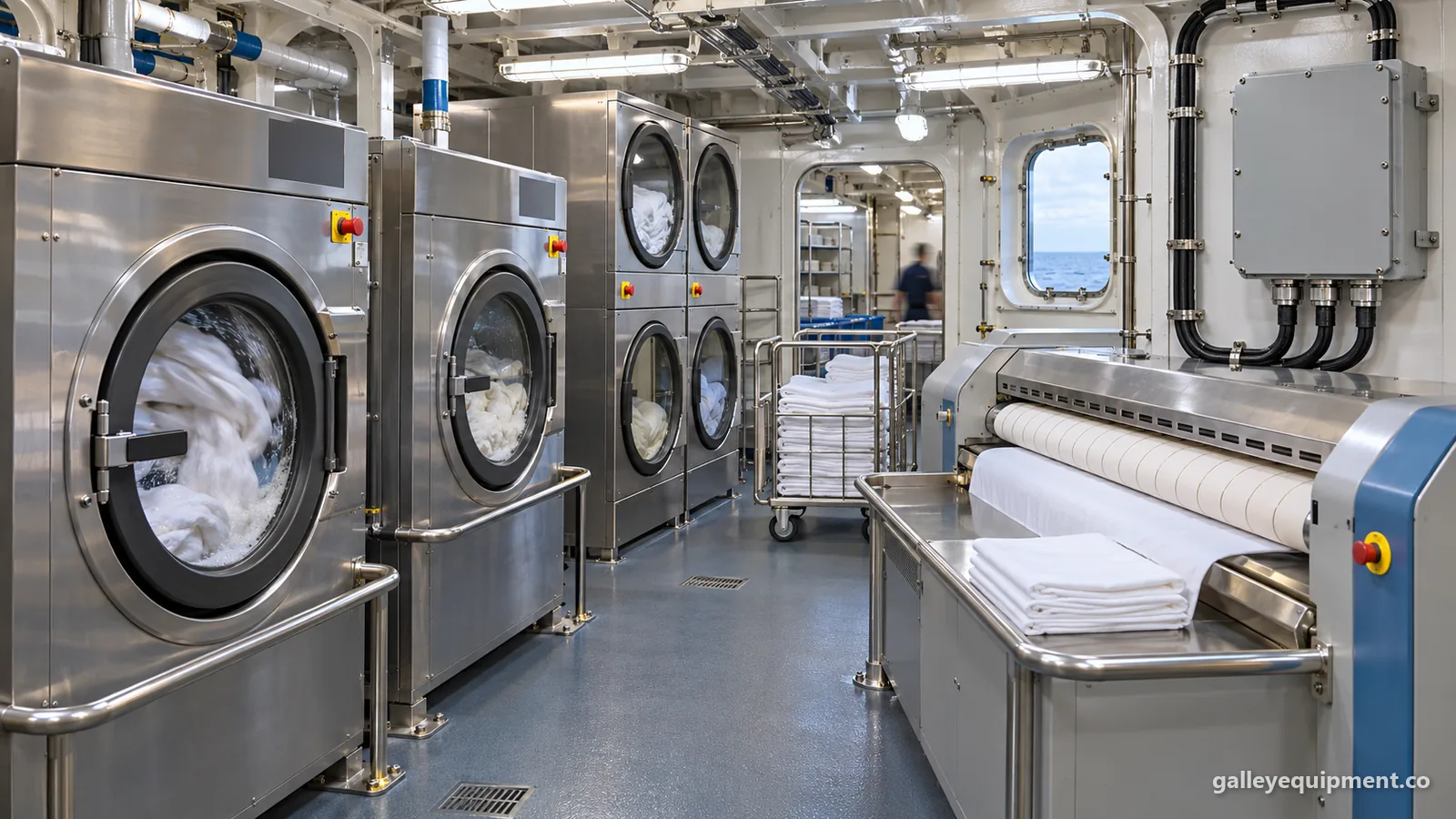
Twenty-eight units are marked for commercial vessels and all 41 for offshore duty. A heavier line typically pairs a larger vented dryer, such as the 14 kg PDR 514 ROP or the 28.2 kW PDR 928, with one of the 12 rotary ironers, which begin at 5 kW on the PRI 210 and climb from there. Heating loads for all twelve appear on the rotary ironer page for 400 V. All 19 dryers here are air vented, so each one needs an exhaust duct drawn into the layout from the start, and in a 400 V laundry with several large dryers the combined heat and airflow often decide the ventilation design for the whole room.
A merchant ship with a 440 V main and no 400 V board would need a transformer for every machine on this page, so the higher-voltage laundry list is the better start. A yacht with only single-phase 230 V available at the laundry should look at the 230 V selection with single-phase options instead, which includes single-phase washers and heat pump dryers. And on a 50 Hz vessel the dual-rated machines still fit, but ranges built around that supply will show more options.
A first message that answers the following saves a round of questions:
Send it with a 400 V laundry quotation request and the variants can be fixed against the vessel's wiring before ordering.
Last reviewed by the Vista Marine galley engineering team.
Questions about 400 v 60 hz marine laundry equipment
Can these 400 V machines run on a 50 Hz supply too?
Forty of the 41 units are rated for 50 Hz and 60 Hz at 380-415 V, so they run on either. The exception is the PDW 909 washer-dryer stack, which is marked 3N AC 400 V 60 Hz only. On a vessel that alternates between 50 Hz shore power and 60 Hz generators, the dual-rated machines avoid the need for a converter.
Do all of these machines need a neutral?
No. Models marked 3N AC or 2N AC, such as the PDR 910, PRI 210 and PWM 906, need a neutral conductor. Models marked 3 AC, such as the PDR 514 ROP and PDR 914, connect to three phases alone. On ships with an insulated three-wire system, choosing the 3 AC variants or adding an isolating transformer resolves the difference.
What is the smallest washer in the list?
The PWM 906 washes 6 kg at 5.5 kW, and the PWM 507 takes 7 kg at 4.2 kW on a 3 AC 400-480 V connection. Thirteen units in total sit in the up-to-8 kg band, which makes this selection usable in yacht laundries where the room may hold only one washer and one dryer.
Are the dryers vented or heat pump?
All 19 tumble dryers in this 400 V list are air vented. Each needs an exhaust duct sized for its airflow, led to open air or a suitable ventilation trunk. Heat pump dryers without a duct appear in the 230 V 60 Hz selection instead, where four heat pump models are listed for laundries with no exhaust route.
Which brands are included?
Every one of the 41 machines is made by Miele, split across the Benchmark, Little Giants and Professional series. Using one maker across washers, dryers, ironers and the stack keeps spare parts and service documentation in one system, which helps on vessels that spend long periods away from a technician.
Request a quotation for 400 v 60 hz marine laundry equipment
Send the vessel type, supply voltage, frequency and phase and the quantities, and our team will come back with a specification and quotation.


