

Miele Washing Machine PWM 507 [EL DP MAR 1N AC 230 V 60Hz] – 7 kg, 230 V, Lotus white
7 kg Little Giants marine washer, PWM 507 MAR, 1N AC 230 V 60 Hz with 64 l drum and 1,600 rpm spin, tested for 30,000 h, Lloyd’s Register approved.
7 kg · 2.85 kW
Marine equipment by electrical supply
This page lists 230 V 60 Hz marine washing machines, 8 models from Miele: seven compact Little Giants machines up to 8 kg and one 9 kg Benchmark machine. Every one is rated at 60 Hz inside the 208-240 V band, four also hold a 50 Hz rating, and the connections range from single-phase through two-line to three-phase.
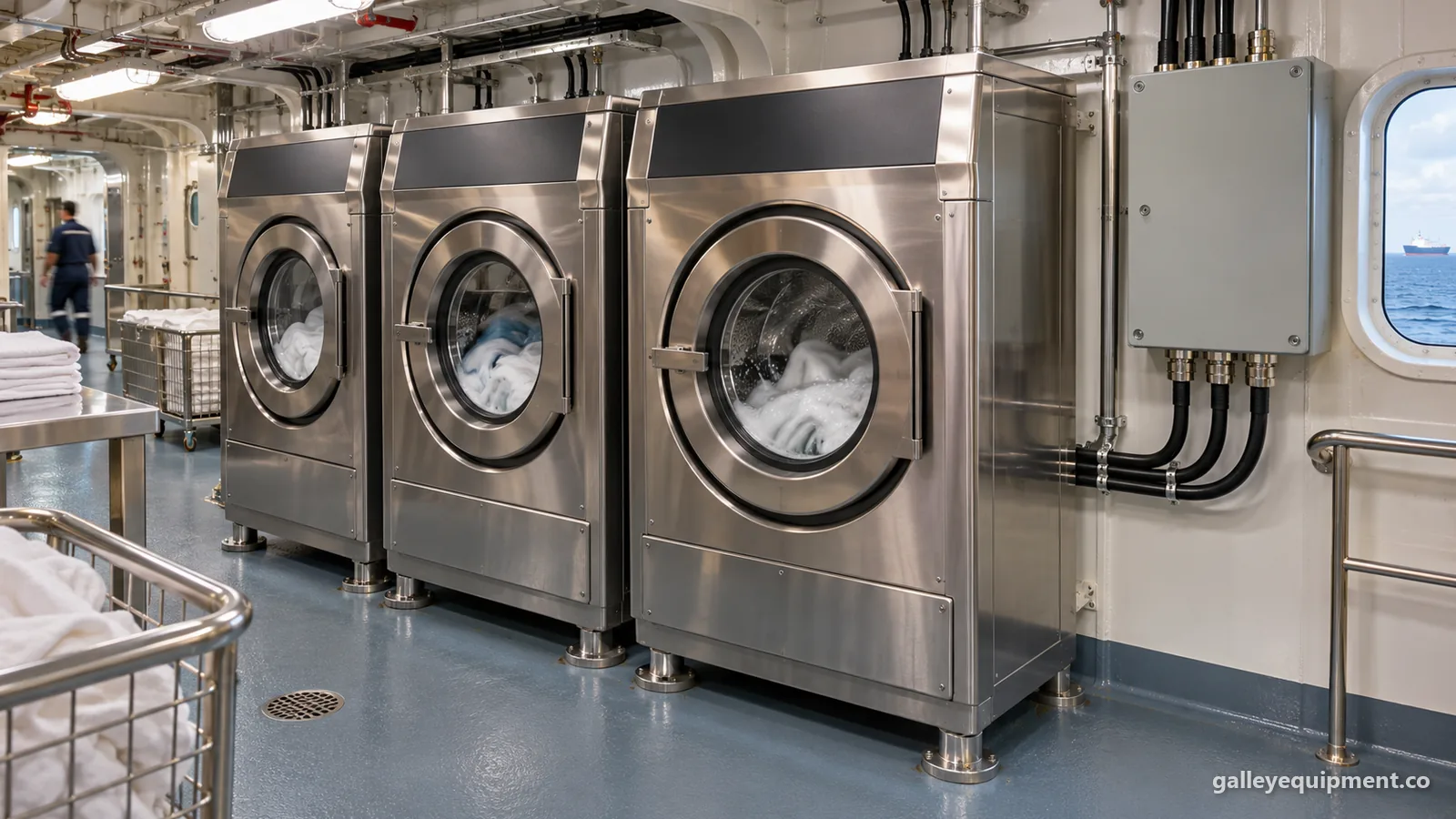
Miele Washing Machine PWM 507 [EL DP MAR 1N AC 230 V 60Hz] – 7 kg, 230 V, Lotus white
7 kg Little Giants marine washer, PWM 507 MAR, 1N AC 230 V 60 Hz with 64 l drum and 1,600 rpm spin, tested for 30,000 h, Lloyd’s Register approved.
Miele Washing Machine PWM 906 [EL DP MAR 2 AC 208-240V 60Hz] – 6 kg, 208–240 V, Stainless steel
Miele PWM 906 marine washer, 6 kg Little Giants, 57 l drum, 1,600 rpm at 2~208-240V 60HZ, Lloyd's Register approved.
Miele Washing Machine PWM 908 [EL DP MAR 2 AC 208-240V 60Hz] – 8 kg, 208–240 V, Stainless steel
8 kg Little Giants marine washer, 73 l honeycomb drum, 1,600 rpm, g-factor 704 at 2~208–240 V 60 Hz.
Miele Washing Machine PWM 906 [EL DP MAR 3 AC 230V 50-60Hz] – 6 kg, 230 V, Lotus white
Miele PWM 906 Little Giants marine washer, 6 kg in 57 l drum at 1,600 rpm, g‑factor 704, Lloyd’s Register approved 3~ 230 V 50/60 Hz unit.
Miele Washing Machine PWM 906 [EL DP MAR 3 AC 230V 50-60Hz] – 6 kg, 230 V, Stainless steel
6 kg Little Giants marine washer PWM 906, 57 l drum, 1,600 rpm spin at g‑factor 704, 3~ 230V 50/60HZ, Lloyd’s Register approved.
Miele Washing Machine PWM 908 [EL DP MAR 3 AC 230V 50-60Hz] – 8 kg, 230 V, Lotus white
8 kg Little Giants PWM 908 marine washer, 73 l drum, 3~ 230 V 50/60 Hz with DN 22 drain pump and Lloyd’s Register approval.
Miele Washing Machine PWM 908 [EL DP MAR 3 AC 230V 50-60Hz] – 8 kg, 230 V, Stainless steel
8 kg Little Giants marine washer PWM 908 EL DP MAR, 73 l drum, 1,600 rpm and g factor 704, 3~ 230 V 50/60 Hz, Lloyd's Register approved.
Miele Washing Machine PWM 909 [EL DP DD SOM] – 9 kg, 3 AC 230V 60HZ, Stainless steel
Miele PWM 909 EL DP DD SOM marine washer, 9 kg at 1:9 load ratio in an 80 l drum with 1300 rpm spin at g‑factor 518, 3 AC 230V 60HZ.
Every build on the page carries a 60 Hz rating inside the 208-240 V band, six of them named for 230 V and two for 240 V. That band takes in the 208 V three-phase and 240 V circuits found on American-built yachts, as well as the 220 V, 60 Hz hotel and lighting supplies that many Asian-built ships use alongside a 440 V main system. For anyone searching for a 220v 60hz washing machine for a vessel, these are the builds to look at.
Seven of the eight are Little Giants machines in the up-to-8 kg band, drawing up to 5 kW. The eighth is a Benchmark machine of 9 kg in the 5 to 10 kW band. The lightest of the eight is rated 2.85 kW and the heaviest 8.2 kW.
The supply code in each model name states how the machine connects, and on this page it varies more than the voltage does.
| Model | Drum | Supply code in the name | Connected load |
|---|---|---|---|
| PWM 507 | 7 kg | 1N AC 230 V 60Hz | 2.85 kW |
| PWM 906 | 6 kg | 2 AC 208-240V 60Hz | 4 - 5.2 kW |
| PWM 908 | 8 kg | 2 AC 208-240V 60Hz | 4 - 5.2 kW |
| PWM 909 | 9 kg | 3 AC 230V 60HZ | 8.2 kW |
The notation follows the usual pattern. 1N AC means one line conductor plus a neutral, a normal single-phase 230 V circuit. 2 AC means two line conductors without a neutral, the arrangement of an American 208 V or 240 V circuit taken between two lines. 3 AC means three line conductors, here a three-phase 230 V supply with no neutral. Where the listings state the phase, five builds are three-phase and one is single-phase. Matching the code to the vessel's distribution matters as much as matching the voltage figure.
A washer has two kinds of electrical load, and they respond to the supply in different ways. The drum motor and drain pump depend on frequency, which is why every build here is rated for 60 Hz. The water heater is a resistive element, and its output depends on voltage alone. That explains the 4 to 5.2 kW range on the PWM 906 and PWM 908: the same element delivers its lower output on a 208 V supply and its full output near 240 V, so heating takes a little longer on 208 V. Our primer on resistive heaters versus motor drives traces that heater-versus-motor split for other laundry and galley equipment.
Four of the eight builds also hold a 50 Hz rating, which is how a washing machine rated 220 V at 50/60 Hz usually shows up in this band. The other four are 60 Hz only.
Three groups of vessel tend to need this band. American-built yachts often have a split-phase or three-phase 208-240 V distribution for larger appliances, with 120 V for sockets and lighting. Ships from many Asian yards carry a 220 V, 60 Hz hotel supply derived from the 440 V main switchboard, and a small crew laundry often connects there. Finally, some smaller workboats and patrol craft built to American standards run their whole hotel load at 208 V or 240 V.
On each of these, the laundry is usually small enough for a Little Giants drum, and the choice between the single-phase, two-line and three-phase builds follows the distribution panel.
Only one machine on the page goes above 8 kg: the 9 kg PWM 909 built for 3 AC 230V 60HZ, listed at 8.2 kW. It suits a yacht or small ship that has a three-phase 230 V supply and a laundry busier than the compact machines can handle. At 8.2 kW on a 230 V three-phase circuit, it draws a noticeably higher current than the same machine would at 400 V or 440 V, so the feeder and protection have to be sized for it.
The 230 V 60 Hz marine washing machines stop at 9 kg and suit low-voltage circuits only. A vessel with a 400 V three-phase supply has a wider choice of compact machines among the dual-rated Little Giants for 380-415 V. A merchant ship that wants a 12 kg drum or larger should go to the Benchmark washers on 440-480 V, 60 Hz, where drums reach 35 kg. A vessel limited to 110 V or 120 V circuits will not find a matching build here and needs a 240 V circuit for the laundry first.
A washer is half of the laundry, and the dryer has to run on the same supply. The tumble dryers rated 230 V at 60 Hz can be compared against the washers on this page, and the complete 230 V, 60 Hz laundry selection brings washers, dryers and any other machines for that supply together on one page.
Read the supply from the distribution panel rather than from general vessel documents, because the laundry circuit may differ from the main switchboard. The enquiry should then give:
Those details can be sent through our 230 V laundry quotation request, and the reply will name the builds that match the circuit.
Last reviewed by the Vista Marine galley engineering team.
Questions about 230 v 60 hz marine washing machines
Will a 220 V, 60 Hz supply run these machines?
Yes, provided the connection type matches. All eight builds are rated within the 208-240 V band at 60 Hz, which includes a 220 V supply. Check whether the circuit is single-phase with a neutral, two-line or three-phase, because the PWM 507, PWM 906, PWM 908 and PWM 909 each use a different arrangement.
Which model runs on a single-phase 230 V supply?
Only one: the 7 kg PWM 507, whose build code reads 1N AC 230 V 60Hz. Its 7 kg drum and 2.85 kW rating make it the lightest electrical load among the eight. It fits a yacht or small vessel whose laundry circuit is a normal line-and-neutral 230 V supply at 60 Hz.
Why do the PWM 906 and PWM 908 list 4 to 5.2 kW?
The range follows the supply voltage. Both machines are built for 2 AC 208-240V 60Hz, and the heating element is resistive, so it delivers less power at 208 V than at 240 V. On a 208 V circuit the load is near 4 kW and heating takes a little longer; near 240 V it approaches 5.2 kW.
Is there a 110 V version of these washers?
No. The lowest voltage band on the page is 208-240 V, and none of the 43 washing machines in the catalogue is built for 110 V or 120 V. American boats normally provide 240 V for larger appliances through a dedicated circuit, which is the supply these machines need.
Can these machines also be used at 50 Hz?
Four of the eight builds hold a 50 Hz rating alongside 60 Hz, and the other four are 60 Hz only. The motor and drain pump are matched to the rated frequency, so check the build code before connecting a machine to a 50 Hz shore supply or generator.
Request a quotation for 230 v 60 hz marine washing machines
Send the vessel type, supply voltage, frequency and phase and the quantities, and our team will come back with a specification and quotation.


