

Miele Washing Machine PWM 511 [EL DP DD SOM] – 11 kg, 3 AC 440V 60HZ, Iron grey
Miele PWM 511 Benchmark marine washer, 11 kg at 1:9 load with 100 l drum, 1,100 rpm spin and 370 g-factor on 3 AC 400V 60 HZ.
11 kg · 6.3 kW
Marine equipment by electrical supply
This page lists 440 V 60 Hz marine washing machines, 7 Miele Benchmark models rated 440-480 V at 60 Hz and connected three-phase. The smallest drum holds 9 kg and draws 6.3 kW, the largest holds 35 kg and draws 34.1 kW, so one switchboard voltage serves a small cargo-ship laundry or the main laundry of a large crew.
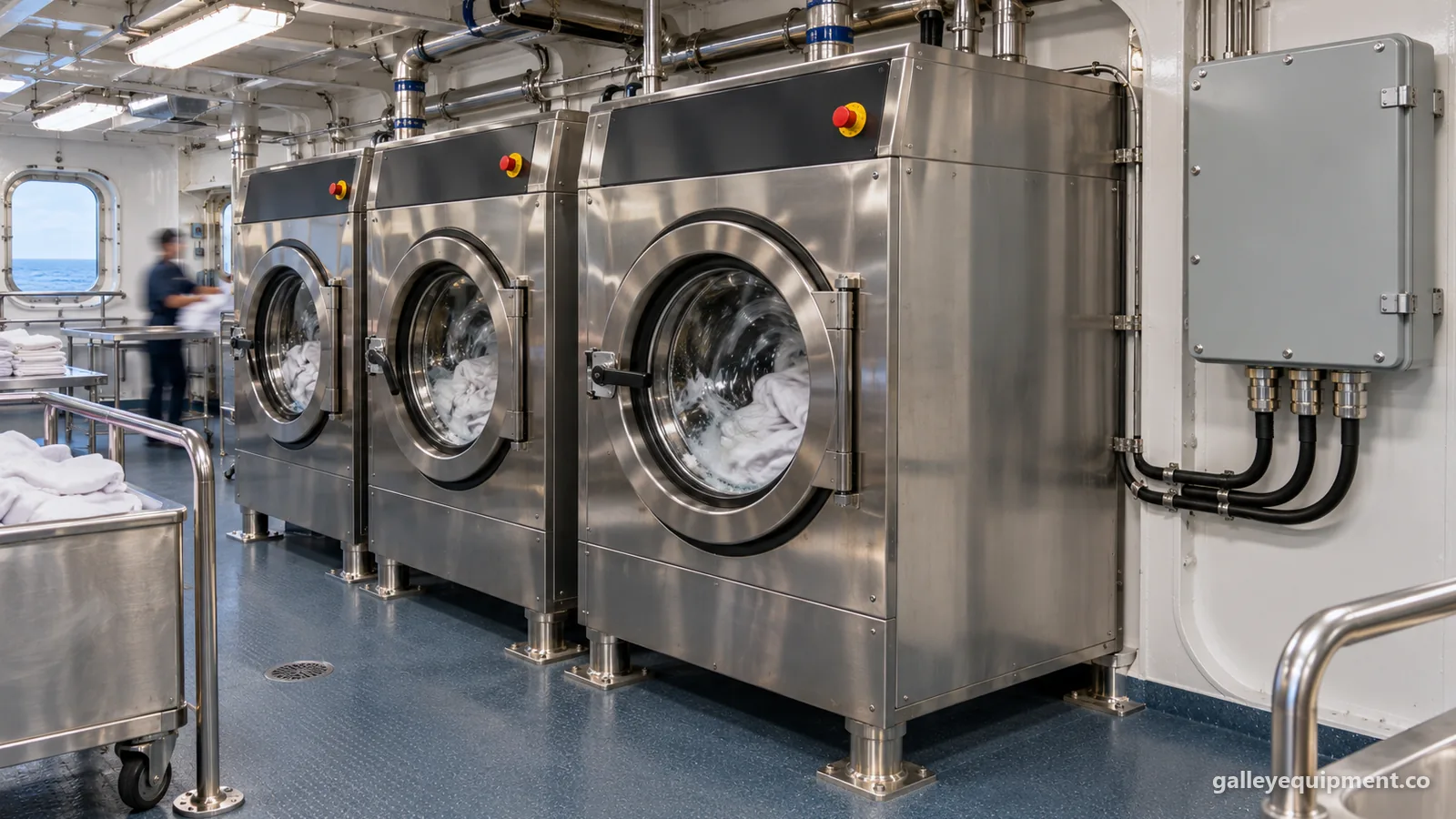
Miele Washing Machine PWM 511 [EL DP DD SOM] – 11 kg, 3 AC 440V 60HZ, Iron grey
Miele PWM 511 Benchmark marine washer, 11 kg at 1:9 load with 100 l drum, 1,100 rpm spin and 370 g-factor on 3 AC 400V 60 HZ.
Miele Washing Machine PWM 912 [EL DV DD SOM] – 12 kg, 3 AC 480V 60HZ, Stainless steel
Miele PWM 912 [EL DV DD SOM] 12 kg marine washer with 110 l drum, 504 g-factor and 30,000 h tested life for Benchmark Performance Plus laundries.
Miele Washing Machine PWM 916 [EL DV DD SOM] – 16 kg, 3 AC 480V 60HZ, Stainless steel
Benchmark PWM 916 SOM washer, 16 kg at 1:9 load ratio on a 140 l drum with 502 g factor and 3 AC 440 V 60 HZ electric heating.
Miele Washing Machine PWM 920 [EL DV DD SOM] – 20 kg, 3 AC 480V 60HZ, Stainless steel
20 kg Benchmark Performance Plus marine washer, 180 l drum, 1120 rpm spin on 3 AC 440V 60HZ, PWM 920 [EL DV DD SOM].
Miele Washing Machine PWM 909 [EL DP DD SOM] – 9 kg, 3 AC 440V 60HZ, Stainless steel
Miele PWM 909 Benchmark Performance Plus marine washer, 9 kg at 1:9 load ratio in an 80 l drum with 1300 rpm spin and M Touch Pro Plus control.
Miele Washing Machine PWM 927 [EL DV DD SOM] – 27 kg, 3 AC 480V 60HZ, Stainless steel
27 kg Miele PWM 927 Benchmark Performance Plus marine washer, 240 l drum, 3 AC 440V 60HZ, 23.6 kW connected load.
Miele Washing Machine PWM 935 [EL DV DD SOM] – 35 kg, 3 AC 480V 60HZ, Stainless steel
35 kg Benchmark Performance Plus marine washer with 320 l drum, 3 AC 440V 60HZ supply and 9656 N floor load. Miele PWM 935.
All seven connect three-phase to 440-480 V at 60 Hz, the voltage most large merchant ships distribute from the main switchboard. Two of them, the PWM 909 and the PWM 511, carry 440V in their names; the other five are named for 480V. Both figures fall inside the same 440-480 V band, which is how the listing groups them, and 480 V is simply the upper end used by American industrial supplies. Every machine belongs to Benchmark, and none holds a 50 Hz rating.
Connected load rises with the drum, but not in a straight line, and the ratio of kilowatts to kilograms shows where the steps are.
| Drum | Model | Connected load | kW per kg of drum | Voltage in the name |
|---|---|---|---|---|
| 9 kg | PWM 909 | 6.3 kW | 0.70 | 440V |
| 11 kg | PWM 511 | 6.3 kW | 0.57 | 440V |
| 12 kg | PWM 912 | 10.4 kW | 0.87 | 480V |
| 16 kg | PWM 916 | 15.7 kW | 0.98 | 480V |
| 20 kg | PWM 920 | 22.5 kW | 1.13 | 480V |
| 27 kg | PWM 927 | 27.6 kW | 1.02 | 480V |
| 35 kg | PWM 935 | 34.1 kW | 0.97 | 480V |
The two 440V machines share a 6.3 kW rating, so the 11 kg PWM 511 heats more laundry per kilowatt than anything else on the page. From 12 kg upwards the ratio settles near one kilowatt per kilogram, peaking with the 20 kg PWM 920. Most of that load is water heating, which explains why the bigger drums need correspondingly bigger feeders.
At 440 V three-phase, each kilowatt of resistive load draws roughly 1.3 A per phase, so the current follows directly from the table. The 6.3 kW machines draw about 8.3 A, the 12 kg PWM 912 about 13.7 A, the 16 kg PWM 916 about 20.6 A and the 20 kg PWM 920 about 29.5 A. The 27 kg PWM 927 reaches about 36 A and the 35 kg PWM 935 about 45 A. These are approximate full-load figures at unity power factor; the data sheet of the chosen build gives the value to design the protection around.
Higher voltage is what keeps those currents manageable. The same 34.1 kW at 230 V three-phase would draw well over 80 A, with cable to match. On a ship, where cable runs from the switchboard to the laundry can be long, the 440 V connection saves copper, weight and space in the cable trays.
The 9 kg to 12 kg machines suit a small crew on a tug, a dredger or a short-sea cargo ship, where uniforms and bedding come in modest batches. The 16 kg and 20 kg drums fit the main laundry of a deep-sea cargo ship or a tanker with a crew of twenty to thirty. The 27 kg PWM 927 on 3 AC 480V 60HZ and the 35 kg PWM 935 belong in larger operations, such as passenger vessels, accommodation units or ships that wash for a big crew at every crew change.
Two smaller machines often beat one large drum on a merchant ship. Laundry continues when one machine needs repair, and workwear and bedding can be washed separately.
None of the seven builds holds a 50 Hz rating, so they should run only on a 60 Hz supply. A ship in a yard where shore power is 50 Hz will see its drum motors and pumps turn about a sixth slower if a 60 Hz machine is connected directly, which upsets spin and drainage. In practice that means keeping the laundry on the ship's own generators during a yard period, or accepting the cost, weight and heat of a frequency converter. Our note on what 50 Hz shore power does to a 60 Hz washer compares the two routes with figures.
440 V 60 Hz marine washing machines are of no use to a ship on a 400 V, 50 Hz supply, which needs a different set of Benchmark builds; the ship washer list, which includes 50 Hz Benchmark drums, shows them alongside the steam-heated models. A vessel whose laundry only needs a compact machine up to 8 kg can look at the dual-rated 400 V Little Giants, one of which carries a rating that runs up to 480 V.
Running every laundry machine at the same voltage keeps the distribution simple. The 440 V, 60 Hz tumble dryers are sized to pair with these washers, and the rotary ironers for 440 V ships finish bedding and table linen on the same supply.
An enquiry is answered fastest when it gives the main switchboard voltage and frequency, confirms a three-phase feeder is available for the laundry, and states the crew size and rotation. Give the size of the laundry space and the path a 35 kg machine would take to reach it, describe how water reaches the laundry and where it drains, and list how many washers, dryers and ironers are planned. Once that arrives through the 440 V laundry quotation form, a set of builds matched to the ship's switchboard comes back, with the feeder current of each machine noted so the electrical side can be checked at the same time.
Last reviewed by the Vista Marine galley engineering team.
Questions about 440 v 60 hz marine washing machines
Do the 480V-named machines run on a 440 V ship?
The listing places all seven machines in the 440-480 V, 60 Hz band, including the five whose names state 480V. That band is designed to cover a 440 V ship supply. Check the data sheet of the chosen build for the exact voltage tolerance, and our team can confirm it against the ship's switchboard before the order is placed.
What current does the largest machine draw?
The 35 kg PWM 935 is listed at 34.1 kW. At 440 V three-phase that works out to roughly 45 A per phase at full load, assuming a resistive load at unity power factor. The data sheet gives the exact figure for sizing the breaker and cable, which matters on long cable runs from the switchboard.
Can these washers run on 50 Hz shore power?
They are rated for 60 Hz only. Connected to a 50 Hz supply, the drum motor and drain pump turn slower than designed, which affects spin extraction and drainage. During yard periods on 50 Hz shore power, keep the laundry on the ship's generators or use a frequency converter sized for the machines.
Why does the PWM 511 draw the same as the PWM 909?
Both are listed at 6.3 kW, although the PWM 511 takes 11 kg and the PWM 909 takes 9 kg. Connected load depends on how each build is designed rather than on drum size alone. The result is that the PWM 511 offers more drum capacity for the same feeder, which suits a ship with limited electrical margin.
Which drum suits a crew of around twenty?
A crew of twenty on a cargo ship or tanker is usually served by one or two machines in the 16 kg to 20 kg range, such as the PWM 916 or PWM 920. Two machines give redundancy at sea and allow workwear to be kept apart from bedding. Smaller crews can manage with the 9 kg to 12 kg builds.
Request a quotation for 440 v 60 hz marine washing machines
Send the vessel type, supply voltage, frequency and phase and the quantities, and our team will come back with a specification and quotation.


