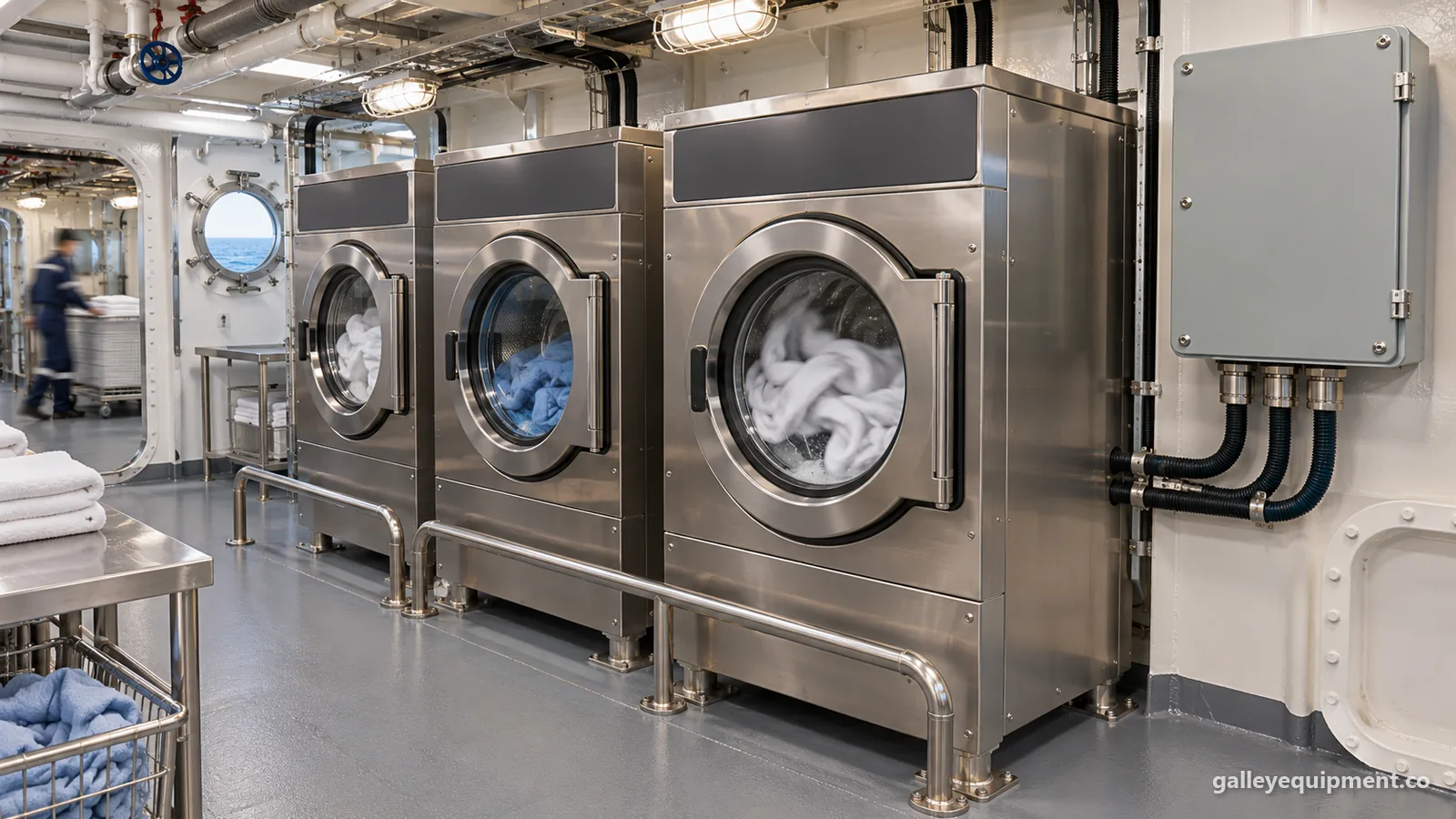
Why all 9 of the 400 V 60 Hz marine washing machines are dual-frequency
Each of the nine builds is listed in the 380-415 V band twice, once for 50 Hz and once for 60 Hz, which makes this the one washer page where frequency does not decide the model. The model names show it directly, ending in 50-60Hz. Every machine belongs to Little Giants, and all sit in the up-to-8 kg load band.
For a vessel on a 400 V three-phase supply that is not certain of its frequency, or that sees both during its working life, that removes a whole step from the specification. The machine is chosen by drum size, connection type and space, and the frequency question is already answered on the rating plate.
Reading the 400 V build codes
The three example builds show how much the connection type can differ inside a single voltage band.
| Drum | Model | Code in the name | Connected load |
|---|
| 6 kg | PWM 906 | 2N AC 400V 50-60Hz | 5.5 kW |
|---|
| 7 kg | PWM 507 | 3 AC 400-480V 50-60Hz | 4.2 kW |
|---|
| 8 kg | PWM 908 | 2 NAC 400V 50-60Hz | 5.5 kW |
|---|
2N AC means two line conductors plus a neutral, taken from a 400 V three-phase system. The PWM 908 code is written 2 NAC in its name, which reads the same way. 3 AC on the PWM 507 means three line conductors without a neutral, and its rating stretches from 400 V to 480 V. Where the listings state a phase, five builds are three-phase. Before ordering, check whether the laundry feeder carries a neutral, because a 2N build needs one and many marine distributions do not provide it.
Which vessels benefit from a dual-rated washer?
Several kinds of vessel gain from a machine that accepts both frequencies. A European-built yacht that moves to American waters keeps its laundry when it changes shore supply. A newbuild whose generator frequency is still open can fix the laundry order early. A charter fleet or a workboat operator with vessels on 50 Hz and 60 Hz can stock one spare-parts list for all of them. And a 50 60hz washing machine also holds its value at resale, since the next owner's supply may differ.
Where 400 V at 60 Hz turns up on board
A 400 V supply at 60 Hz is less common than 400 V at 50 Hz or 440 V at 60 Hz, but it is far from rare. South Korea and several other countries use 380 V at 60 Hz as their standard three-phase supply, which brings that combination onto vessels built or refitted there, and some yachts run 60 Hz generators wound for 400 V so that European-standard equipment can stay on board. A motor built only for 50 Hz runs roughly a fifth faster on such a supply; these machines are rated for it, so the drum and pump behave as designed. The frequency reference with the converter trade-offs catalogues the penalties for equipment that is not dual-rated, from pump flow to converter heat.
The PWM 507 build that stretches to 480 V
The 7 kg PWM 507 rated 3 AC 400-480V 50-60Hz is the widest-rated machine on the page. It takes 7 kg, draws 4.2 kW and, according to its name, accepts anything from 400 V to 480 V at either frequency. The listing files it under 380-415 V, so before connecting it to a 440 V or 480 V board, confirm the rating on the data sheet with our team. Where it fits, it is a compact machine that a ship's small crew laundry and a European yacht could both order in the same build.
Up to 8 kg only: when to choose a different page
The 400 V 60 Hz marine washing machines on this page stop at 8 kg, so they are the wrong pick for a laundry that needs to wash a large crew's bedding in few cycles. For drums from 9 kg to 35 kg on a 440 V ship, the Benchmark drums for 440 V ships are the next step. A vessel on a 208 V or 240 V circuit should look at the Little Giants and Benchmark builds for 230 V circuits instead, since those match a lower-voltage distribution.
How a 6 kg, 7 kg or 8 kg drum fits the daily load
The three drum sizes differ by only a kilogram or two, but on a small vessel that gap decides how many cycles the crew runs. A 6 kg PWM 906 suits a yacht with four to six people aboard, washing towels and bedding in two or three cycles a day. The 7 kg PWM 507 adds a little capacity for the same electrical load, since it is listed at 4.2 kW against 5.5 kW for the 6 kg and 8 kg builds. The 8 kg PWM 908 takes a full set of double bedding with towels in one drum, which shortens the evening laundry on a busier vessel.
Dryers and ironers on the same 400 V supply
A laundry is easier to wire and maintain when every machine shares one supply. The 400 V, 60 Hz tumble dryers pair with the washers on this page, and the complete 400 V, 60 Hz laundry range adds ironers and lets the whole room be compared in one list.
How to brief us on a 400 V laundry
Give the switchboard voltage and frequency, and say whether the laundry feeder has a neutral conductor. Add the vessel type, the number of people on board, the laundry dimensions and the water and drain arrangements, and state how many washers and dryers are wanted. Our team needs nothing more to check a 2N build against a 3 AC build and return an offer once the details arrive through the 400 V washer enquiry form.