
Miele Rotary Ironer PRI 421 [EL SOM LAM IB RF] – 3 AC 450V 50-60HZ, Iron grey
Miele PRI 421 rotary ironer, 365 mm roller, 2,040 mm working width, 113/67 kg/h at 25/50% RM, 3 AC 440 V 50–60 Hz.
24.6 kW
Miele rotary ironers for bed linen, table linen and flatwork in a ship's laundry.
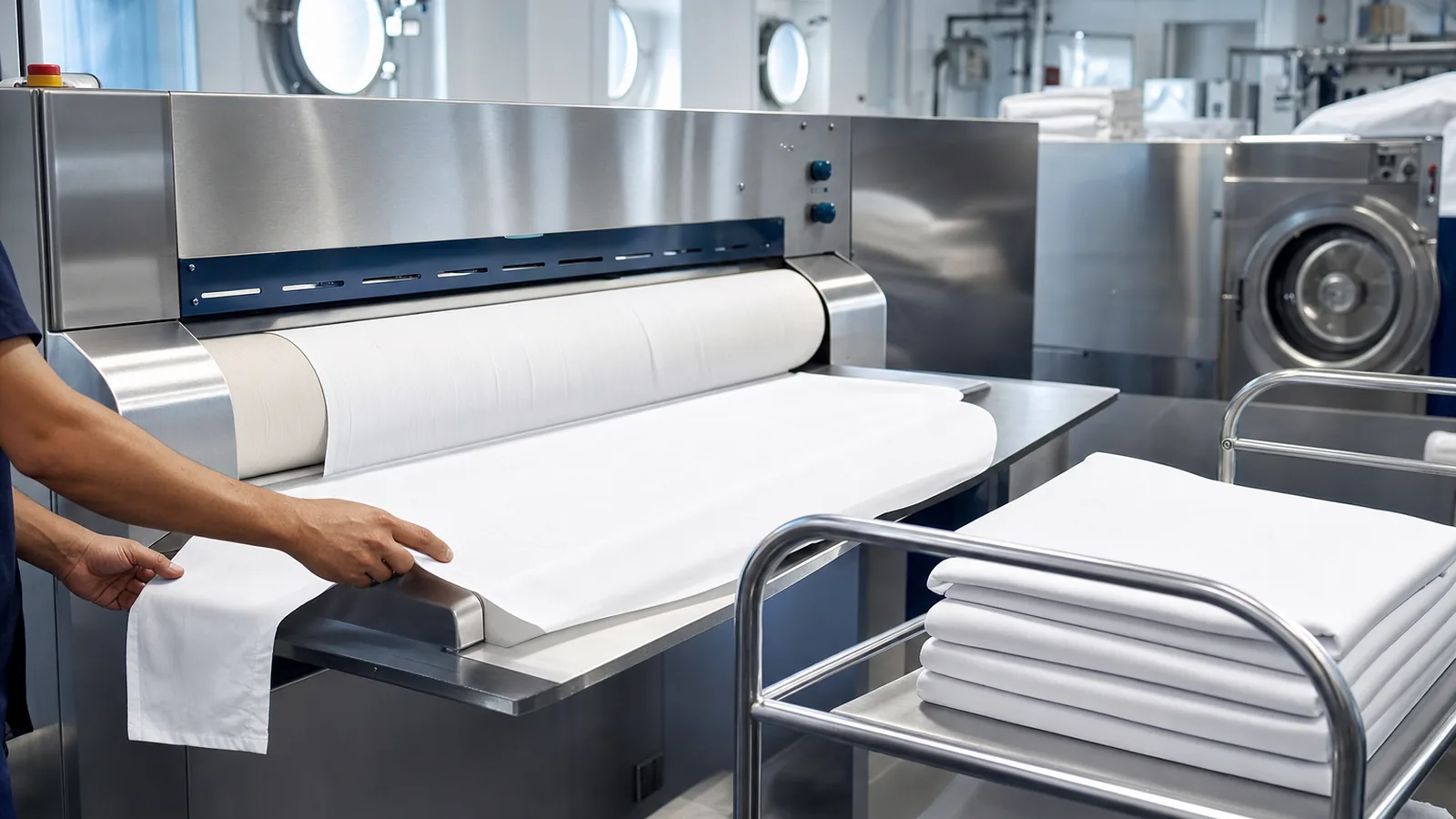
Miele PRI 421 rotary ironer, 365 mm roller, 2,040 mm working width, 113/67 kg/h at 25/50% RM, 3 AC 440 V 50–60 Hz.
Rotary ironer PRI 421 with 365 mm roller, 2,040 mm working width and 113 kg/h max output at 25% residual moisture for marine laundries.
Miele PRI 421 rotary ironer with 365 mm roller, 2040 mm width and up to 113 kg/h at 25 % residual moisture on 3N AC 400V 50–60HZ.
PRI 418 rotary ironer, 365 mm roller, 1,750 mm width, up to 104 kg/h at 25% RM, 3N AC 400 V 50–60 Hz, iron grey.
Rotary ironer PRI 418 with 365 mm roller, 1,750 mm working width and 104 kg/h output at 25% residual moisture, 3 AC 400 V 50–60 Hz.
Miele PRI 418 rotary ironer, 365 mm roller and 1,750 mm width delivering up to 104 kg/h at 25% residual moisture for shipboard and offshore use.
Rotary ironer PRI 318 with 300 mm roller, 1,750 mm width and 87 kg/h output at 25% residual moisture, 3N AC 400 V 50–60 Hz, iron grey.
Rotary ironer PRI 318 with 300 mm roller, 1,750 mm working width and up to 87 kg/h output at 25% residual moisture, 3 AC 400 V 50–60 Hz.
Rotary ironer PRI 318 with 300 mm roller and 1,750 mm working width, 18.3 kW at 3 AC 440 V 50–60 Hz, iron grey, for offshore and shipboard use.
Rotary ironer with 300 mm roller and 1,750 mm working width, 87 kg/h at 25% RM, electric 18.3 kW, 3N AC 400V 50–60HZ, Octoblue casing.
Rotary ironer PRI 318 with 300 mm roller, 1,750 mm working width and 87 kg/h at 25% RM, 3 AC 400V 50–60HZ, Octoblue.
Miele PRI 318 rotary ironer with 300 mm roller, 1,750 mm working width and up to 87 kg/h flatwork throughput at 25% residual moisture.
Rotary ironer PRI 318 with 300 mm roller, 1,750 mm width and 87 kg/h at 25% RM, 3 AC 440V 50–60HZ, Octoblue casing.
Rotary ironer PRI 217 with 250 mm roller, 1,660 mm width, 60 kg/h at 25% RM, 3N AC 400V 50–60 Hz, specified for shipboard use.
Rotary ironer with 250 mm roller, 1,660 mm width and 64 kg/h output at 25% RM, 3 AC 440 V 50–60 Hz. PRI 217 [EL SOM STW].
Rotary ironer PRI 217, 250 mm roller and 1,660 mm width, 60 kg/h at 25% residual moisture, 3 AC 230V 50–60HZ, iron grey.
Rotary ironer PRI 214 [EL SOM STW] with 210 mm roller, 1,400 mm width and 33 kg/h output at 25% residual moisture for marine laundries.
Rotary ironer PRI 214 with 210 mm roller, 1,400 mm width and 33 kg/h output at 25% RM, 3N AC 400V 50–60HZ, steel-wool padding.
Rotary ironer with 210 mm roller and 1,400 mm working width, 35 kg/h at 25% RM. Miele PRI 214 [EL SOM STW], 3 AC 440V 50–60 Hz.
Rotary ironer PRI 214 with 210 mm roller, 1,400 mm width and 33 kg/h at 25% RM, 3 AC 230 V 50–60 Hz marine version.
Miele PRI 210 rotary ironer, 30 kg/h at 15% RM over 1,000 mm width, 210 mm roller, 3N AC 400V 50–60HZ for shipboard use.
Miele PRI 210 rotary ironer, 30 kg/h at 15% RM across a 1,000 mm width, 3 AC 440V 50–60HZ for marine and offshore laundries.
Rotary ironer PRI 210 with 210 mm roller, 1,000 mm working width, 30 kg/h at 15% RM, 3 AC 230 V 50–60 Hz, iron grey.
Rotary ironer with 160 mm roller and 830 mm working width, 13 kg/h at 20% residual moisture, AC 220–240V 50–60Hz. Miele HM 16-80 D.
The Professional rotary ironers on this page run from 985 mm to 2759 mm wide, with net weights between 39 kg and 458 kg. That range covers everything from a compact unit that can sit in a small crew laundry to long machines for a full hotel laundry. All are rotary ironers, so the decision is essentially about how much flatwork must be cleared per hour and where the machine can physically stand.
On vessels where every kilogram on the deck plan is argued over, that 39–458 kg spread is a structural input. A narrow 985 mm ironer can often be worked into an existing space with modest reinforcement, whereas a 2759 mm unit calls for early involvement of the naval architect around floor loading and access routes.
Electrical power on the Professional series runs from 3.2 kW up to 23.5 kW, and those numbers map directly into how many sheets per watch the laundry can clear. The small 160 mm‑roller HM 16-80 D delivers 13 kg of linen per hour at 20% residual moisture; at the other end of the range, PRI 421 with a 365 mm roller reaches 113 kg per hour at 25% residual moisture. They are published figures at a stated residual moisture, so the washer-extractors upstream decide how close to them a laundry actually gets.
That power draw is also pure heat into the laundry. Miele publishes the heat dissipated into the room for each model, and on a closed laundry deck that figure feeds straight into HVAC sizing. A 3.2 kW unit eases into an existing air volume; a bank of 20 kW‑class ironers needs extraction and supply planned from the outset so the room does not run hot in port or in warm climates.
Every ironer here is electric and available for both 50 Hz and 60 Hz supplies, which takes away the usual frequency concern when equipment moves between yards or works on shore and ship power. Across the Professional series, named supply voltages include 220–240 V and 230 V on smaller units, and 400 V, 440 V and 450 V on the larger models. Most of the higher-throughput machines sit at 400 V, 440 V or 450 V.
In practice that lets a designer keep the rotary ironers on the same board as other heavy laundry consumers rather than dropping transformers into the line. For refits, the presence of 440 V and 450 V variants in the range is often the detail that decides whether an older laundry can be upgraded without major changes to the ship’s electrical backbone.
All 24 rotary ironers here sit in Miele’s Professional series and are explicitly tagged Marine approved and Offshore specified. Within that, roughly half of the models are flagged Energy management ready, so they can participate where a vessel is already using load-shedding or peak-limiting systems on hotel services. Ten of the Professional ironers are Payment system ready, which matters on ferries, offshore accommodation and mixed-use vessels where the laundry is run as a charged service for concessionaires or crew.
Only one Professional ironer in this group carries a Steam function flag. That narrows the field quickly for operators who want to integrate steam into the finishing process from an existing boiler plant, and it is a point to verify early because the rest of the range is straight electric heating.
These rotary ironers are finishing equipment for flatwork: bed linen, table linen and similar items that can be fed across a roller. They do not wash or dry; they assume the flatwork is already at a controlled residual moisture when it reaches the infeed. Where the main issue on board is getting mixed garments, workwear or towelling clean and dry, the heavy lifting will sit in the Washing Machines and Tumble Dryers categories, with rotary ironers specified only once that upstream capacity is in place.
On small yachts or vessels where space is limited to a single column of equipment, Washer-Dryer Stacks may give more day-to-day utility than dedicating footprint and electrical capacity to a rotary ironer that will only run intermittently.
Use the published throughput figures as your starting point: the HM 16-80 D gives 13 kg/h at 20% residual moisture, while a PRI 421 reaches 113 kg/h. Match those numbers to the daily flatwork load and available man-hours, then check that the chosen width between 985 and 2759 mm fits the laundry layout and access routes.
Across this category, named supplies include 220–240 V and 230 V on smaller models, and 400 V, 440 V and 450 V on larger units. Every Professional ironer listed is specified for both 50 Hz and 60 Hz, which simplifies integration on vessels running either frequency.
Thirteen Professional rotary ironers are marked Energy management ready, allowing them to be coordinated with shipwide load-shedding or peak-limiting schemes. That is particularly relevant on the higher power units, which draw up to 23.5 kW and can otherwise create short peak loads when started together.
Ten of the Professional rotary ironers in this range are Payment system ready, designed to accept external payment interfaces. Those models suit ferries, offshore accommodation units and other ships where cabin or crew laundries are operated on a pay-per-use basis rather than as a pure service function.
How a ship galley is planned from the people it feeds: crew size and service pattern, rotation and provisioning, volume cooking, the scullery, power and steam, fire rules and the laundry.
Read guideWhat actually changes when a commercial appliance is built for a ship — supply, fixing, water protection, materials, hygiene construction, refrigerant and certification — and why shore equipment fails at sea.
Read guideThe constraints that actually decide a galley specification — service, power, space, water, heat, motion, materials and compliance — worked through in the order they bite.
Read guide